Episode Transcript
[00:00:04] Speaker A: Hi, and welcome to A Time to Thrill. It's with your host, Amy Austin.
April Fools, I guess Happy April Fools. It is April. I'm actually recording this a couple days before April because when I record this, I will not be sitting here in California. Instead, I will be sleeping maybe in Seoul, South Korea. So I haven't been to Seoul, turns out, in 21 years. It's a lot to look at pictures of yourself from 21 years ago.
But I'm taking my son, who's never been to Korea and is very excited to go.
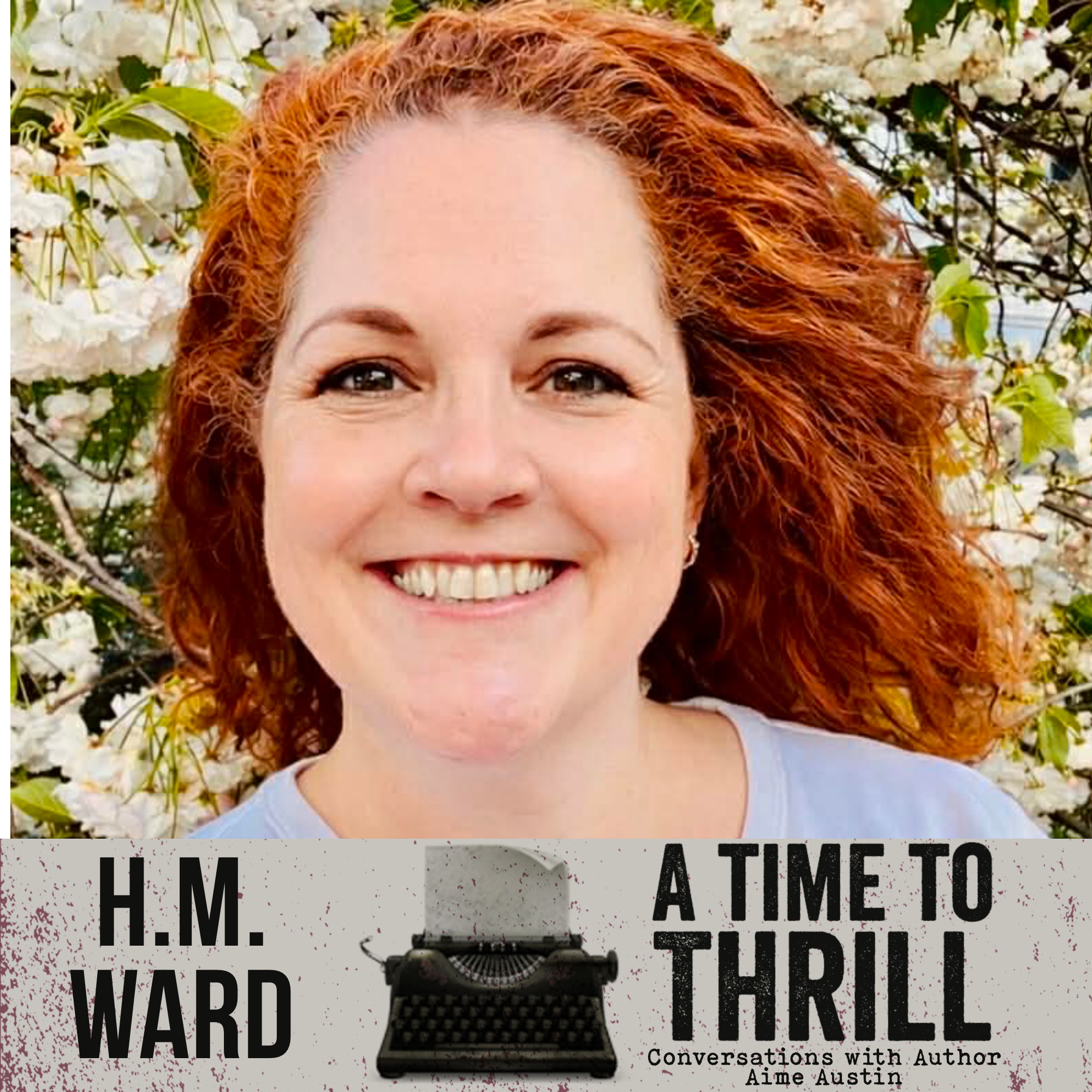
So this month I have the delight of interviewing H.M. ward or Holly Ward.
Holly started publishing. Oh, my God. We talk about this in 2011, and I don't want to say overnight sensation because we always use that word, but she, after a few books, really took off. And she talks a little bit about this in the podcast, but I always find it fascinating. Like, I've talked to so many people in the podcast who wake up. You wake up and you're like, you wake up and you're in the New York Times bestseller list, or you wake up and you sold 70,000 books or 100,000 books or whatever. And it's just, it's an interesting sort of phenomenon, I imagine, to experience.
So. So we had the best conversation.
I will tell you right now. We do talk too much about renovations of kitchen sinks. I will leave a marker so you can skip that and get right to the book chat and the other things. But one of the things I actually found super interesting about this conversation, she's one of the few authors that I have interviewed who did not was not steeped in romance as a child. So most of the authors I've interviewed, even if they're not writing romance now, started out writing romance, which is also true for me.
And it was in at least when I was young, in the 80s or whatever.
And this is true now. There are so many. You can read an infant number, never run out. And they really encapsulate sometimes the best storytelling. There's like a really strict structure around it. And then you have to tell a story from that structure. And who doesn't appreciate that in terms of learning how creativity works?
So she didn't do that. And it's interesting that I think, to be frank, I think if she started writing now, she would be probably nearly as popular, but it would be probably in the romantasy genre instead of romance or the, the bridges that she, let me say this, the genres that she bridged in her books. So it's, I'm super excited to talk to her. It's just there's so many people I've met over so many years and. And they've, like, had such amazing success and amazing journeys, and I'm so excited to bring those to you.
That said, let me see. Is there anything else I wanted to say? I was thinking about recording this, and I was like, gotta get it recorded. Mainly because I leave to go to school and pick up my child. And so I was like, let me get this done so I can get the podcast up before I have to open a suitcase and put stuff in it. I hate packing.
I have one thing out, which is, like, some content, but I do need to do more than that. Although I do have a friend who is similar, and I swear to God, she left for Korea yesterday and texted me. She's like, so the only problem is I ordered new luggage and it's not here. And I thought, I'm not the only one. I do have luggage, but I do need to order. I ordered a coat for my son, but it's like 153,000 degrees here in LA and you can hardly ever get a coat to begin with. So it had to come from the East Coast. And fingers crossed, it arrives.
Who knows?
Lots of fingers crossed. Otherwise he has to wear last year's coat, which is a little tight around the hips, apparently.
So back to Holly Ward. So Holly took, like, a detour, which we'll talk about in the detour, Like a pause in her publishing journey, and she is back. And that's like, the super exciting thing.
There's so many people that I know, okay?
Artistic careers take a lot of turns, and hers is no different. But she's got her feet back under her and she's back.
So all that said, I will share in the show. Notes A, I know you're like, what are you talking about? The sink that she ultimately chose.
B, I should. I should have done this. But I'll include a link probably to the macarons. She does these beautiful, beautiful macarons. I actually. I could never eat one. I don't like sweet things. But she does these beautiful. They're beautiful. So cute. Include a link to that. And then I also want to talk about. She is re. Issuing a book and has a new cover. And I'm allowed to share it with you only today. It has to be April 1st before I can share it with you. But it will be somewhere here in the.
There somewhere. I'll put it up here.
The beat of graphics. I'll put it up there. But it's a new cover for Demon Kissed.
It'll be out probably now. And I'm like, just super excited that she's relaunching and energizing the millions and millions and millions of fans who have enjoyed her work all of these years.
So I think that's it. If you haven't bought his last mistress, buy it. I'm still working on the ransomed deep dive. It's. I have no idea where I'll be by the time this is up, but I'm working on the ransom deep dive. It's all available on the YouTube channel. Although most people are still listening in audio. For all this video recording, I'm still having primary audio listeners, which I find interesting. It's like thousands of audio Downloads and like 50 video views.
Fascinating. But either the tides will turn or I have just done a lot of video work for who? Who knows?
So, without further ado, I can't wait for you to get to this interview of Holly Ward.
Before we dive into today's conversation, I want to take a moment to thank this episode's sponsor, Audible. You know how much I love a good story. I write them, I read them, and sometimes when I can't sit down long enough to open a book, I listen to them. Lately, I've been listening to Audible while I walk, travel, or even sometimes while cooking dinner. There's something about hearing a story perform that makes it come alive in a different way. I just finished okay, Julie Chan Is Dead by Leanne Zhang, an Alice Feeney book, Blue, Beautiful Ugly, and the latest Linley book by Elizabeth George. So I'm gonna be honest, this is how I do it. I get a book both on Kindle and on Audible, and I go back and forth listening to both. So when I'm driving in the car or with my son at some activity, I will listen to audiobooks. And then when I'm home, I read them on Kindle. And Audible makes it easy to switch back and forth in the app.
Honestly, I do it every time. I just, I want to keep the book going while I'm driving. And so I just switched switch to the audiobook and then when I get home, I switch back to the Kindle because honestly, I can read faster than I can listen.
Anyway. The best part is that with Audible, you get a 30 day free trial. You can start listening today. You get one audiobook you can keep forever, even if you cancel. So if you've been wanting to read more, stories that pull you in won't let go, including my own Casey Court series, which are all available on audible.
Go to audible.com the link is is in the show notes or in the alternative ebooks Buzz Audible.
Hi, and welcome to A Time to Thrill. It's me, your host, Amy Austin. This month I have the delight of speaking with H.M. ward. Hello.
[00:08:13] Speaker B: Hi. Thanks for having me.
[00:08:14] Speaker A: Okay, so the first thing we're going to talk about, incidental to anything else, is the kitchen sink.
So I don't know, we were. I don't know if you. Well, on Facebook messenger, you. We were talking. You were talking about things. And so I messaged you and I was like, don't get a white sink.
And you're like, I'm thinking about a white thing. So let me tell you, I actually thought about you over Christmas and I was going to photograph it, then I was embarrassed by the sink. And then I didn't send it to you because I'm like, she doesn't need to see my sink. This is crazy.
So I did a remodel at. I have a house in Budapest and I did a remodel. And how can I say this? I have decision fatigue. And with. When there's a lot of stuff going on in my life, I can't also make decisions about every nook and cranny. Honestly, I don't enjoy picking knobs or closet knobs. Cabinet knobs. Like, there's so many knobs. Bathroom knobs. Like, I was just like, stop.
So I hired a design build firm. I didn't. I've done it before.
Well, I have feelings about that, but I did it a second time. And they make all the decisions. You can make some decisions, but if you walk away, they will make all the decisions.
So I made some big decisions. Like I had to have a certain kind of stove, which they thought was crazy. And I was like, I cook every day. I need a certain kind of stove and I need many things that are really important to me. Everything else I do not care about.
One of the things I did not care about was the kitchen sink. Like, I wanted red cabinets. Like I was really. And I wanted a black and white floor and a certain stove. Beyond that, I could not really get into cabinets. I once picked cabinets and it took hours of my life that I'll never get back. And I don't care that much about it.
They can't be tall because I can't reach them. So I, at some point I get a bill or email, I don't know. And they're like, we're gonna have this sink. And I don't it wasn't in English, but it's like a granite sink.
So like the counters are like marble and there's a marble table and they put in a white granite sink because they thought it looked nice.
I get there, it's cute. I am not anti sink, but every morning I have tea and I leave the tea and there's no garbage disposals in Europe that I know of. So I leave the tea in the sink because I want to drink the tea and not clean out the strainer. Also, it's in Hungary and paprika is very popular. So that's in the sink.
The sink stains.
I didn't think about it until like one day I took the tea or I took the tomato or I took something out and I was like, oh, there's a stain in the sink.
I googled it. I called the sink manufacturer. You can, you're supposed to use a cleaner. And they literally sent me a thing saying, you should clean your sink every day right after use.
I'm not a sink cleaner.
A daily sink cleaner.
So consequently it's stained. But when I got there over Christmas, there was no more stain. So I'm thinking that either the, the person who cleans when I'm not there got the stain out or I had bought some stuff that I think cleaned the stain. But it's kind of vague and I don't care that much about it. What I don't like is when I'm walking in the sink and there's a stain, but it's cleanable and it looks cute. But honestly, here I have a stainless steel farmhouse sink and that would be my preference. They're kind of large though and doesn't work in everywhere.
So why are you getting a white sink?
[00:11:34] Speaker B: I'm not. I really want one. I don't know, it's. It's.
I'm doing my. I have this little 1920s ish looking bungalow and there's a lot of original features that are still in it. And I wanted to think that kind of went with the time period because like nothing in this house was updated. And so I had been thinking, yeah, like big cast iron sink. And so are we allowed to curse? Yes.
This is a family show.
Anyway, so, yeah, I was thinking why you'd think. And then when I spent too much of my life picking cabinets, the woman there is like, you don't want a granite sink. She said what you said and that all. Spent most of my life cleaning that sink. And I was like, well, what about like cast iron? And then they Mentioned fire clay. And then I started asking on Facebook because I only remember having. Remember when stainless steel came out. I'm dating myself now. Those things where people are. My mother was like, oh, my God, I have to have this sink. And I vaguely remember the cast iron ones before that. I don't remember them staining. I do, but they remember a lot, you know.
[00:12:51] Speaker A: But wait, they had a. What is the. The. They were enamel coated. That's it, right?
[00:12:56] Speaker B: Yeah, yeah, yeah, Yes.
[00:12:57] Speaker A: I had to think about the one time.
[00:13:00] Speaker B: Yeah. No, and so the. I'm hearing that the fire clay is like a coating, so that's not porous like the granite. I did stay at an Airbnb where it's harder to clean than, you know, stainless steel is. You just kind of wipe it out. Just back to it. You're done. Like.
Yeah. I don't know. So I'm still going back and forth. I have to, like, get my sink this week, so it's probably going to be whatever they have in stock because I waited too long.
[00:13:28] Speaker A: Well, okay.
[00:13:28] Speaker B: That.
[00:13:28] Speaker A: That is. I will say that also contributed to it. The first time I did a remodel, I was like pie in the sky. And I didn't understand ordering in stock. Didn't always mean in stock. Ordering meant forever.
And I decided this time, like, if it's not in stock, I don't want. It's not that I don't need it that much. They're like, they were looking at toilet paper holders. Like, you can't. This one's not in stock. And I was like, I just don't care. Just put the toilet paper somewhere. So. And I don't actually. I don't know what it is. I don't know if it's ever going
[00:13:56] Speaker B: to come up again.
[00:13:57] Speaker A: So I wish you luck.
[00:14:01] Speaker B: Thanks.
[00:14:03] Speaker A: And I don't have any regrets. I will say this. So the first house, I remodeled it. Second one was 1922.
And the only thing I gave up was the. With four original features was the kitchen. Because I just didn't think I could manage it in my life. So I got like. Like they did a cabinet for the bathroom that like, matched the original. And like, they read they could. They picked the strips of floors to, like, pull out other ones to match the original and all of that. And I delighted in it, found it delightful. I did the same thing. This time the Budapest Place is 1896. And I was like, I got to keep the original floors. And there's a lot of things I love.
The sink is not gonna be the Thing.
But fire clay. Okay, I. I hear you. Okay.
[00:14:50] Speaker B: Might try the firefly. So. Yeah. And if I regret it, maybe I'll get a cheap fireplace thing and see what happens first.
[00:14:58] Speaker A: I don't nes. I never have regrets. It's just that. Look, sometimes I think, you know, and I actually. And I had thoughts about the marble because I hear that marble. If you have stuff spill red wine, it stains and so forth. I don't drink a lot of wine, and I cook with it sometimes, and it hasn't been a problem. But that's also, like, another, like, fear in the back of my mind. Like, one day I'm gonna have red wine, and then I'm gonna be, like, trying to figure out how to get out of marble.
[00:15:20] Speaker B: Yeah.
[00:15:22] Speaker A: Okay. Anyway.
Anyway, it's good to talk to you. How are you doing? So when are you moving? Moving is stressful.
[00:15:31] Speaker B: It is.
I'm. I don't know.
We had a snowstorm come through, and I live in the middle of Texas, which usually doesn't get snow, so everything's been closed for a while, and we've been inside, which is weird. So anyway. But it kind of slowed things down, so my timeline keeps shifting, so I'm just kind of rolling with it and packing while that's going on. So I'm hoping. Hoping in a few weeks, you know, in March, after the kitchen's done. But we'll see.
[00:16:03] Speaker A: I've lived without a kitchen once. I would never recommend it again. It was hard, but I was like, oh. Because I ordered the special order things, and then I had no kitchen.
Never again. Okay. So anyway, can I call you Holly?
[00:16:22] Speaker B: Oh, yeah.
[00:16:22] Speaker A: Yeah.
[00:16:23] Speaker B: Okay.
[00:16:23] Speaker A: So let's get back to it.
[00:16:27] Speaker B: You.
[00:16:27] Speaker A: Oh, my God, you've probably sold 95 billion books and you started publishing in 20.
I don't know why I'm asking. I'm, like, trying to remember. I believe it's like the early.
Back when we all started. I feel like. Well, for me, it was 2012. Maybe for you earlier.
Do you.
[00:16:44] Speaker B: It was 2011.
[00:16:46] Speaker A: You were earlier. I didn't. I. We came at the end of 2012, and I was like, oh. Like, I woke up one day and I was like, look at what's going on in the world. I gotta get with it.
So how many books have you published? Because you're one of those people who was like, in the 100 Club, and I can't with that.
[00:17:07] Speaker B: Stop counting. I think I got up to, like, 105.
I have a few books slotted where I haven't counted them yet. So, yeah.
[00:17:19] Speaker A: Okay. So you took a hiatus from publishing. When was that? Because I was thinking about this. Okay, I'm in California. The weather's always the same. I have no sense of time.
I mark things by random, but there's never, like, it was snowing, it was cold, it was dark. It's always sunny and warm.
So you. When did you. When did you. I feel like you made an announcement that you were gonna, like, pull back from publishing. What year was that?
[00:17:46] Speaker B: I think it was 2018. Ish. I finished the Arrangement series, and I just felt like I said everything I want to say in my whole life books, and I just didn't. I felt like something was changing, and it was. I just guessed wrong on which thing needed to be discontinued. And so anyway. But, yeah, I actually announced I was retiring. I want to be writing more books.
And so surprise. That's not true. So. But yeah, because I continued writing. I just didn't realize I wanted to at that time.
[00:18:24] Speaker A: What made you think that you wanted to stop? Okay, I. I'm asking because I.
Many authors I know, okay, they've one done of one or two things. They've quit. Quit, quit. Like, literally legit quit. And like, I talked to somebody the other day, and she's like, I moved to Florida. I'm gonna play with my grandkids. You know, I'm out. You know, like, out, never coming back.
And she also retired from her other job, so. But some people dip in and out. But you're. You sounded so definitive, whereas people sort of fade away and then they come back or whatever. What made you make a definitive announcement as opposed to just fading and I'm. As opposed to. And separating that from people emailing you constantly?
[00:19:10] Speaker B: Yeah, I had.
I was very sure of that. Where I felt like I concluded my longest series at that time, and I didn't really want to expand on it. And I've always been a writer, but for some reason, I just felt.
I felt like that chapter closed. And I.
Yeah, it just felt definitive. And part of it was what was going on in my personal life was a chapter was closing, and it affected my writing where I just didn't want to write then. And so I thought that was forever.
I didn't realize I've owned other businesses.
I had a brick and mortar store. I've had some other stores. And this feeling comes when it's time to close those. And then I just don't. I hold on to them too long, and they, like, become, you know, weight. And so for this one, I was like, No, I.
I'm not going to publish anything in the foreseeable future. I usually had, like, six to seven books in the works at a time where I just bounced between them, writing them, and I didn't have that anymore. And so, you know, I just finished up what I was working on. I was like, I guess I'm done. And so it was a lot because before then, I've been working like 120 hours a week.
I had family, my marriage was imploding. Putting it.
Yeah. And so where I had to decide where my time was going. And so I took it and refocused it on relationships and trying to salvage what I could there. And so it just felt like it was the end of this era with writing and publishing. And.
Yeah, like I said, it was the end of something. And it made sense to me.
When I finished the. The Arrangement series, it just. It felt like a chapter closed. And so, you know, a lot of writers write and they're reflecting their own lives, and it just never occurred to me that, you know, that chapter of my life was ending in terms of marriage and divorce. So.
[00:21:15] Speaker A: So I think that.
So wait, I'm going to say this, and then if you don't want me to say it, I'll cut it out. So, okay. We connected in a romance author divorce support group.
And.
Okay, let me think. I think that. So I got divorced in. I. I separated in 2018. Divorce took forever, and there's covet and all that.
But so I will say that I did notice. Okay. During the divorce, I think I wrote three romances. I really wanted to write this trilogy.
It was actually the easiest books I ever wrote. And then suddenly I was like, I can never write romance again.
And so the change for me was. The change was not writing romance, but not. Not writing.
What made you think it was not writing? As opposed to. I'm not saying people should, like, you should flip genres or do 10 other things, but what made it, like, pull all of it away as opposed to moderating, quitting, thinking about other. Thinking about, like, pivoting or something like that.
[00:22:30] Speaker B: At the time, I didn't. I hadn't accepted my marriage was over.
And so I didn't know that was coming. I just felt like if I keep going, something like, you know, something will change, something will get better.
And it felt like it just needed more time than I had. And I was being pulled in two directions for, I mean, like, 120 hours a week. I'm not exaggerating. That was so much time. It was so exhausting the release schedule was a book average, a new book published about every two and a half weeks. And I liked, I liked that. I liked the, I liked the writing and I like, I liked a lot of things that went with it. The creativity and it just was.
I couldn't figure out balance. And I think right before I pulled away, I had started going, I'm gonna see how little I can work and try to obtain that balance.
And I just couldn't. My, My marriage was.
It was all in at that point where it was, you know, you're. You need to take your 120 hours and put it all over here. And so my effort was massively redirected.
In the meantime, I had thought that I would have. I switched to teaching other authors, marketing. I taught some writing classes and workshops and stuff like that. And I kind of thought that that would be an interim kind of thing until I figured out what was next, because it just felt like something's changing, something's coming, something's next. And I just didn't understand what it was.
[00:24:01] Speaker A: I appreciate the dedication. Like, I didn't.
Yeah, I'm not that person.
No. I mean, I, I, I think I would have quit something else first. I don't know. It's hard to say because I did. I did not dedicate 120 hours a week. I maybe like, dedicated like 30 to that. And then who knows what else I was doing with my time, But.
Okay, so let's go back. Okay. Hey, I have to ask you where in New York you're from. I mean, your accent, but where?
[00:24:33] Speaker B: I grew up on Long island, like, smack in the middle in Deer Park. So.
[00:24:38] Speaker A: Okay. Because I'm born in Brooklyn, I do not have an accent.
[00:24:43] Speaker B: I didn't know that.
That's why I like you.
[00:24:47] Speaker A: My dad's from Brooklyn, so I will say this occasionally. I said something to my son the other night, and he was like, you know that that's not how people say it. And I was like, oh.
[00:24:59] Speaker B: But for the most comes out.
[00:25:02] Speaker A: It does. In the bizarre things. I know I can't say the word. I'm going to say coffee.
See, I did. I can say coffee and talk. And then, like, there's a couple of words that I really struggle with, but if I try hard enough, I can say that and it's okay.
But if I'm around people from New York, like, a friend of mine who grew up on Long island, like, she comes to visit, and then my son's like, between the two of you, he's like, stop.
But to me, he sounds like Paulie.
[00:25:34] Speaker B: Sure.
[00:25:35] Speaker A: So like, sometimes the California kids are in the back of the car.
Well before they're like, they're older now. And it was just like, I'm like, are you making fun of me? Like, are you just doing your Valley Girl stuff? Like, what is up with this?
So let me say this. So what did you read when you were a kid?
Because I went to the Brooklyn Public Library. So I mean, that was. Those are my options before I discovered used bookstores. But I had to be a little bit older before, you know, I could
[00:26:03] Speaker B: do that kind of thing.
Yeah.
So my mom was a reading specialist and a first grade teacher and loved reading and shoved so many books where the Dog Dies down my throat when I was little. I mean, like, I love that she was like, read a book and kept giving me books. And every time there was a book fair, here's $2, go buy some books. Or how much I was back then, you know, and so trying to buy books where the dog didn't die, like where the Red fern Grows Founder Old Yeller. It's like, my God, pick something else.
Anna Green Gables. And so I had.
I remember my mom, how much she loved Anna Green Gables. And I think she remembered her grandmother reading it to her. And my great grandmother, which is her grandmother grew up during that time time. So that was contemporary for her, which blew my mind. Later on, when I was older, the first book that I picked up because I wanted to and wanted to read it, I went to the Deer Park Public Library and looked for an original copy of Peter Pan. And so I had found out you're pre Internet now. And so I had figured out that there were multiple copies before that. And I had just liked the story. And I was into the original telling of Cinderella back then where it was like, oh my God, it was grizzly.
[00:27:24] Speaker A: Yeah, I didn't grim.
[00:27:26] Speaker B: And so I wanted to see what.
Yeah, so I wanted to see what the original version of Peter Pan was. And so I had taken the book out from the library and had. I'm an artist too. And so it had beautiful illustrations in it. And I'm reading this and it's kind of. It's not modern English, but it's not quite old English. But I mean, like, it's chunky writing, like. And the story was so much.
I don't know, something about it caught my attention.
I also didn't know at the time that I was reading that I remember the pages being so shiny where I'd get a headache from reading it and I have dyslexia and then the shiny pages, especially with textbooks and stuff like that. Reading was always a huge effort for me and it had to be worth getting a headache. And so reading meant pain and so it had to be better than that.
So yeah, Peter and Wendy, it was. That version of the book was the first one where I was like, this is worth getting a headache for because I didn't pace myself or anything. I just read the whole thing.
But I. It also meant I read slower than most people and I had to learn to basically deal with disability and dyslexia and people not really understand what that was then or what it was affecting. And yeah, it was around the same time, about 14, when I started reading things for myself because I noticed reading's fun and the dog doesn't die in every story.
[00:28:57] Speaker A: I hate dog death stories too.
[00:29:00] Speaker B: Anyway, I'm so grateful for those websites and reviewers where the like, the dog doesn't die. I was like, I need to know if the dog dies and I need to know if a kid dies. If they do, I'm out late. I don't know. So.
But yeah.
[00:29:13] Speaker A: So did you read romance when you were younger or. No,
[00:29:19] Speaker B: no, I don't read romance, which is kind of weird. My, my first book, the Five Year Anniversary, there it is behind me is dark paranormal fantasy romance.
It's got a dragon. We can call it fantasy.
But yeah. And so that I have always liked it and it's such a.
Now it's gotten bigger. But I mean like, you know, in 2011 it was kind of narrow in terms of market share and so in terms of how many readers you could get and could you make a living off of that? And it was like, not so much. And so I liked writing the romance as like a subplot in the background of the fantasy series. And so I just went, I wonder if I can write a romance book. I don't really read romance books. I, when I, when I was married, I was gifted by my ex a romance book from Carly Phillips. And I don't know who she was at the time.
I was just like, this is a dirty book.
So I totally, yeah, I had no idea that I met her later anyway. But yeah, no, so I just, I wanted.
I don't know, I was always attracted to the more fantasy and then specifically more dark fantasy types of books. And so that's. I was going to say that's usually what I read and on my own, but I bounce all over the place. And what I read currently, I liked Peter Pan because it was dark. And so.
And I liked those old Cinderella stories because they were dark.
And it wasn't that everything had a happy ending. It was. It was a world that made more sense to me. It was more real than Disney's versions.
And so I started to gravitate towards stories that echoed life in some way and had survival stories in them and that type of thing. So, yeah, so I don't really. I don't read too much romance. I do pick stuff up once in a while just because it's. If it crosses my path and people are like, this is so good, I gotta die. I'll pick it up and read it. But, yeah.
[00:31:27] Speaker A: Okay, so then I have a question. How did you. Okay, so everybody I know who wrote read.
Okay, I have to take a moment. Excuse me, everybody I know who read romance.
I mean, wrote romance. Excuse me. Read a great deal of it. So like, when I was from, like, I don't know, excuse me, maybe 13 to. Who knows, 13 to like 21 thousands of them. Like, and this is before Kindle. If I had a Kindle when I was a kid, I would never left my room. So. But I had to leave my room to go get the books. But. But I read them all the time. And so when I first wrote them, not well, mind you, I knew, like, I. I didn't. I had to know the word tropes and like, you know all of the words that I know now for all of the parts of romance and like, black moment and all these things. But I knew, like, you know, forced proximity, enemies to lovers, friends to lovers. Like, those things I had a working knowledge of. So then how do you write? Because I'm trying to. I.
Okay, I'm gonna ask you this question. How were you able to write them without having that working knowledge? And I will say this.
My experience of mostly American literature is that there usually is some kind of romance in it. Even like, so called, like, dick lit. Like the books that like men, right, where they're. That they're spare of word, usually have some kind of like, woman in the background that they're thinking about having, relationship, not having a relationship, but there's some kind of romance in the background of those.
But I feel like it's. So how did you do it? Because I'm just. I'm like floored.
[00:33:08] Speaker B: As I finished the Demon Kiss series, so the fantasy series I had liked, I liked stories that have a lot of tension. And so romantic tension, sexual tension, I don't know any kind of tension. And I Was like, wonder if I could just write a relationally driven book that's just romantic tension. What would that look like? And so I started thinking about it, and I didn't have the tropes. I totally didn't know what I was doing.
And I was like, let's just wing it and see what happens. And so I.
I wrote. Oh. And it was at the same time where they had the.
I had just heard of Nano Ramo and like, where it was the write a book in 30 days. And I was like, that's crazy. It took me three months to write a novel, which I thought was a long time. And so, yeah, when they were talking about having a draft in 30 days, I'm like, that's impossible. So I went, I'm going to try that on this book. Why not? Like. And so I had wrote Scandalous in six days, draft. Had a draft about two weeks later, had finished edits on.
Was weird. I. I could say, I.
I don't feel like my books really fit into the mainstream romance. Maybe I'm wrong because I don't read a ton of it. But I mean, like, I do read. I read some stuff now, you know, I just didn't growing up. And so.
But the things that always made me attracted to the romance part of the story in the books I just put in here. And it was all that. And so.
And in hindsight, I can go, oh, that was the black moment. Oh, I have five of those, because I really like those.
So where it's not exactly traditionally structured, but. Yeah. And so Scandalous sat there and did absolutely nothing because my fantasy fans were like, okay. And so a couple of them read it, but, yeah. Then like nine months later, it hit the New York Times bestsellers list. And I ended up writing romance after that. And I'm. I'm gonna. I'm gonna tell you a secret.
I don't. I don't really think of most of my books as romance, and they break a lot of the romance guidelines. And so I market them as romance, but there's, like, other stuff going on, even if they're relationally driven books.
Yeah. I don't. I don't know. I've always felt like I was marketing them as romance because. Yeah, I felt like mine are a little screwbally in terms of trying to put them into modern romance.
[00:35:45] Speaker A: So I will say. Okay. So, two. Okay, let me ask you. Did you ever consider.
Well, because I. Well, I think. I feel like I know the answer. Did you ever consider, like, after you wrote that, like, first one, like submitting it for traditional publishing.
[00:36:00] Speaker B: I submitted that one and Demonkist I did try to get. I had an agent and it was submitted for traditional publishing and they had asked me to change it so much that there's a lot of theology and Demon Kiss.
I attended seminary and I just liked the imagery of all these religious artifacts and broken churches and things in the background of the story because it was shadowing the world that she's in. And so.
And it's an apocalypse story. And so I felt like that was tied to it. And they really wanted me to change a bunch of stuff and that I didn't want to change. And so it was kind of, well, I'll publish it on my own. We'll see what happens. And then when I switched to started, when I wrote Scandalous, I thought I did a bad job. Nobody bought it or hardly anybody bought it. It was my worst selling book period at that point.
And so I took, I took Demon Kiss, which was selling well, and I took a copy of Scandalous and I entered both of them into, you know, to get feedback from an author that knows what they're doing in that area.
I would have never written another romance book if I had gotten back my romance review before I found out I hit the New York Times list.
I got it a week later where I was like, well, like, it was a, you know, it didn't fit the mold. It's, it's, it's weird. It doesn't have this. It's, it's, you know, and, and certain, some of the criticism was accurate, but I just thought that, okay, if I had read that first, I would have went, I'm doing this wrong. I can't write to this market. It's.
I don't understand it. And since yet hit the USA Today and New York Times bestseller list, which I didn't believe when it happened. And people were telling me you hit the list. I'm like, no, you got somebody else.
[00:38:07] Speaker A: Me.
[00:38:08] Speaker B: They can't be me. That, that book really? Because I thought they were going to tell me it was Demon Kiss. That would have made sense to me.
Scandalous didn't make sense to me. And so, yeah, so anyway. But I just decided to keep writing these sort of romance books that were super dark and, you know, and one of them, the hero dies.
Like, yeah, it's like my highest rated one. But you didn't kill a dog.
[00:38:36] Speaker A: But then you kill the hero.
[00:38:39] Speaker B: I killed the hero in a romance book. So it was very noble though.
[00:38:46] Speaker A: Do you think then, so I.
It's so weird because I wonder.
Okay, so the era in which I was born and came of age when I thought about being a writer and this was like an abstract thought because I had no plans to do that. I was gonna get a job and, you know, I don't know, make widgets. It didn't occur to me.
Okay, Obviously I couldn't see indie coming. Like, there's no. There's no way I could have forecast that. But the only path that I saw was traditional publishing. And it was a very.
It may. It's nice to have some thoughts about. It's a very, very narrow path.
And so I feel like your stories, like, obviously met a moment. Like, it's a certain zeitgeist. Like, you came at a time when people a. Like, as. As a reader, I always wanted something different, but you could only buy what people were selling. Like, there was no.
I could want a lot of things, but, you know, it didn't exist.
So I think readers have always wanted that. Publishers have said that readers don't. I think that clearly that didn't work out, but I do.
If you hadn't had the indie moment, do you think you would have cons you would have stuck to, like, the fantasy storytelling thing and eventually forge that path, like, long term?
[00:40:04] Speaker B: If I would have stayed fantasy and not swung into romance, I. I wanted to make a living off my writing.
And so. And I had considered traditional publishing at, you know, other times between, you know, from the time I started to the time I got bigger, I had offers and.
And it just felt like they.
And it may not be true anymore because it was a while ago, but I felt like they were trying to contain me or narrow me, including the agents that I had at the time where they were like, don't make everything into a big pharaoh universe. That's that, you know, for the arrangement and damage to this whole family that really hadn't.
Indie authors hadn't done that. And then it made more difficult to piecemeal off and sell pieces that maybe a traditional publisher would want. And so I totally ignored them and did what I felt like. You know, I was like, no, these are brothers. Everything's going together. And so where I had characters appearing, stories where it'd be a nightmare to try to sell the rights to, it is what I was told.
And so, yeah, I don't know if I felt like I was wanting to write about. About life, but I was doing it through a way that felt approachable to me and safe. And so putting it through, like A, a fantasy, post apocalypse kind of lens. At the time that I was writing, that, that, that felt, that felt like something I could do. I think I, I think I probably would have started to roll into more contemporary type of storytelling and I may not have noticed it was romance. I would have said it had romantic themes.
Especially like if that criticism, the, the letter came back on Scandalous, where it's like, you can't write romance. I think then I would have just went, it's contemporary fiction with romantic elements. Like, I think the stories I wanted to tell, where they're, they're about survival and power dynamics and control and trust. Those are coming through everything I've been writing. And it didn't matter whether they're a fantasy romance, contemporary horror. Like I wrote something was horror that nobody reads. They all have the same type of thing going on. So they're just approached differently.
So.
[00:42:22] Speaker A: Okay, so I'm going to ask you a question which I've actually always wondered. Why did you choose initials rather than your name? I mean, not your name, like a Christian name.
I asked this because. Okay, as a thriller writer. Well, okay, I, if I had to do it all over again, I do a lot of things differently, but alas, here we are. But it comes up from time to time in the thriller context where authors, I know women authors get inappropriate messages from like men, whether it's on their Facebook page or why are you writing this? Or who do you think you are? Or whatever. And if they use initials and men read their books, they assume that they're men. But this is not true for romance at all. So what made you then do that? Because it seems very well to me, like thriller action coded as opposed to like romance coded, where everybody's name is like, you know, you know, oh, I don't know, Amber Happy. I don't know, you know what I mean? Like, like if you're gonna brand it that way, those names are better. Like even, like when I talked to Pippa Grant, like when she branded it like Peppa Grant, it's very like, you know.
[00:43:27] Speaker B: Yeah, okay. So when I chose my, what name I was writing under, I would just go with my name.
Those are my initials. But so the COVID in the back, Demon Kiss, have one closer to me.
I shot that. I made the covers, all of them early on. And I am an artist. And so part of me was going, holly, H, O, L, L, Y. I'm gonna have this stupid descender coming into people's faces or whatever's in this part of the, of the book. Cover and. Or. Or it'll come down on the bottom where. I just didn't want to deal with the descender and my name. It was a marketing move. I thought it would look better this way, so. But it wasn't the marketing move that most people have. It's just that, yeah, I didn't want the descender and Holly coming down onto people's faces.
[00:44:17] Speaker A: Okay, well, that. Okay, but that's like an accidentally brilliant move. I mean, and I will say that there is something too, like, even when I was talking to Pippa Grant or even like my other pen name or whatever.
When you think about a pen name later and you think about it in marketing terms, it's so much better if, like, they're even, like, even first name and last name. Number. Excuse me. Number of letters or the spacing work. So, you know, it's not all I.
Which, you know, if your current is too little. So things like that later we all thought about. But you started out thinking more about it, so what? I know that you used to do photography, which is one of my hobbies that I love, but what.
In terms of being an artist, not. Not a writer. What kind of things did you enjoy doing?
[00:45:05] Speaker B: I did a lot. I. I still like photography, and so I did a bunch of different types of that, which my favorites are babies and brides and boudoir. I don't like to shoot weddings, but I like shooting wedding dresses. That's fun.
I like.
I like painting.
And so I've been painting with.
I can't reach them anyway, but there's paintings behind me. And so that's always been something that I. I've enjoyed. And so, I don't know, like, I. I consider like so much so many different areas art, but I guess in terms of traditional, it's painting, drawing, photography, trying to think if there's anything else. My daughter would be like this. That. The other thing, I'm like, I don't know, they're just. They're there, like.
[00:45:55] Speaker A: Okay, so I mean, I'm gonna. This is. This was not planned. This is frolic in detour. So are you still taking pictures?
[00:46:03] Speaker B: Yes. And so I still take pictures and I still. I. I love dark, moody stuff like that picture back there. And so I've been taking more travel photography lately, but I still, like, have an image in my head for a bunch of stuff that I would love to do with some of the ballet company here. And so we have an old. An old timey 1910 stage, 1912 stage. And so where it's Just there's so many things in there and it's just so beautiful. And I don't know, I have things in my head where it's like, I need to shoot this, I need to paint this. And so. Yeah.
[00:46:38] Speaker A: Okay, so then what kind of camera are you using? Because I have so many thoughts about camera gear right now because I switched systems. This is a very hard thing for me. But what are you a Canon person or.
[00:46:50] Speaker B: I'm not. And you're going to be like, oh my God.
[00:46:53] Speaker A: Well, because everybody is. I am not.
[00:46:55] Speaker B: I'm not. My workhorse is an Olympus E3. And so I just. That camera has the most beautiful skin tones and I switched and got a really nice Nikon. When my, when my photography, when my, when my writing career took off and it sits in the bag, I don't. I like my Olympus. And so the Olympus goes with me too because I'm like accidentally drop this or somebody takes it. I'm not going to have a stroke because it's old and. But I just for what I take pictures of, I feel like it does a really good job. And I mean like I, I used to shoot with an E500 and then an E550 and I taught photography workshops like 20 years ago. And people be like, you can't get this type of picture from that type of camera. And I was like, yes, you can. And so it's a. Where cameras can do amazing things there. You know how to use all the little menus and stuff. And so it's just exciting to see.
Yeah. What. What a little, little camera is capable of pushing it to the extremes. I like dynamic, really dark and moody pictures. And that's definitely pushing the E3 because it doesn't like dark.
So it doesn't have the crazy high so that other camera systems have.
[00:48:08] Speaker A: Well, it's gotten really a lot lately. So wait, do you do a lot of. Okay, so I have so many feelings about the photograph. Do you do a lot of post processing?
[00:48:18] Speaker B: Not too much.
I, I liked it when I. Okay. I ended up shooting Boudoir.
That was my main thing that I was shooting right before I started writing romance books and normal books. Normal books, fantasy books, whatever.
And so I had someone come into the studio at that time where I'd been mostly shooting brides and she's. Her husband was deployed and she kept going, please, please shoot this for me. And I was like, no, I'm in like this very footloose town where that, that would have some repercussions. And I don't know how I felt about it at the time. And so it was like, I admire art and I don't have a problem with. With art and, you know, Renaissance art, nude sculptures and that kind of thing. You know, when I'm looking at stuff and taking pictures, people turn into shadows and light. It's not a person anymore. I'm trying to figure out how to capture them, their. Their being, their personality and them. And so.
So it wasn't so much that or being awkward or shy or anything. It was kind of like I just didn't picture myself doing that. And so she came back qu multiple times and just kept asking me. And I'm like, why are you even asking me? I want to shoot this. And so I don't have experience shooting. This may end up looking weird. And so she had the same name as me, which is super weird. And because I don't meet that many people named Polly. And then she. We have the same birthday, different year, but I was like, okay. And so I shot it. And then she sends other people to me and more people came to me. And I really liked how much people would come in for different reasons. I had this one client that came in and her cancer had come back, and she remembered from the previous time that those days when it was really hard, she just wanted to remember what she looked like before, who she was before and what she's holding onto. And she told me that's what the pictures were for, that's for her. And I was like, oh, my God, that is so empowering. And so in terms of why am I talking about this? I didn't put that much processing on the pictures because I wanted that to be them. So when they're looking at the pictures, it's. It's the pose, it's the lighting, it is them. They haven't been photoshopped with it. You know, where they are missing a rib to have this waste that doesn't exist.
And so in the skin smoothing. No, like, you should have some texture on your face. And anyway, so it was a cross between, like, Rita Harrell type of old school boudoir pinup stuff. And I did shoot some that were like that with the legs up in the air and stuff like that. And then just some newer, newer stuff. And it was very empowering to the women that had it done. And over and over again, they had no idea they looked like that. And I'm like, this is you. And I like being able to go, this is you. This isn't Photoshop. This is the Filters. This literally is you.
And so that was just something that was really.
It turned out to be an incredible experience. And I went into it so reluctantly, thinking it was going to be this one thing, and then it ended up being this totally different thing.
[00:51:27] Speaker A: And so that's fascinating because the boudoir photos that I've seen, which now I'm thinking, why are people showing this? But the ones that I've seen are really, really.
Well, this is before era, but like photoshopped to the max. Like, it was just.
There couldn't be.
Nobody had any lines in their skin. And there was always like this overlay of like haze, you know, to give it, I think, I assume like a sexy feel or something. And the lighting was always diffuse like that. You know, in those contexts, they were never my favorite. I've never had them done. I can't. That's beyond my scope. But that's interesting. I. Okay, so I'll take off my feelings. So have you. In terms of travel photography, what kind of things do you focus on?
[00:52:18] Speaker B: Like monuments, people, people? My family that's traveling with me.
I love photographs for myself. And so this past year we went to.
We spent a few weeks in Ireland and then went to Edinburgh and Paris and then got stranded in London for a little while. And so it was like, I just. I didn't even have my camera with me all the time. But I like having pictures are so different than what comes out of the phone. And like I said, you can really push the camera to do whatever you want it to do. If you want a bokeh, narrow depth of field or say you want everything, like, you have those options. And I know you have those options with the iPhone and different cameras. I mean, like, there's so much more role on a dslr.
And so, you know, my kids were laughing at me because I've got this dslr, I'm turned sideways and, you know, trying to get this picture of this. What was it? It's a sea rose. We don't have them here. There's no sea here. So we're in Ireland and I'm like upside down at the Giant's Closet Way, trying to take a picture of this flower growing out of a rock on the side of a hill. My daughter takes a picture of me taking a picture at this weird angle, and I'm like, okay. Then she shows it to me. There is a sign over my head that says, beware of falling rocks. And I've got my head right on.
So anyway. But yeah, no, now it's like, so when I'm home, I can remember, you know, how it felt to be there and look at those places because they're awe inspiring. And so that's what I've been photographing.
[00:53:58] Speaker A: Okay, sorry, just. I completely follow. I just.
It's something I do, actually, and I stopped posting them. But anyway, okay, I'm gonna move away from that. So you're back writing again. What inspired you to come back? Because divorce.
Well, I don't know. It's different for every person. Like, now that I'm thinking about it, like, some people have had, like, much. I don't want to say more. Very devastating consequences to, like, their IP and stuff like that that really, like, would. Would like, really kill their thing because they're having to share royalties or like, you know, you get 10 books and I get 10 books, and then you're. Then you know, that I could. I could see that killing creativity, like, in such a horrible way.
But getting. I'm noticing that people who continue writing who have gotten divorced are coming back to it, but for every person, the coming back is really different.
It's changing genres or just like letting go of the other things and like writing something new. Like, even if you know it's in the same genre, just. But like pivoting to something new. So what inspired you to come back? Or did the inspiration. Well, no, I'll just ask you what inspired you to come back?
[00:55:13] Speaker B: So I did stop writing for probably between 2018 to 2020. I didn't write very much. And the divorce and everything, that didn't happen until after Covid. And so, yeah, so in 2021, that everything came to a head with my marriage, and I was still thinking that maybe it'll work out. I, like, waited so long, man, and did everything I could because everybody's like, oh, you should give it all. Give it your all, like 500%, just go for it. And it's like, at what point do you just go. It's not working. But you know, we're.
The whole relationship's not on one person. And so anyway, I have a lot of trouble with that because there's just so much family and cultural and everything. And so, yeah, when that fell apart and I realized that this is. This doesn't hold going forward. I can't do this anymore. That I need to take care of myself and like, that I'm trying to figure out how to say this.
My characters in my books are giving everything they have to surviving. And that very much echoed my life then, and that needed to stop Because I couldn't survive it anymore. And so those type of stories of wanting to tell them, surviving at all costs, and having love that endures at all cost no longer, I. I didn't agree with it. And so, yeah, so the divorce took a while. And during that time, I went. I. I needed the catharsis of writing. So I just started writing again. And I'm like, this is crap. I don't like this. You know, I'm not going to publish it. It was just for me. And so I started a lot of stories and had no intention of finishing them.
And to me, it just looked like I was bleeding onto the page.
In hindsight, I was bleeding onto the page before and I didn't know. And so where authors write from pain, or maybe they write from life, I was definitely writing from pain. Just trying to figure out how to make sense of what was happening to me.
And so that's why my characters. And I think that's why so many people like those stories, is that it's their survival stories, even the romance ones, like, that's very heavily ingrained into them.
And.
Yeah. And all those thematic elements of trust and control and power dynamics and all that, and exploring how that comes about. And then I want to say a spoiler because I think this is what pivoted everything.
When I ended the arrangement, I made it so that the main character saved herself. It wasn't the guy. It wasn't one of her friends. It wasn't for to it as like, it was just.
There was no way out of this unless she did it. She had to show up. And so I felt like that made me pause because I was like, what does that look like for me? And so anyway, it took a while to figure that out. And as I started writing this other stuff that I thought really wasn't going anywhere. I can't write books anymore. I guess I am really retired forever.
Maybe I'll sell macarons. You probably saw that.
[00:58:25] Speaker A: Oh, you do make beautiful macarons. You do. Really? They are beautiful. I just. I don't need sweets, so I don't. I was like that. Those are pretty. Very pretty.
[00:58:32] Speaker B: I was just like, awesome macarons. Those cost about the same as a book where it's like, what? Those cost the same as a book. That's crazy. But, like, that's a whole nother discussion.
[00:58:40] Speaker A: And Beverly Hills. We do, by the way.
[00:58:42] Speaker B: But okay, they do.
Yeah. So I just was like.
I started writing and I was like, maybe I just won't write romance anymore because I Can't. I couldn't. I kept trying to write where I was coming from before and I didn't realize I was shifting and my worldview was shifting. And so I wouldn't say that my, my writing at this point, it actually still rotating around the same things, but I'm asking different questions. So before a lot of my questions revolved around who is worthy of forgiveness. What does redemption look like within a relationship.
The love that you know endures is true love.
And like the length of it mattered not so much how people were acting and the trust that was given and how people behaving in like real time and in the stories.
And now as I was like sat down and just started last October, I went, just write something, write anything, write something new, whatever comes into your head. And I had really been wanting to write something that was like about ghosts. And I was like, you know, who likes ghosts? Victorians, you know.
So I ended up with this like write a crazy Victorian esque Christmas story with ghosts in it. And so, and then I decided, well, there should be magic and because people will accept that then by my main readership, you know, there's some romance in there. And I was like, I can't add the romance, I don't feel like it. So I just kept writing and I was like, just see where it goes. And so, and it still has the similar elements going on in it, but they pivoted again. And so, and I can see it in my writing from the stuff that was published. And I have this time period of things that aren't published where I can tell there was a shift there. And then there's another shift in this writing. I mean like I have a magical mouthy Christmas tree that's talking to her that only she can hear. And her ghost granny shows up and starts talking to her and she thinks she's hallucinating. And then the romantic interest in the story wasn't one in the beginning. You have no idea. He is.
And he bought. Believes her. And so where instead of earning trust and yanking it away and having all this, it's there to start with and they're friends in the beginning and it's, it's more of a.
I wouldn't have even said slow burn. It's, it's just something, it seems more realistic even though it has a talking Christmas tree. It's just, it feels like more realistic romance to me where it's like, you know, so you have all this stuff going on in the background and I feel like, you know, yeah, belief that's what the story is about, because it's belief. And, you know, somebody that's not. Not into Christmas doesn't like the holiday stuff, doesn't, you know, I guess, trying to situate themselves to holidays and joy in life again. And instead of having this guy come in and rescue her, he's just walking beside her, like, as a person, as a friend, and accepts her as she is and all these weird, quirky things that are going on. And so anyway, that was supposed to be like a little novella. And this is what popped up. I didn't even realize I put it into the book because I'm like, it's a Christmas story. It's not a romance book. The last thing that I wrote, I'm like, okay, this is too big to be a novella. It's turning into a novel. I'll release it next year.
And the last thing that I wrote is like, banter. How did banter get in here? Why is there sexy banter in this book?
It's not like, run for your life, oh my God, we're all going to die. And everybody's kissing, like, where it's.
Why are they bantering? Like, it's just, you know, this is just supposed to be a friend person. And so I was. I realized it's coming out things from a different angle. And I just kind of planned for it to be there. And it's like it's there again. And it's interesting that it, that it did that. And so I feel like
[01:02:53] Speaker A: my.
[01:02:53] Speaker B: My view on romance and love and relationships has.
Has shifted. I don't think was like two pivots, which are pivots later, where my understanding of things, you know.
[01:03:10] Speaker A: Yeah, and then you had said something. Okay, so the thing is, like, there's several, like, emails, and I should have read them all this morning. I was doing something else. You also said something about doing like a rev release or was it an anniversary release that you were doing?
[01:03:25] Speaker B: I'm working on.
I never released the Dark Prince because that was 2018 when all this started. And so I was working on that. So that's in the background. That's a fantasy book. And I've had to restructure a little bit because where I'm writing from shifted or restructured a lot. Let's just say that I like the COVID I'm not giving up on that story. And so.
Yeah, and then.
[01:03:48] Speaker A: So I said the same thing to a friend yesterday. I was like, but, but you should see the COVID I have.
[01:03:54] Speaker B: It's beautiful.
2018.
So. Yeah, but so no. And I like that story and I took a lot of time figuring it out and it's a fantasy world, so I mean like. And it's totally fantasy world. So there, there was so much time spent making it and I really like it and it's like, write the story down. And so anyway, but that. That's coming eventually.
That.
The other thing that I was considering was doing a.
My. My readers have been asking for it. They wanted a special edition of the arrangement. And so I was thinking about.
I was thinking about re releasing that and what that would look like.
Would you do a Kickstarter?
[01:04:39] Speaker A: Because you know, people love the Kickstarter special editions. It's a whole world they do.
[01:04:45] Speaker B: And so I thought about if, if I do it, I think I would probably just do pre orders and maybe not do the whole Kickstarter thing. Kind of leave it as a limited time thing and. Yeah. So. And it would let me know who's still there for a while. Part of the.
I had disappeared from online like not during COVID it was afterwards where some of my fans were like, has anybody seen Holly? She's not.
So you know, and in my groups and I had like one super part time VA that was kind of still checking in once in a while and. But you know, they had gotten very, where's Holly? And so I was like, I'm here. And that was part of why I announced the divorce. But they were like, oh, that's where you went. And so, yeah, it's nice to have concerned citizens looking for you still around.
Oh,
[01:05:37] Speaker A: so what do you want? Okay, let me ask you this because I. You're sort of in a different position. Do you have a vision of what you want your career to look like going forward?
[01:05:49] Speaker B: It is not going to be two and a half books a month.
[01:05:52] Speaker A: Well, I know, I thought about that. I was like, are you gonna work 120 hours? But I mean, I don't know who can sustain that. Well, no, no, that's just. Okay. No, I say no.
[01:06:01] Speaker B: That. That was like survival mode, like extreme.
I.
I like creating. I have to create. And so if that's what the photography is, that's what the writing is, that's what the art is. I need to make something and put something into the world I've always had.
I've always liked words and just.
I don't know if you're an author, you could, you know, I got the thing where I got to write this thing and, and express this idea and so, so. And words are the way to do that. And.
And I like leaving signposts for people that like, hey, I survived this. You can too. And not necessarily directions, just, I was here. You'll get through it. And so books. Books offers that. And so I'm trying to figure out, yeah, right now what it looks like to.
For me to personally be learning and growing, be there as mom for my children, and what writing looks like in. In my new life where I've got this old janky house that I'm fixing too. And so. Because I didn't think was gonna happen. And so.
But I. I liked. I love learning. If I can learn stuff, like every day, I'm like, super happy. And so I think as a. As a writer, I want to put stuff out that.
That still speaks from a place of understanding and truth and from growth for where I am now. Yeah. And that has those signpost things in there for. For others. And I.
I'm kind of thinking, yeah, a book or two a year would actually suit me. Great.
My fans are going to be like, no, although you should be really happy because I said I was retired.
[01:07:45] Speaker A: So I really, like, no, I will say this. Like, I thought about it. So I have a spreadsheet because I'm this person and I was looking at the amount of words and books I used to put out, and I can't imagine. I don't know if I'm tired. I don't know if it's perimenopause, I don't know if it's age, but I just can't imagine working at that pace. And I wonder who was that person who could work at that pace? Because I can't. And I'm talking like two and a half books a year. I'm not talking that space and even that now I'm like, oh, a book
[01:08:13] Speaker B: or two a year.
[01:08:14] Speaker A: And I think it's okay. Like, I think it's okay. I've already hit like, this number of books and this number of words, and that's enough. Like, I could. I don't say I could die now because I'm trying to die, but you know what I mean? Like, that would be sufficient.
But I. But I think a slow and more deliberate and hopefully more thoughtful pace going forward is a really acceptable thing.
[01:08:39] Speaker B: Yeah, that's what. There's other stuff I want to do. And it also totally bottlenecks creativity to have no, no input from life. Like, if I'm not doing anything except writing. And so a lot of my writings up until 2020, I guess 2018. Ish. Were pulling off of high school. That was a long time ago. And like, you know, maybe early college, before I was married. And like, so. And then you have this married period where I'm like, don't talk about that. And then afterwards and I'm like, you know, I haven't had to sit there and go, who am I? What do I want to be? Since I was 17, because I got married really young and so. And it's odd to have that conversation with myself now. But I mean, like, I feel like that's what makes the books better. And taking the time to actually live and then convey whatever you're learning into whatever kind of format, whether it's a dragon or a romance book like it, it's spreading more stuff. And so yeah, I signed up to be a master gardener. I'm taking a master gardener class.
And I was so excited. And I bet there's going to be a lot of gardening stuff in my books.
Right now they're Christmas books. When the gardens are dead. But I'm gonna figure it out.
[01:10:01] Speaker A: This is so funny. So I have a friend. So I didn't. So there is a master gardener class here. I took a gardening class when I first moved here. A couple of them. Because the terrain is so different or whatever the sand, I don't know what's outside here. I don't quite understand it. But whatever's going on out here in Los Angeles is so markedly different than like east coast gardening that I took it. But, but people went to the Master Garden 11. I was like, yeah, I just need to know like how I can water and grow some stuff here because I don't understand what's going on. And I've let go of the fact that I can't have bulbs. So.
But it's, it's.
Enjoy it. Like when my son and I were just talking about the time I grew strawberries, like he wants to grow random things. Actually he's growing something right now. It's the bizarre thing. I'm like, what, 15 year old boys? Like, I gotta grow this thing. So we're like, we have water by the, by the kitchen window. Because he's like trying out like growing experiments.
But I having done it, having no people who went much farther than me. I think it's a lot of fun.
[01:10:58] Speaker B: It's.
[01:10:59] Speaker A: It's a lot of fun to rethink about putting things in the soil and seeing what happens.
[01:11:09] Speaker B: It is. It.
I never really understood it. My mom was a gardener and then right before COVID Oh, I was supposed to Go to Florence with my daughter. And I got a kidney stone and got stuck at home. And thank God. But, like, the.
In preparation for the trip, I had wanted to see some stuff. And so I started watching this documentary on Italian gardens by this British guy, and his name's Ma, and he's like, a big deal over there. I don't know that. And so I just. My dog liked watching that channel. I liked watching it. So we watched, like, four hours of gardening videos and then go found Gardener's World, and I'm like, learning all this gardening stuff, and I'm like, well, I bet that would work in New York. But I'm in Texas, and so some of it works in Texas and some of it doesn't, obviously. And so.
And then.
Yeah, no, it's about my application to the. To the Master Gardeners thing. I told them that I learned everything from the BBC and I kind of need to learn the American names of plants.
What is rocket? What? Where is that? We call it arugula.
Like, what is rocket?
Yeah. So they're like, join us. Be a Texan now. I was like, okay, I.
I did
[01:12:33] Speaker A: learn a lot about growing plants in a different area because I also took, like, horticulture in college. I went to women's college, which. Well, they still have it, but we can do this kind of thing. And it was fast. It was fascinating. No regrets. Odd, but no regrets.
And I never write about plants in my book. I never write photography in my book. Actually. I never write this. Actually. It's come up with readers. They're like. Because I'll send them newsletters. And, like, you do all these things, but you never write about any of the things that you do. And I don't.
[01:12:57] Speaker B: Well, okay, we're not.
[01:12:58] Speaker A: I have no idea why that is, but I appreciate your books may have macarons.
[01:13:04] Speaker B: Oh, it's. There's going to be a macaron somewhere.
Yeah. I wrote an entire series on photographers, and that was one of the first romance books that I wrote. But, yeah, they don't. I don't know. For some reason, I'm like, people are going to think this is boring. And, I don't know. I put some stuff in Damaged when that first came out, where I'm like, maybe I shouldn't put this in here. Maybe this is just my weird sense of humor. And I had so many people, like, telling me that they spewed their drink everywhere when they started reading stuff about Mr. Turkey and in there. And it was like, they're like, did you actually. One of my friends that lived in Texas and was from New York. She's like, that happened to you, didn't it?
A suicidal turkey vulture on the side of the road that you kind of want to save. Even though it's probably super, super toxic, like maybe.
But yeah, it's like based on real life sort of.
[01:14:03] Speaker A: Okay, I will only say this. I once got a text in the middle of the night. I think after like maybe my second book came out. This is so many years ago. I once got a text I forgot. It was like in the middle night for me. It was like 9:30 and she's like, this is real, isn't it? I was like, we're not going to discuss that. I was like, oh look, my phone's not working.
But occasionally things creep in. So I want to thank you for taking the time to have a chat. And I only wish you like, the best. I don't want to say that best intentions, but like the ability to give readers what they need and to write what you need going forward.
[01:14:42] Speaker B: Thank you.
[01:14:44] Speaker A: So thank you Holly Ward, for taking the time to speak with me and I hope you have a good move. I'm sorry moving is so stressful. If I had to move. Well, moving is stressful and I hope, I hope it's not stressful for you.
[01:14:58] Speaker B: Thank you for having me. I'm so glad to be here and talk about all this with you. It's exciting to talk about writing again and being in that space. I really missed it. So thank you.
[01:15:08] Speaker A: A time to throw with me your host, Amy Austin. If you enjoy today's episode, I'll help you share, rate and leave a five star review on Spotify, Apple Podcasts or wherever you listen. It'll help others find and enjoy my conversations with brilliant women creators. Also, please hit the subscribe button on your podcast app. In addition to hosting this podcast, I'm an author. My latest book, His Last Mistress is out now. Check out the five star reviews. Get your copy before someone else spoils the twist.
I'm also the author of the Nicole Long series of three Eagle thrillers. The first four books in the series are now live. You can download Outcry, Witness, Major Crimes Without Consent and the Murders Began to your e reader right now. I'm also the author of the Casey Court series of legal thrillers. These titles are available wherever books are sold, your local library, and also an audiobook. You can follow me on Substack, Instagram, Blue sky, Facebook, and TikTok, all at legal thriller author One Long Word. Thanks for listening and I'll be back with you soon with more great conversations.
[01:16:26] Speaker B: It.