Episode Transcript
[00:00:00] Speaker A: Foreign.
Welcome to Time to Thrill. It's me, your host, Amy Austin. This is February, and, okay, it's February 2026.
The thing about February is that my son's turning 16, which is so weird because it feels like he was born yesterday, which is obviously not the case.
Okay, so it's February, and today I'm interviewing the first musician I think I've ever interviewed.
I've had actors and people singing and dancing, all sorts of people.
[00:00:43] Speaker B: Lots of.
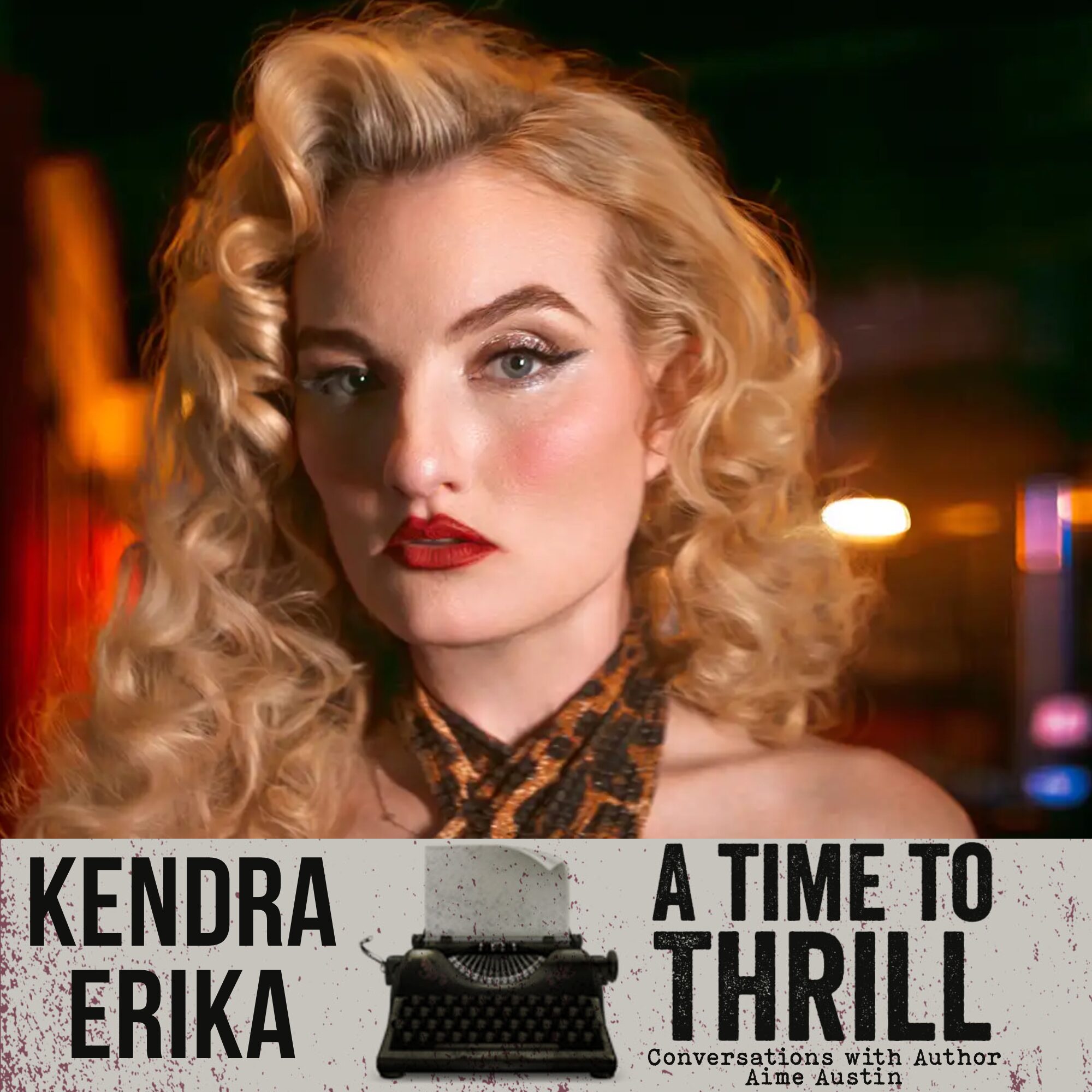
[00:00:43] Speaker A: Lots of creative people. But this is the first singer songwriter I'm interviewing. So this month I'm super. It's super interesting to have Kendra Erica on the podcast.
So I will say this. Like, I was sitting around thinking about music. This is so weird because I generally don't listen to music in my house or my car that often. And it came up, somebody was asking me, like, what kind of music they wanted to play. And she was like, what were you listening to in your car on the way here? It's like I was either talking, listening to a podcast, or listening to an audiobook.
[00:01:20] Speaker B: So.
[00:01:21] Speaker A: So I was thinking that I was like, I don't listen to musicians. I don't talk to them that often, except for people I know. And then I get an email and it's like, do you want to interview Kendra Erickard? I was like, I absolutely do, because I would love to talk to somebody who makes music.
And what's even more interesting about her story is that she was, I guess it was maybe tone deaf. So she started like. Like a lot of people do. Like, she was watching people on tv and she grew up in that, like, Disney, I want to call them the Disney girl era, but like, the era of, like, super popular, like, singers on the Disney Channel. And she's like, I want to do that and. But couldn't carry a tune, which is deeply ironic.
So she fortunately had parents who really encouraged that, hired a coach and. And taught her how to sing. And now it is her profession, her career, and her talent. And so I really wanted to talk to her about that. And especially what was more interesting to me was having parents who are supportive of the arts that if you listen to any podcast, especially comedians or anything, having parents who are supportive of the arts is like a come and go sort of thing.
Some parents are supportive, some parents aren't. Some parents worry that you're just going to be, like, you know, homeless, living on the street, and some have more faith.
So it's fascinating. And she'll talk about this like her parents having that, being supportive, being Supportive of her being an artist, but in addition also being like also get a four year degree, not so much to fall back on, but partially to fall back on. But what I thought was interesting is that it also gives her that confidence and boost in an arena where it's easy, especially in music to be taken just taken advantage of. And her having a background in education and a background to some degree in business gives her that the gravitas to I think hopefully like push back in an area where artists can easily unfortunately be exploited.
So we talk about that and then also. So she has a certain aesthetic that I find very interesting. And in an era like when I look at like my, excuse me, my ipod for his albums, but when I look at my ipod and the list of music I have a lot of it is a certain sort of like a jazz standard music or certain like a poppy tunes because I, you know, I'm an 80s kid and you know Madonna and you know there was certain like people saying. But there was also like pop and a certain upbeat vibe. And she has embodied that sort of vibe.
And even this morning I was listening to or watching actually on YouTube. I'll include a link in the show notes.
Her official music video for the song I'm Nice Till I'm not.
And its song has a certain, I mean she's in a flapper dress, it's like the 20s, it's speakeasy vibe of a. And it's shot at this club, restaurant, whatever in Vegas. So that's the vibe. But it's, it's mixing that sort of vibe of like little, little like jazz standardy voice with a little bit more of like a poppy upbeat. And her new album A License to Thrill sort of takes on that vibe obviously across a whole lot more songs.
So I, I wanted to talk to someone about that. And also, and she said this in the beginning and I was like, oh my God, you're right. So okay, obviously my podcast is called A Time to Thrill.
Obviously it's a send up to John Grisham's Time to Kill which is a super popular, who knows, New York Times bestselling book and I hope the 90s would probably be the 80s, I don't know dating myself.
And her entire send up is sort of like a bond, Bond girl vibe. And I really like the idea of hearkening back or that echo to something that people like. It just gives people a little bit, you're like, that's oh, you know, that's familiar. And I love the fact that she did that so without further ado, let's enjoy this conversation with Kendra Erica. And as you know, I have so many questions. Questions.
[00:06:03] Speaker B: Before we dive into today's conversation, I want to take a moment to thank this episode's sponsor, Audible.
[00:06:10] Speaker A: You know how much I love a good story.
[00:06:11] Speaker B: I write them, I read them, and sometimes when I can't sit down long enough to open a book, I listen to them. Lately, I've been listening to Audible while I walk, travel, or even sometimes while cooking dinner. There's something about hearing a story performed that makes it come alive in a different way. I just finished. Okay, Julie Chan Is Dead by Leanne Zhang, An Alice Feeney book, Beautiful, Ugly, and the latest, latest Linley book by Elizabeth George.
[00:06:40] Speaker A: So I'm gonna be honest. This is how I do it.
[00:06:42] Speaker B: I get a book both on Kindle and on Audible, and I go back and forth listening to both. So when I'm driving in the car or with my son at some activity, I will listen to audiobooks. And then when I'm home, I read them on Kindle. And Audible makes it easy to switch back and forth in the app.
[00:07:02] Speaker A: Honestly, I do it every time. I just, I want to keep the.
[00:07:07] Speaker B: Book going while I'm driving. And so I just switch, switch to the audiobook. And then when I get home, I switch back to the Kindle because honestly, I can read faster than I can listen.
Anyway, the best part is that with.
[00:07:21] Speaker A: Audible, you get a 30 day free trial.
[00:07:22] Speaker B: You can start listening today. You get one audiobook you can keep forever even if you cancel. So if you've been wanting to read more stories that Pulleyman won't let go, including my own Casey Court series, which are all available on audible, go to audible.com the link is in the show notes or in the alternative ebooks buzz Audible.
[00:07:46] Speaker A: Hi, this is the Time to Thrill. It's your host, Amy Austin. This month I have the absolute delight of speaking with reporting artist Kendra Erica. Hello.
[00:07:55] Speaker C: Hello.
I'm so excited to be on A Time to Thrill because there's something very similar in the wording of A Time to Thrill and the project that is coming out.
So.
[00:08:09] Speaker A: Okay, can you say that? Can you talk on that? Or if it's. I'm sorry, I live in LA and people say that. And then the next thing is. It's a secret.
[00:08:16] Speaker C: Oh, no, no, no. It's not a. I mean, it's, it's, it's classified, but it's declassified. But it's the Licensed to Thrill album coming out February. So, yeah, we'll talk about that. Okay, so I just. I just set the stage for you, so we're good.
[00:08:35] Speaker A: I mean, you. I don't know how many years you've been here, but people will say, oh, my God, I'm working on this thing. And you're like, tell me about it. And they're like, I can't talk about it. And you're like, okay.
[00:08:42] Speaker C: Oh, yeah, no, I'm not. I'm. I'm not originally from here, so I'm not like that.
[00:08:50] Speaker A: Okay, so tell me about. Where are you from?
[00:08:53] Speaker C: I'm originally from Boca Raton, Florida.
And I grew up always wanting to do something in performance, I think, because when my. My mom showed me a bunch of the Disney princess movies and exposed me to that, I saw them performing and creating their own and just performing and singing and dancing, and I was like, that's what I want to do.
And I. I just. I had one little problem, and that was I couldn't carry a tune because I was tone deaf. And I had all the confidence in the world, but not the skill set. So you can imagine it's like a bowl in a china shop. It's a little bit. It's like.
It's like a. It's like a laughing. Not. Not a laughing hyena. But it's just.
It's just. It's just like a. It's. It's an atonal horn that just has so much confidence behind it that it's just. It's blaring. But I'm over dramatizing it. But still, I needed to get some training and some skills behind me, so.
[00:10:02] Speaker A: Sone deaf. So I.
I may not be able to carry a tune.
So life is full of things. I can't do that. Astrophysics. There we go. So my understanding of being tone deaf is that if somebody says to you, God. Okay, now, see, I'm like. I have, like, memories from, like, choir and, like, school. Somebody's like, so Mrs. Katz would have, you know, a piano. She has to be long dead because she was in her 80s then. And she would hit a note and then repeat the note. Singing. And then the next thing would be start with that note, right? She might as well have been speaking Russian because I was like, that's cute. What are the words? The song?
Because I.
[00:10:46] Speaker C: You're like. And I'm too young to drink vodka, so I can't.
[00:10:49] Speaker A: I can't.
[00:10:50] Speaker C: I can't take a shot and then sing the correct note, right?
[00:10:55] Speaker A: So I just couldn't.
I had no idea what that meant, um, now. But nobody ever explained it to me. To be frank, nobody ever explained it to me. It was just sort of, what do you want? We had choir, band, or orchestra. Which one do you want to do? And I was like, I'll do choir. Didn't have the confidence, but I love the idea of singing. Like, I would do it at camp, like, in. Like, we had sleepaway camp, and they'd be like a talent show. I'm like, I'll stand up and sing. Couldn't carry a tune, but I did it anyway, so. But what. Who told you that? Who let you know that you were toned up? Because I don't think I could hear it except to record it. And I'm much older than you, so it would be like, I'm so sorry. Like a tape. And they would record it, and then you hear back and you go, oh, no, no, no. That's nothing like what I want to sound like.
[00:11:40] Speaker C: Well, I couldn't hear it either. I mean, because I was. I was so young. I was a child. You know, when you're a child, you're like, I can do anything.
And. But I think no one really told me. It was just my. My parents really saw that I wanted to do this, and they're. They. They just knew I had to.
I had to get into a position where I could do what I wanted to do, and I had to.
Like I said, I had to get that education under my belt, which was that. The vocal development.
And.
And thank God that they did, because I.
Because my.
My vocal coach, My original vocal coach was a. A German opera singer. So he was very.
He was very strict, but he.
It was almost like he broke me down and built me back up again. And he built such a good. A great foundation for me to build upon.
[00:12:40] Speaker A: But he did have to say. So it was. How can I say this as a German vocal coach? I can't. Was he gentle in saying, okay, so this is what you. You should sound like. This is how we get here?
Or was it more like, honey, let's. You know.
[00:12:57] Speaker C: He had his own way about doing it. I just remember, you know, it was. It was when I was a child, so I don't really have, like, the vivid memories, but I have, like, the. The things that stuck out.
And.
And I just remember him, first of all, teaching me my first German curse word, which is shaisa, like, which means in German. And then if you wanted to, you know, really emphasize it, you say ficta scheisse, which is, you know, shit.
But. And then I Just remember, because at that age, I like everyone else during the 90s, we looked up to Britney Spears, Christina Aguilera, Destiny Child, Spice Girl, Girls, all of them. All those like papa makers and shakers.
And I just remember him being like, oh, yeah, like just. You want to sound like Britney Spears.
And I just remember him just completely.
Yeah. Just completely being so adverse to that. That kind of sound.
Um, and which, Which, I mean, he does, he does. He did have a point.
And that, you know, in order to really be great, you can't just focus on the nasal. You have to include your. All of your, Your body, including your diaphragm, your lungs, all of it.
And also the opera world is. Is not too, too fond of the pop world.
[00:14:38] Speaker B: I can.
[00:14:39] Speaker A: I mean, I, Yeah, I will say this, actually. I just got a Christmas card from her or holiday card. Somebody I know has a son who's an opera singer. So, yeah, it's a.
He moved to New York City. I mean, he's not here right as one does.
So let me. Okay, I believe.
Well, okay, I believe, like if I got up tomorrow and I said I wanted to draw a masterpiece, I don't think there is a sufficient amount of teaching that I could get to that point.
Well, I don't believe that. Maybe for other things, but not that. Do you think that you had some raw talent that had to be honed, or do you think that learning to.
How can I say this? Recognize and sing notes was something that was teachable?
[00:15:32] Speaker C: I think it was a little bit of both.
I, I think that.
I think I was naturally gifted in a different way, but I knew I, I had, I had like. I knew the calling. And the calling was that I, I think I was naturally born with a vision and, And. And messaging and, and what I, What I want to say and how. And, And. And just how I view things.
I just, I just knew that the vehicle was going to be this. But this wasn't.
This wasn't polished or it wasn't developed even.
So I needed to develop the vehicle in order for the actual gift, which is like the. How, you know, my, My messaging or my cause or whatever it is to.
To sit in that vehicle and drive forward and use singing and vocal art as the passageway.
[00:16:43] Speaker A: Okay, so let's go back. So how old were you when you first. When they first hired a vocal coach?
[00:16:50] Speaker C: I was eight years old.
[00:16:52] Speaker A: Okay, that's eight year old. Sometimes it's. Children are so fascinating because sometimes they ask for something because they're so serious about it, and sometimes how Is it that you. Or. Let me not say how. Why do you think your parents took you seriously? Because not everybody, you know, some people are like, I want to play guitar, and it's like two days. And I'm not saying I wouldn't. Like, you wouldn't. Someone wouldn't be supportive of that, but clearly you're serious enough.
[00:17:19] Speaker C: Yeah, well, I think I'll.
[00:17:21] Speaker A: I'll.
[00:17:21] Speaker C: I'll tell you why they. They were so serious about wanting me to pursue my passion.
Both of them grew up in the boomer age, and I think this. This has to do with intergenerational. Not conflict, but more evolution and.
And understanding and for your kids to want better or. Or to achieve what better than you had.
And I think because both of their parents came from a different generation where there is a bunch of war and uncertainty, and then they taught their kids to be more pragmatic, even if they both did have a passion. Like, my dad wanted to pursue athletics and be a professional football player, but his parents said or encouraged him to become a lawyer, because that's more of a pragmatic job.
And then my mom, she always wanted to become a concert pianist or a professional ballerina. And her father, my grandfather, lost a job, therefore not having the means to fund that sort of aspiration or aspirations. And so she was also encouraged to follow more of a pragmatic route as well.
So with me, my parents wanted to do differently, and they wanted me to pursue something that would offer me fulfillment and also offer me that chance to see the dream through.
[00:19:11] Speaker A: So this is utterly fascinating because then I. So my next question. This is, like, not related to this, but do you think if you had children, you would encourage them to do something artistic or something pragmatic?
[00:19:23] Speaker C: I would encourage them to do both.
[00:19:25] Speaker A: Well, okay. I only asked this because I had the pragmatic parents.
I went to law school, so I know this, and most of my friends did as well.
Our parents were, like, born in the 40s and then. But so there's. No, not necessarily a good reason for it. I don't have a good reason for it. Just, you know, you should become. Well, your options are doctor, lawyer, and maybe engineer, maybe.
[00:19:49] Speaker C: Yeah, maybe, maybe. I mean, maybe he's an engineer and.
[00:19:54] Speaker A: His parents were like, you should still go to law school. And he did.
So there's that. But then even I know parents now. We were talking about this, like, at some point, social event and who are, like, actors who are successful at it, who still want their kids to be in a more pragmatic path because they have found the struggle to be.
There's a struggle and they don't want their kids to go through that struggle. And these people who are like movie stars, they're like, they're not starving, but the struggle is so hard they wouldn't wish it on their children.
[00:20:29] Speaker C: But even the kids of those artists or even celebrities, even, even they have seen the struggle and the toll that it's taken on their parents and they've, they've wanted to do something different as well.
Those who, who don't feel like, I don't, I don't know, they feel that they've got some sort of like vendetta that they've got a, that they have to fulfill.
But no, it, that's, that's why, that's why my parents wanted me to pursue that, that passion.
But at the same time, when I graduated high school And I, at 18 years of age, I wanted to, I wanted to go to either New York or LA and start a career at 18 years old, possibly doing Nickelodeon or Disney or something like that. And, and thank God that my mom, she said to me, she said if you want to still continue the, your aspirations in music and performance, I will do that, but you're going to go to college and get a four year degree in something other than music.
[00:21:47] Speaker A: And what did you major in?
[00:21:49] Speaker C: Oh, I majored in, yeah, I majored in communications, broadcast journalism and international business.
[00:22:01] Speaker A: Okay.
[00:22:02] Speaker C: So I did, I did something other than other than music. But after that I said I still want to pursue this. So it's almost like I held up my end of the bargain and that's how I got my, for my four year degree. If my mom didn't offer me that sort of, that, that deal or that, you know, ultimatum, I, I don't know, I don't know what, what, what would be in, what would have been in store for me and I don't know what, what could have come of that. But I will say that was a blessing because as we've seen so like way too often young people, especially in their late, early teens, late teens, early 20s, getting taken advantage of and the climate of this industry is, is ruthless, especially when it comes to, you know, the, the, the unfortunate, you know, traffic, pedophilic nature or tendencies that tend to happen.
And I, I just, I, I thank the grace of God for that.
[00:23:23] Speaker A: Did you, okay, so during college, because, okay, in retrospect there's a lot of time in college. You know what I mean? Like when you're there, it seems like you're busy, but you're really not busy. Did you pursue, were you continuing to not pursue music or train and that kind of thing? I mean, because it's not, I find that most talents you can pick up and put down, but, you know, you still need to work at it.
[00:23:48] Speaker C: Yeah, no. All throughout college, I, I, I still was singing and I stayed local for, for college and I lived at home. And the reason for that is because during high school I, I got gigs around town locally, and if I were to have gone away, let's say to Vanderbilt or Berkeley or wherever, or, you know, UCLA or any or anywhere, I would have had to forfeit those, those money making jobs. And I didn't want to do that because I, I wanted to keep the momentum going.
And that's why I say that's why I stayed at home. And during college, I was still gigging, I was still performing. And also during my last two years of college, I began traveling back and forth for, for my career, either whether it was to New York or to la. And I was starting to write and record in Nashville, in Miami, and I, I began my original songwriting journey then. So.
[00:25:04] Speaker A: Okay, I have to ask a question that's, that's been on my. Okay, what are the audiences in Boca Raton? Because my experience is that it's old people in Florida, but I imagine there have to be, there has to be somebody under 80.
So what were your audiences like, your first audience?
[00:25:24] Speaker C: I was like Will Smith and I am Legend. I was the only one under 80. No, just kidding.
I was the only one standing. I was there with my, you know, my German shepherd and I was like, let's go. Oh, look at the cardboard cutouts, everybody. You know?
But no, I, Yeah, there it's. So Boca is as they want to say it.
I mean, I didn't, I didn't come up with the saying. They did, but they, they call it Heaven's Waiting Room.
Awful. It's morbid to think of, but at the same time, it's definitely a city and community for retirees, especially from New York, New Jersey, from the seaboard. Yeah. So Boca. So you know that Boca is the Eighth Borough, right?
[00:26:20] Speaker A: Yes. And so that's in my head, I'm like, okay, but I'm imagining all my friends, parents, and you, and it's like not meeting in my head.
[00:26:30] Speaker C: Yeah. So it's made up of those retirees. So one of the things that I had to do when I was gigging and when I, when I first started performing at these restaurants, especially the, the Italian restaurants and, and lounges is I had to create a repertoire of song, of jazz standards and American songbooks classics because that's what they, that's what they love.
And that's, that became a part of my, A part of my, my musical DNA in my developing years is because not only was I doing opera or classical, but I was also, I was also cultivating and creating a repertoire of, of standards and jazz music and just really just making myself cultured and seasoned at such a young age and performing those and embodying those and connecting with people that saw the real Sinatra singing those back in their day and saw the real Billie Holiday singing then the real Dean Martin singing them. I was like, am I doing it well?
It was like a 16 year old. I was like, I just got my car, but am I doing this song well?
[00:27:59] Speaker A: So I mean, that's so. Okay. So I got sent like, you're single, which is obviously just audio. So I went to YouTube and I was looking at the videos and I was like, okay, this is a certain esthetic, but it does have that.
I don't want to call it throwback. And it may be only like this is where you are now, but it does have a certain timelessness.
I mean even like with your hair and all of that. And I'm much older than you, so I grew up with people who also went to those shows and talked about it when I was in New York at the Cotton Club or when I, you know what I mean, when I was in so and so because my people, my parents generation, like went out and did that.
It was a completely different era for us.
But how, how did you integrate that with the whole like Britney Spears, that's like a whole different like pop like era. And it's different. Even the music I grew up with, it's so.
I don't, I don't have a good word for it. Like, I don't call it trendy because that's not it. It was just a whole like sexy in a different way than like the glam like era and also like completely different kind of music. Like, you know, I'm just completely different.
[00:29:11] Speaker C: Yeah, well, when I wanted to do more of the pop, pop stuff, how that, how that came to be is I, I was working with an artist development firm in New York and, and quite funnily I.
The image that I was working on developing with them was very much like a Bond girl. Like, it was very, it had, I was, I was researching Lana Del Rey a lot. I was researching, you know, artists Like Jesse Ware, Ellie Goulding, a lot of like British, like classy artists.
And I was integrating and I was using those kinds of sounds to create this like Bond girl image. And I was, I was marketing myself as this like Bond, Bond desk type girl.
And, and then when working with that, with their, with their songwriters, I kind of just, it ran stale a little bit. And then I was introduced by them to my then Billboard promoter, Jason Dalman, who had connections with the dance world.
So I then started working with him because he, he just said, scrap what you're doing in New York, come out to LA and work with my team of songwriters. And his team of songwriters were very much in that dance genre. And he said, you know, the sound of the timbre in your voice, the tone of your voice, it can suit very well with these dance beats or EDM songs. So I then started going back and forth from Florida and la, writing and recording with his team and also with other people that spawned from those kind, from other connections that I was making.
And that's what I was doing and working with people like Damon Sharp, Lugo, Luigi Gonzalez, Kevin Wild, Chico Bennett, also then Andy Kirk, first in LA and then in Nashville. And I just, I created that, that, those Billboard charting hits and which led to me doing a remake of Laura Brannigan, Self Control. And then that went to number one. But for that span of years, for that span of it, I would say eight years, I was doing a lot of dance music.
And then towards the latter part of that, only just like a couple or few years ago, that's when I started to make the transition because I started just getting a little bit, just a little bit outgrown of it and I wanted to go back to my roots. So that's when I said I want to do a remake of Frank Sinatra's Witchcraft.
I also did a remake of the title song, Phantom of the Opera with Damon Sharp. It was an upbeat version, but I wanted to showcase my ability because I felt like that was going to be the difference differentiator between me and my constituents. So.
[00:32:35] Speaker A: But I also think it may have like more longevity because pop and dance music styles go in and out, you know what I mean? Like, the tempo's this and the thing is that. And there's a lot of production involved and a lot of that that's not easily like, you can't replicate that so easily as opposed to like a single singer doing their particular brand.
[00:32:58] Speaker C: Yes. And that's why they call them classics, because they're timeless and they do and they they do have more long longevity. But I, but now I feel showing your capability is a lot cooler because now you have people like Adele show or not Adele, but Gaga, you know, going back to her roots and showing like, hey, I could do. I could sing a duet with Tony Bennett.
And then you have people like Nicole Scherzinger who were, who, who said, you know what? People aren't taking me seriously because I'm wearing too short of skirts and singing about, Singing about buttons loosening and singing about like, don't you wish your girlfriend was hot like me?
Like, it. She. She said, she literally said, she said people weren taking me seriously. So then she, you know, got on, gone on whatever stage and was like, don't cry for me, Argentina. And everyone's like, yeah, she went back to her roots. And I feel like that I'm on that similar, that similar path. And I'm, I'm really happy about this, this new project that I have coming up. And I'm, I feel like more impassioned about it because I, I just feel like it's, it's what I've been meaning to do.
[00:34:23] Speaker A: So let me ask you this in terms of the songwriting, okay, There are people, okay, I'm sure you know this for people who do things, it's like actor directors or writer directors or singer songwriters. There are some people who only do one thing. They just sing or they write songs.
And they're. No shame because I know you can do very well being a songwriter in your house, never leaving amazing to me the whole process.
But what made you want to do the singer songwriter route? To create, to be, to be in the process of creating the thing that you were going to sing.
[00:35:02] Speaker C: Well, when I was singing a bunch of covers in Boca, I.
There was just something. There was a little bug inside me that said I want to get more into the songwriting aspect of it because I was so fascinated by about the, the development of a song and seeing it go from like an embryonic stage to like a full grown stage.
And also when you're recording your own original work, you have, you have more stake in it.
[00:35:49] Speaker A: That's true.
[00:35:51] Speaker C: And you can, you can, you know, make something, make something of it.
So. And I just wanted to have my. I wanted to do something original musically.
I think that's what I'm getting as I wanted to do something original musically and be my own, Be my own artist.
[00:36:14] Speaker A: Okay, so then what.
Okay, so. Okay. I did not listen to your entire catalog of songs, so I've only heard like the most recent things.
So let me say this. What.
Let me go back. What are you trying to showcase musically now? Like, what kind of genre, what kind of lane? I hate in lanes. But where do you want to put yourself now in terms of, like, right. Songwriting?
[00:36:45] Speaker C: Well, right now I have the James Bond album coming out in February, and that's my re. That's my reintroduction and my.
The.
That's the. The new aura. That's. That's the new journey that I'm going on, and that's the new project that I'm promoting. And I actually have written and recorded in the last. In the last couple months, two original songs with Damon Sharpe and Luigi Gonzalez. And they're. They're upbeat. They're upbeat because I'm. I'm not fully departuring from or. Or departing from dance and doing upbeat music. But I wanted to do it in a vein that was.
That was in the now and in the vein. In that classic vein.
And that's. And that's this. This classic, jazzy standard. 007 Avenue and in Corridor.
[00:38:04] Speaker A: Okay, so.
Okay, so when is your. When is your new. Oh, my God. When is it coming out? You said February.
February seems to me both very soon and very far away. But it's literally like six weeks. It's not, you know, it's not six weeks.
[00:38:21] Speaker C: It's right around the riverbend.
It's coming out February 13th.
And then the release party, the big debut release party is going to be February 15th in Las Vegas.
[00:38:36] Speaker A: So what's the Vegas connection? Well, okay, my son and I were just talking about this the other day.
Okay. I have mixed feelings about Vegas. However, it is a great place to work because the audiences change constantly.
So that's. I mean, who can beat that?
Who can beat that? So why Vegas?
[00:39:00] Speaker C: Vegas has this quality to it where if you have something to bring to the table, then you've got something to offer. And Vegas will not accept anybody that does not have anything to bring to the table.
So while in places like la, where anybody can be famous by, or be well known or be even respected for that matter, for having, you know, a certain following or a certain, you know, sort of. I don't want to say, like, but, you know, average quality product or talent, in Vegas, it's different.
And I. And I've always felt like in la, I have been a little bit out of place because I feel.
I feel I have more to bring to the table than LA really wants to deal with right now.
[00:40:08] Speaker A: So LA is hard. Like, this is the thing I don't okay, I've been here 20 something years and I.
One day I will understand it or I will just never understand it because it's a great place to meet lots of other talented people, but I'm not sure it's a great place to perform or work. I mean, outside of TV or movies or something like that.
So if you would like to collaborate with a lot of creative people, you can throw a stone. But if you want to launch a career, like outside of television or movies, as an actor, it is. It is a little hard. So comedians often will live here but don't work here.
Yes, like, but it's true for singers, songwriters, comedians, stage actors. I mean, there's a. Like a group of.
A large group of people for whom performing here does not necessarily. Does not necessarily work. I don't know why I cannot. I'm still to this day trying to figure it out.
[00:41:07] Speaker C: Well, I think. I think it's changed over the years, and I think also the pandemic had a lot to do with it. Also the tragic fires that happen also had something to do with it. I think both of those, both those circumstances, both the pandemic and the fires, I think sent a lot of. A lot of the talented people packing and relocating. So that's why there are more there. There are more people moving to Vegas. A lot of more movies are being filmed in either Florida or Texas or even Chicago or New Orleans.
Um, and I also think that with the, with the influence and. Of the influence and the, and the permeation of.
Of social media and the digital age and TikTok, Louisiana has become more of the influencer capital of the world, whereas it used to be the entertainment capital of the world. And then slowly you would see the, the.
The explosion of reality shows. And then, and then, and then, and then one day you would have, like, I don't know, like, you would have someone like Jennifer Aniston on the COVID and then the next day it would be like Spencer and Heidi on the COVID you know?
[00:42:40] Speaker A: No, it's.
[00:42:43] Speaker C: It's.
[00:42:43] Speaker A: So, yeah, I mean, like, a lot of my friends who like music. Friends like music move to Nashville and.
[00:42:49] Speaker C: I'm like, yeah, Nashville's another place too.
[00:42:54] Speaker A: You're leaving here? And they're like, yes. And I'm like, okay. You know, it's just. It's been fascinating to watch people. I know music people move to Nashville. And I thought, wow, that's a change from, like, people of my generation who grew up with, like, going to Sunset, you know what I mean? To play in, like, the, The.
The bars, whatever, to play in the bars and sort of develop there. There's a lot of bands that develop there. And now people are like, well, I'm gonna leave here, move to Nashville. I'm like, oh, my gosh, this is such a. To me, it feels like a sea change.
[00:43:25] Speaker C: Yeah, well, like I said, it's been. And it's.
I don't see. I. I don't see anything as, like, a bad thing. I just think, like, that's so. That's the way how it's going right now. And LA is a great place to still live here and record because a lot of my producers are still here and I still record with them. And it's. It's funny, I heard someone say something the other day. They said, LA is a great place to record, but Vegas is the place to perform.
And, I mean, even my vocal coach has relocated. He lived in LA his whole life, and now he's living in Vegas.
And it's just the. The evolution of what has.
What has transpired and, you know, the, the shifts that have happened with both, with. With all the. The political circumstances, the. The spiritual circumstances and also the, the natural disaster circumstances and the biomedical circumstances that have happened. So, yeah, I don't see it as a bad thing. I just. I know. I. I'm just perceptive and I see things for how. How they are.
[00:44:44] Speaker A: Okay, so this morning I was watching your video, and I have. Okay, I have questions.
Yeah.
Where did you film it?
[00:44:55] Speaker C: Which. Which video?
[00:44:57] Speaker A: Oh, my gosh. Okay, so you're in a. I don't call it the saloon.
[00:45:00] Speaker C: That is not the saloon Speakeasy.
[00:45:05] Speaker A: Thank you.
[00:45:06] Speaker C: Oh, yeah, we filmed that.
[00:45:09] Speaker A: Well, she knocked it. I'm like, oh, this is the. This is the Prohibition era.
[00:45:15] Speaker C: The saloon. I think. I think the next video will be at a saloon. I mean, I.
I think I'm gonna do a whole country thing.
We filmed that in Vegas at Capos, and it's a. It's a renowned Italian speakeasy, and that's. That's where we filmed it.
[00:45:33] Speaker A: So I have not been there. Okay, so I've been to Vegas exactly once in my life for two days in 2004. Three. Something like that. Really?
[00:45:41] Speaker C: It's been a while for you. So you need to come to the.
[00:45:44] Speaker A: Release party in a minute. Like, I. The traffic was enough that I was like, oh, no. And then I actually, I was going to take a flight to Vegas and the flight was delayed, and I thought I could have driven there in the time that I'm waiting for this flight and I just left the airport. Went home. Yeah. Yeah.
So, okay, the aesthetic of the video, which, okay, this is now video, but I realize I don't have it here. So the aesthetic of the video is very like 1920 flappers, all of that. The. I assume the restaurant then looks. Looks that way permanently.
Yes. And then you, you infringe. Slotted yourself in.
[00:46:21] Speaker C: I, you know, I, I did. I slid into their DMs or as I should say, through their. Their secret door.
[00:46:30] Speaker A: And so how did you like.
Well, I say this, I will always like the hair from that era. But how did you like that embodying that era?
[00:46:41] Speaker C: I loved it.
I feel like I was born in a different time. I feel like my body is in the times, but my soul is in like the 20s or 30s or 40s. I just think that it's in within that kind of, that kind of time era.
[00:47:07] Speaker A: And.
Okay, let's go back. So what. Okay, so with the License to Thrill, how many songs. How many songs will you be doing?
[00:47:18] Speaker C: So there are nine songs on the album, plus a bonus track and that's a stripped down version of A Deeper Love. It's a. One of my Billboard charting hits. It's originally a, A dance upbeat song that I originally, that I wrote with Damon and my. And Myron, the producer who, who masterfully put together the License to Thrill album, stripped it down so wonderfully and, and so, and just so stylistically that I, I felt it needed to go on the License to Thrill album because in that, in that, in that state, it sounds like a Bond song.
[00:48:05] Speaker A: So. Okay, I, I'm going to ask you this because I haven't thought of this in a while. What made you decide to do a music video? Because it's not. I come from the era when MTV came out and so it went from people only doing some videos to like wall to wall videos, you know, and then, you know, video Kill the radio star. So I mean, you know what I mean? Like it went from that to wall to wall videos to now being more like it was in the beginning where it was very selective. So what made you decide to do that? Because I'm not. I actually don't know who the audience for it is. I will watch them.
I will watch them if somebody, if I like a song and then I will go watch them. But it's not. There's no, you know, MTV on in my house 247 with, you know, videos like I'm 13.
[00:48:55] Speaker C: So what was the style of it or what?
[00:48:58] Speaker A: No what was the, what made you, what prompted you to do a video in an era when not everyone does them and there's a cost? I mean, they're not free. You know what I mean? It's not.
[00:49:05] Speaker C: Right.
[00:49:06] Speaker A: It's not recording and then uploading to Apple. So I mean, you know, well, I.
[00:49:12] Speaker C: I wanted to do it in that, in that style because the song is very, is within that nature and I wanted the visual representation to, to complement and be and, and to really represent it.
So I wanted to do a video that was, that was replicating of, of, of that era. And that's why I, I had, you know, flapper dresses on. I had even a leopard print dress that, that was, that it's, its design was very much, you know, 1920s. Like you would see it in that kind of, in that kind of time period.
And I wanted it to, I wanted to embody that and really encapsulate people into that, into that world and, you know, throw them back a little bit.
[00:50:09] Speaker A: Okay, so I will say this because we started the conversation with this and. Okay, so the podcast is called the Time to Thrill. And there's a book, a famous book obviously called A Time to Kill.
And so I, obviously we all have those moments where like this is. I still like it.
So what made you decide to do that kind of send up yourself?
[00:50:38] Speaker C: Like, what was the question?
[00:50:41] Speaker A: What made you decide to name the album, like, do that send up to like the Bond era?
[00:50:48] Speaker C: What?
Well, it's, it's always been something that I've, I've wanted to, to do.
But it's funny because in the beginning of COVID it was, it was like knocking. It was like knocking out my door.
And then it just started like growing louder and louder and louder until I finally, I told my mom and my dad and I told people on my, on my team. I said I want to do a James Bond album of all my favorite Bond songs, but just like stripped down in a very jazzy, jazzy form.
And once I decided to do it, then I lined up the producer that I wanted to work with, which is Myron McKinley, who I had done a remake of Witchcraft by Frank Sinatra. I done a remake of that with him and Ralph Johnson from Earthbone and Fire.
And it went, it, it was an award winning song. Literally. We won the Hollywood Independent Music Award for it.
And I knew that because Myron has such an ear and he is so talented in, in restylizing songs and having their own, their own stamp on them.
I, I elected him to really produce this and to be the producer for it.
[00:52:25] Speaker A: So. Okay, let me ask you this.
What.
Okay, I have two questions in my head. How do you decide original versus remake? What goes into that kind of decision?
[00:52:43] Speaker C: Original is when I.
It's funny because whenever I want to do something original, it's because I want to do something original. And then when I want to do a remake, I just decide to do a remake. So. Yes. So it's, it's. It's not like if the. If there are a certain amount of clouds in the sky that I want to do remake, and if it's like a sunny, A clear sunny day, I want to do it. And an original. So it's, it's, you know, as, as they would say. And, and what. What's that song from Babes in Arms? Whatever, Whatever Lola wants. Whatever. Whatever country was Kaecher gets.
[00:53:30] Speaker A: Yeah.
So then. Okay, the original. It's clear because that you're inspired. You write a song, you know, it's about what. It's about what. How do you choose a reading? Because there's like not a million. Well, there are millions of songs. There's lots and lots of songs out there. So then is it something that catches your eye? Do you keep like a list of things that sort of. You might like to think about later that how you would do it differently or like, it's just original? I understand like picking something to remake. It just seems like there's so many options out there and I'm easily overwhelmed by options.
[00:54:04] Speaker C: Right.
Well, for.
Well, I'll. I'll just use tangible examples for, for self control.
That was a song that I had always loved performing, even when I was performing in, in Boca and in Florida, because when I was doing these, these restaurant and bar gigs, at the end of the night, I would always do like an upbeat set and I would always throw that song in there and I would sing it in the Laura Brannigan in the Laura Brannigan formation.
But I, I just love the song so much that I wanted to do a remake of it and I wanted to do my own, put my own spin on it.
And also because a producer that I was working with, his name is Fred Cannon in Nashville, he back in the day worked on Carrera Records.
It was a French label. But on, on that label there was an Italian pop singer by the name of Raf signed to it. And he, he did the original self control and made it big in Italy in, in the 80s. And then, and then a year later, Laura Brown again, they made it big in the United States.
So and then I wanted to, because, you know, a few years have passed.
I wanted to, you know, re. Reemerge the song or, you know, refurbish it and. And put my own little, you know, quill on it.
[00:55:48] Speaker A: Okay, so then. Okay, completely different question.
What is it like? Because I'm trying to think. Well, I have no idea what this would be like.
[00:55:57] Speaker B: The.
[00:55:58] Speaker A: I guess the goal. Well, no, I'll ask you.
Musically, what is your goal? So is your. I mean, other than, like, enjoying yourself and, you know, being able to eat and put a roof over your head. But what is the, like, bigger goal? Is it.
I don't know. Like, some people like to tour. Like, I know somebody who tours all of the time.
He just loves it.
What he loves about it, I can't figure out, but that's not me.
Other people like to.
Well, some people want to just be famous. Some people want to sing a certain kind of thing, live a certain kind of life. Like, people have, like, all sorts of different things they'd like to do.
Some people like what I was talking about, like, a couple of songwriters, and I just want to sit in their house all day and write songs and then hear them later, like, on the radio sung by somebody else, but not be out there performing. So people have all sorts of feelings, goals, what they want to do. What is it that, like, ultimately you would like?
Not ultimately, that's like get to the.
You at, like, heaven's waiting room. But what is your goal more or less, in terms of performing, singing, that kind of thing?
[00:57:07] Speaker C: Goals are to write, record, also.
Also tour, also perform.
But yeah, I think. I think my answer to that question would be Circle D, all the above.
[00:57:27] Speaker A: Okay, so then in terms of storytelling, what kind of stories do you want to tell in music? Because, okay, so I was doing yesterday, the Spotify wrapped thing. You know, you can click on it for, like, podcasts. And so it was like, you know, you've had this growth or whatever. But the last frame, which I did not put in my Instagram story, was like, the number one person that people listen to in addition to you is Taylor Swift. And I was like, okay, that's not what I expected. But it's probably the same for everyone, to be honest.
But she tells a certain kind of story in song.
Some people tell, like, there's other artists who tell, like, completely different kinds of stories and songs, and then there are people who are all over the place depending on where their life is. It's like heartbreak, love, you know, more heartbreak, you know, moving on, you know, Metamorphosis, that kind of thing, depending on how their life is going at the time. What kind of stories do you think you want to tell in terms of songwriting and singing?
[00:58:24] Speaker C: For me, I, I've, it's, it's funny. I've never really put out a, like a lovey type of song. A lovey or a heartbreaking type of song. I've never been on one end of the spectrum or the other. Like, I've never ever really done that. I've, I've always just, I've.
I've recorded like thought provoking songs or, or just sort of feel good or there's like some like, resiliency there and, and now with, with the new, with the new goal and direction in mind, like when I did I'm Nice till I'm not, that was a segue into reintroducing myself as more of this classic image.
So everything, everything that I've done has been, I would say more of like a strategy.
But it's, it's not about working harder, it's about working smarter.
But as far as what kind of message I want to, I want to tell, well, speaking quite currently, the message that I want to, that I want to tell is that I'm the new Bond girl.
[01:00:08] Speaker B: Fair enough.
[01:00:09] Speaker A: So let me ask you this because this is a thing I ask.
Well, lots of the guests because what was it like getting that first? And I don't even know how they do it anymore from us. It used to be a phone call, but now it's like an email getting the first notice that you'd like hit a billboard that you charted on, that.
[01:00:27] Speaker C: You charted the first note. Well, when I hit number one for self control, I was actually performing that night and at a, at a wine bar in Boca. And my, my mom was there and my dad was there and the chart, I remember the charts always came out Thursday. So like Thursday night we were like, what's gonna happen?
And I, I remember just singing, just singing whatever song I was.
And my mom got a notification on her email for the charts and, and she was like, like I just remember her doing something, saying something to my dad and saying something to the friends that, that were. That were there.
And then when I got done singing and then when I was doing, when I had a break and I went over to, you know, say hi and spend time with, with them. And that's what she told me.
And after that, like, I had, I had another set to do. So I just sort of compartmentalized my excitement.
But then afterwards I Was, you know, of course I, I celebrated a little bit.
[01:01:50] Speaker A: So had you been expecting it? Because, so I think about this like the first time I hit a bestseller list. I have a friend who's in Australia, so, you know, they're like, awake when we're, we're definitely asleep. And that was the first email I got. She was like, you hit the, you know, USA Today or whatever it was, right? And I was like, wow, you're up.
Or, you know, whatever.
[01:02:12] Speaker C: She was keeping tabs for you.
[01:02:14] Speaker A: Well, it comes out well, different day of the week. But people do refresh, you know, like, right to see. Because usually, you know, it's. You can see that your sales are going up and you know that it could happen. It's not, nothing's ever guaranteed, but it could happen.
[01:02:28] Speaker C: It could. It has the potential to happen.
[01:02:33] Speaker A: And so, like, I woke up so I didn't have to refresh anything. Like, you know, I'd already gotten that email.
But what, what did you, like, how did you share it and what did you think about? What were the next steps? Because this is the.
We talk about this. So some authors I know, they're like, well, when I hit this list, it didn't make any difference because I was going to get up tomorrow morning and do the same thing over and over again. And then other people are like, I had champagne and flowers. And then I thought about how my career was going to be different and not saying people do all sorts of different things and things can make a difference and also cannot make a difference depending on how you do it. But once you hit that, what, what was your next thought? Like, what, what now? What next? What, how am I gonna, what am I going to do with this? Or what does this mean to me?
[01:03:18] Speaker C: I just, I, I just thought that this is, this is not, this is not the be all, end all. This is not the, the end. Like, I still want to continue onward. And this is just a symbol. And this is just. This just signifies that there are.
That there's more to come.
[01:03:39] Speaker A: Or at least that you're on the right path. It's not, you know, like, yes, gone, left.
Okay, so with this upcoming release, what, what are you doing around it? I mean, I, it is so much work. But what are you doing? That makes me tired to think of it. I'm too old to be, like out at night, but it just makes me tired to think of it. But what are you doing?
What are the things that you're doing for this?
[01:04:04] Speaker C: Well, the release party, like I said, is going to be in, in Las Vegas on February 15th at the Space. It's called the Space.
And that is going to be the showcase of the full album. It's going to be an hour show and with, with live band with, you know, visuals and it's really, that's.
You talk about telling a story that's going to tell, tell the story. Because I cover songs and, or I should say I've reimagined songs from the different decades of Bond, so all the way from the 60s, 70s, 80s, 90s and today.
So it takes people on that, on that Bond esque journey and it's, it's really, it's really going to be something I can, I can already tell it's going to be remarkable.
[01:05:04] Speaker A: So wait, who's your favorite Bond girl?
[01:05:07] Speaker C: My favorite. Oh, well, I, my favorite would be.
Well, I have two, I have two favorites. One is Solitaire Jane Seymour from Live and Let Die.
And then my other favorite would be Rosamund pike and Die Another Day and she, she played Miranda Frost.
[01:05:36] Speaker A: And so how long are you going to be in Vegas?
[01:05:39] Speaker C: I will be in Vegas for, for a few days or a week in the, around the, the, the release time. But I'm currently, right now I'm back and forth from LA to Vegas for, for shows, for rehearsals, for all of that. So.
[01:06:02] Speaker A: Drive or fly? I hadn't even thought about it.
[01:06:05] Speaker C: I fly.
[01:06:06] Speaker A: Okay. Because that's, that's the drive. Sorry, I can only imagine. What do you plan to do touring for this locally? Not locally. Sorry, I mean that's, I mean, when I meant locally, what I meant is the US versus internationally. That's what I was thinking. But I did not mean like Westwood to like Melrose to downtown in like Santa Monica and back.
[01:06:27] Speaker C: Well, I am planning on, on touring with this show because it does have touring, it does have that, that global appeal as we have a cat here on my lap.
So we have Double O Gato.
Okay, we're not gonna show that. But this is, this is not a, this is not a twerking podcast.
But no, this, this doesn't just stop in Vegas.
This is gonna, this is gonna happen all over.
[01:07:10] Speaker A: Well, wait, will you do subsequent parties? Because I do know people who like, will do it like a party here and then one in New York and then one in some third location and you know, they, they, they keep it moving.
[01:07:24] Speaker C: Yes, it will be a soiree.
[01:07:31] Speaker A: So are you, are you, how long. So are you looking forward to this? And then are you going to be okay? There's two kinds of people. The People who are like, I'm going to tour in this. And the people who are like, I'm back in the studio. And you're like, oh, my God, did you breathe? So will you be recording immediately thereafter? Will you tour and then take six months, a year, whatever? People do all sorts of different things between then and the next thing, because there's always the next thing.
[01:08:00] Speaker C: You know, if I'm, I'm just gonna let and see where the wind goes and then be full sales with that.
[01:08:13] Speaker A: I'm sorry. The cat was like, you have ignored me long enough.
It is my time.
[01:08:21] Speaker C: It is my time.
[01:08:22] Speaker A: But at least the cap didn't step on the keyboard, which is always the worst thing, because it'll be like, oh, no, my.
[01:08:29] Speaker C: Now my other cats, like, she, she, she treats my keyboard like, like John Travolta treated Saturday Night Fever. It's like that little boop, boop, boop, boop.
I'm like, no, we're, we're not gonna do the boogie woogie, because if we do the boogie woogie, we're gonna do the control alt delete.
[01:08:48] Speaker A: Exactly, Exactly. It's always my worst story.
So what's the cat's name that we saw? Because if people are gonna ask me, and then I'll be like, they're like, you didn't ask the cat name.
[01:08:58] Speaker C: Oh, yeah, well, that's, that's Mikko. She's my. She'.
I say eldest, but she, she'll be seven coming up. Oh, funny enough, she'll be seven when I release the 007.
[01:09:15] Speaker A: Oh, God.
[01:09:16] Speaker C: I just did, I just did the, the Tiger Woods.
[01:09:19] Speaker A: Yes, I know.
[01:09:24] Speaker C: But. And then my other cat, her name is Winnie. So, yeah, so she's, she's the, the littlest of, of the.
[01:09:32] Speaker A: And apparently Winnie does not need to be the center of attention, which is fine. We need all takes, all kinds.
[01:09:39] Speaker C: I, I know. Usually she, usually she's the one. Like, I'm here. Look at me.
I, I'm the calico tortoise shell. Look at this. Look at this orange spot. And then look at, look at this black spot and look at this white spot.
But no, today she's being very good. I, I, I, I don't know why. It's her. It's, it's her. It's her. Night to be the angel.
[01:10:05] Speaker A: There we go. So I didn't ask you, where do you record here?
[01:10:10] Speaker C: I record mostly in Burbank and Studio City, so. And then another producer that I, I work with, he. His studio is in Topanga.
[01:10:19] Speaker A: Okay. So no, Different. That has not changed then.
It has not changed. It's not changed. It's so funny because I see, like, friends and, like, different people standing in front of the same studio. I mean, Studio City in different eras. You know what I mean? So it's like same studio, different clothes. Same studio, different car, same studio. Oh, that they painted. You know what I mean?
[01:10:42] Speaker C: They changed the locks.
[01:10:43] Speaker A: Exactly.
So some things don't change.
So I will. Let me go back. I'm sorry. I'm going to edit this out because I just made a. Is there anything else that you want to talk about in terms of the album, in terms of touring, in terms of, like, song release? What you want people to. What you want people to know?
[01:11:03] Speaker C: Well, as of last night, Friday, December 12, which is Frank Sinatra's birthday, I released the Official visualizer for GoldenEye, which is the. The lead single from the License to Thrill album. So check that out and enjoy it. And just get in that. Just get in that double O mode and.
And just stay tuned for the album.
[01:11:29] Speaker A: Okay, so where can people find you and what is your handle? Because you'd be surprised. People like. It's Kat. And you're like. Your name is Jane, but okay.
[01:11:38] Speaker C: You're like, okay, so we're gonna need to work on continuity with you.
[01:11:43] Speaker A: And they're like, on this one, it's this one. I'm like, oh, cool. Please try to just have one. But okay, so go ahead.
[01:11:49] Speaker C: Well, my Instagram is at Kendra Erica.
I'm on Facebook at Kendra Erica Music. YouTube @Kendra Erica Music. And then I'm on X as well. So. But mo. And. And also TikTok at Kendra Erica. So you can just find. Find me and just. Just Google me and find whatever your heart desires.
[01:12:10] Speaker A: I know, because everybody loves their platform. I have a lot of friends who love TikTok more than I will ever understand. Stand. TikTok.
[01:12:17] Speaker C: I know. And they're probably. And their attention span is probably like red ball, blue ball, brown.
[01:12:27] Speaker A: I just can't do anything where I have to be involved in swipe. I'm like, nah, I can do something else all day.
But I hear It's a good 3:00am Companion. So at 3:00am If I.
[01:12:36] Speaker C: If I find myself swiping too much, I'm like, oh, my God. Like, I feel. I feel like swiping. You lose more brain cells than you do with a shot of Jaeger. Okay.
[01:12:51] Speaker A: Okay. You must have an old soul if you know what Jaeger is.
[01:12:54] Speaker C: Oh, yeah. And German.
[01:12:56] Speaker A: So that's true.
That would put me out for sure. Oh my God.
Just the thought of it. Okay. So Kendra Erica, it was really great talking to you this evening. Thank you so much for taking the time out.
I wish you the best of luck. I love a name that's a send up. So clearly meant to be and I can't wait to see what comes.
[01:13:23] Speaker C: Yes, the fest is yet to come. I can't wait to meet you in.
[01:13:26] Speaker A: Person because I know I do. Apparently I leave the shell that I'm in from time to time.
[01:13:33] Speaker C: Gotta cloister it, you know.
[01:13:35] Speaker A: Absolutely. Anyway, it was great speaking with you, Kendra Erica, and good luck.
[01:13:41] Speaker B: A time to throw with me your host, Amy Austin. If you enjoy today's episode, I hope you'll share, rate and leave a five star review on Spotify, Apple Podcasts or wherever you listen. You'll help others find and enjoy my conversations with brilliant women creators. Also, please hit the subscribe button on your podcast app. In addition to hosting this podcast, I'm an author. My latest book, His Last Mistress is out now. Check out the five star reviews. Get your copy before someone else spoils the twist. I'm also the author of the Nicole.
[01:14:09] Speaker A: Long series of three eagle thrillers.
[01:14:11] Speaker B: The first four books in the series are now live. You can download Outcry, Witness, Major Crimes Without Consent and the Murders Began to your e reader. Right now. I'm also the author of the Casey Court series of legal thriller. These titles are available wherever books are sold, your local library, and also an audiobook. You can follow me on Substack, Instagram, Blue sky, Facebook, and TikTok.
[01:14:33] Speaker A: All legal thrillerauthor.
[01:14:36] Speaker B: One long word.
Thanks for listening and I'll be back with you soon with more great conversations.