Episode Transcript
[00:00:00] Speaker A: Hi and welcome to A Time to Thrill. It's me, your host, Amy Austin. It is September, and I am so pleased to be able to share with you the premiere of season eight of A Time to Thrill.
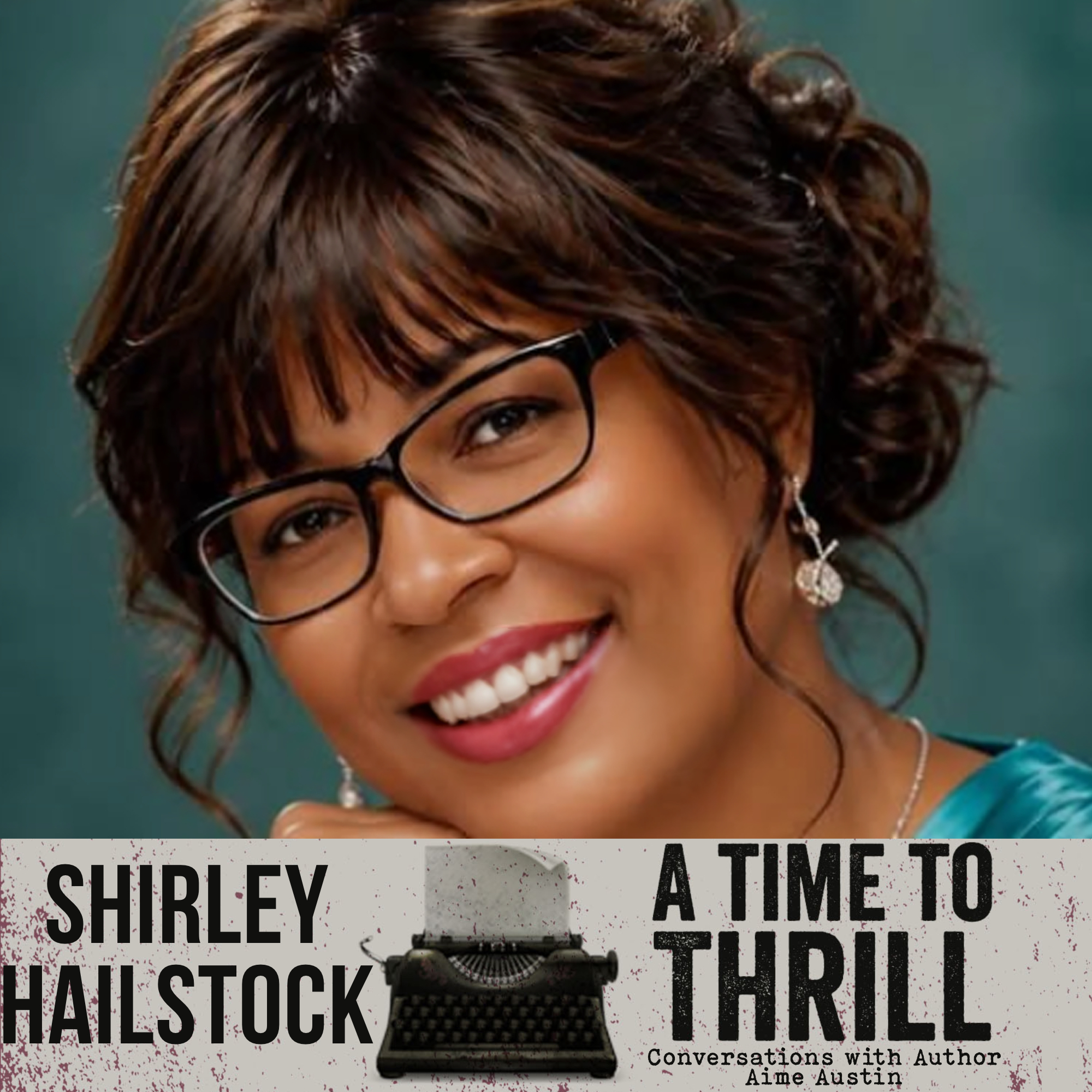
My guest this month is wonderful author Shirley Hailstock.
So to be honest, she and I did go back and forth. I don't know when I met her, but it was either in this is
[00:00:29] Speaker B: so Crazy somewhere on the east coast
[00:00:30] Speaker A: or the Pacific Northwest.
Back in like 2017, 18, 19. I used to go to a lot of writers conferences and I saw her at two different ones and we had an opportunity to sit down and chat.
[00:00:43] Speaker B: So Shirley's one of those people who
[00:00:45] Speaker A: I've admired for years for a number of reasons. One, she's one of the first.
Not first, I don't want to say that. She's an African American author who wrote for Harlequin back in a time when that was difficult for African American authors to break in. She wrote for Kimani, but she also wrote for mainstream lines. And back then, not a lot of black authors did that.
[00:01:10] Speaker B: But also.
[00:01:11] Speaker A: So we do talk a lot about that in this episode. From Kimani to.
[00:01:16] Speaker B: Okay, arabesque.
[00:01:18] Speaker A: You'd have to. This is so, so the past to like Harlequin.
[00:01:24] Speaker B: Heartwarming.
[00:01:25] Speaker A: Which is, it's. It's an interesting career span.
So we do talk a little bit about that. And it's just sort of interesting because she was able to break genre conventions fairly early on when many of many authors, especially those who wrote for series lines, were really like shoehorned narrowly into trope, word count, topic, location, like so much that.
So it's such a great conversation. I got to chit chat with her in her home on the east coast and me here in Hungary, and it was great.
I do really enjoy speaking to people who I have admired from afar, I guess, for many, many years. So I hope you enjoy that talk.
In addition, by the time this is up, I better get this correct.
I am super excited because my next book is up for pre order. It is a standalone psychological thriller called Leave at the First Lie.
Unlike many other books I've written, it takes place in Los Angeles.
So for now, Cleveland's on the back burner and we're in the forefront here in Los Angeles. My main character is a woman named Summ Morris. She lives in Los Feliz and I love her.
[00:02:51] Speaker B: She's so, you know, do with this
[00:02:55] Speaker A: what you will, but she is a woman in her 40s living in Los Angeles and facing dating in the current climate at her current age and it's just, it's, it's, it's a doozy.
I. There's so much I really enjoy about this book. It's one of my favorites and I do hope you'll consider a pre order. She Summer wrung me out. So some of you, if you're my beta readers, hey, you have read the book and have given me their opinions on it and people love Summer but hate what happens to her in this book.
So she honestly, she goes through it.
[00:03:44] Speaker B: So it's up for pre order.
[00:03:45] Speaker A: It's coming out January, I believe. 19, 20, 27 and soon. If you're on the newsletter, I should have a cover reveal up soon along with maybe chapter one. If you're not signed up for the newsletter, it's ebooks. Buzz, B, U Z Z Backslash, Amy Aimews, N, E, W S.
You can sign up. Actually, maybe I'll put a QR code up here for those of you who would like that. And there definitely will be a link in the show notes for the book, the pre order, as well as a way to sign up for the newsletter if you want all the latest information on the title.
So without further ado, I can't wait for you to enjoy this interview with romance author Shirley Hailstock.
[00:04:38] Speaker B: Hi and welcome to A Time to Thrill. It's me, your host, Amy Austin. This month I have the okay, I'm too excited. Have the absolute delight of interviewing Shirley Hailstock. Hello.
[00:04:49] Speaker C: Hello.
[00:04:50] Speaker B: How are you?
[00:04:52] Speaker C: Oh, I'm just fine. I'm glad to be here. I haven't been interviewed in a while, so this will be interesting.
[00:05:00] Speaker B: I don't think I have either, but I haven't written a book in a minute, so. So, okay, I have so many questions, but let's start with. Well, there's so many I have. Okay.
How did you start? How did you come to writing? Because it's not. It's not. It's not everybody's journey.
[00:05:18] Speaker C: I thought about this last night. Not that you would ask the question, but I usually tell people I started it on a dare. And that is true. But I didn't real. I didn't think about the fact that when I was younger, like in school and high school, that I was on a lot of writing projects. Like I was on the school newspaper and the play and skits and things that we used to do, but.
Oh, a lot. Sometime in the seven late 70s or early 80s, I was reading a book on a train with a friend from, from college and she asked me what I was Reading it was a Harlequin Romance. I didn't even know what the title was. And I still don't know. I just, like, turned the book over and shoulder. And so I go, I've read so many of these, I could write one. And so she said, I dare you. So I went home and decided I was going to write a book.
And I wrote.
Took me a year, but I wrote it longhand. Took another year to type it because we didn't have computers.
And then I let her read some of it, and she said, well, what are you going to do with this now? And it's like, now? There was no now.
But she convinced me to try to send it in. And since I wrote it as a Harlequin, I sent it to Harlequin. And no, they did not. They did not buy it.
But I did eventually sell to them years and years later.
[00:06:37] Speaker B: Okay, so wait, how many years between let's call it your dare book and the book that you first sold?
[00:06:45] Speaker C: It was only three.
Well, I don't know if it's three years. Let's say I sold the first book in 93, came out in 94, and I started writing in 89, but I had only written, like, three full books.
And the third book that I wrote was the first one to sell.
The first book never sells. I'm never going to.
It's a practice book. A lot of authors say that because you don't know you're practicing when you do it. It's just that later on it's like, it's so bad.
But it helped me learn.
[00:07:19] Speaker B: So wait, what was the second book then?
[00:07:23] Speaker C: The second book was steeped in 1975. You couldn't move it out of 1975 because it had to do with the ending of the Vietnam War.
And of course, they rejected that one, too, and explained to me that they only printed or bought contemporary books. So you couldn't set it in a time period that wasn't supposedly the present.
Because if you pick a book up now, Even if it's 10 years old, it's still supposedly the present. Or it can't be the present at that time because you couldn't write it now and set it back 10 years or however many years.
[00:08:02] Speaker B: Okay, so, okay, what was the first line that you sold to then?
[00:08:07] Speaker C: I sold to Kensington. At the time they called the line. It was a pinnacle line that already existed, but it was the African American books. And later that became.
What did they call it? Oh, Arabesque.
It became Arabesque.
[00:08:23] Speaker B: I remember.
Sorry, you Just brought back a memory.
[00:08:26] Speaker C: I haven't got bought by bet, and then BET got bought by Harlequin.
[00:08:34] Speaker B: Okay.
Oh, my God. Okay. Sorry. I haven't thought about it in a while.
Oh, that's like. That's like so many minutes ago. But I was reading so many books back then. But I remember now.
So what made you.
Well, what was your. How can I say this? What made you submit to that line as opposed to. I don't know. I don't know. I actually don't know. At the time,
[00:08:59] Speaker C: they were talking about having a line of African American books, and Monica Harris was the editor that they had hired, and she was going to be at RWA in St. Louis that year.
So I went to St. Louis and I had. I didn't have an interview with her, but I had one. I went to her workshop and I pitched my book, like, right after her workshop ended. And I went up to speak to her, and she told me, yes, I could send her the proposal.
So when I got home from the conference the next day, that proposal went out. I didn't read it. I didn't. Because if you start reading it, it's going to be six months later. This is tr it to her. She said her turnaround was 30 days because, remember, it was new.
And 30 days to the day, I got a letter asking me to send the full, and the full went out the next day.
And then two weeks later, she called and said she wanted to buy it. Okay, this is. Sounds like it's overnight, but the journey started in 89. And I wrote those books. And then in 93, my critique group kept saying, that's the book, you know, not the book. I was writing that third book that I had written. They said, that's the book. And I go, okay, guys, I'm going to edit this book and I'm going to get it ready. And that's what I did. And then I went to the conference and the book was done. It was complete. It had been at least edited by me at that time. We didn't hire outside editors before you send it to your editor.
So I sent it to her and she bought it.
[00:10:32] Speaker B: Okay, I have like 10 questions, but let's wait.
Hold on, let me think. Hold on. Give me a second to go back.
Okay. A.
Okay, you have. This is like such great confidence because almost everybody I know that got a request went home and rewrote that first chapter.
So what made you not go home? And. Okay, I'm going to read this because this is. I mean, what people do they read it and they go, okay, well, I'm just going to rework this, and then I'm just going to rework the first three, and let me just rework this synopsis. And then let me, let me, let me. And then literally six months pass.
[00:11:10] Speaker C: Well, there's a 10% rule.
You ever heard of that? The 10% rule is people go to conferences and they all get these requests. Only 10% of the people who get a request actually follow through.
[00:11:22] Speaker B: Wait, really?
[00:11:23] Speaker C: I was determined. Yes, I was determined in the 10%.
So whether she liked it or not, I mean, I had read that book and written that book and gone through my critique group with that book so many times. I wasn't even writing that book. I was writing. I was working on another book.
And then, you know, so, okay, I'm gonna send. I'm gonna send it in. But I know that if I start to read this, I'm gonna change stuff.
So let it go as it is. If she likes it, she likes it. If she wants me to change something, then I'll change it.
But I liked it the way it was, and that's the way it turned out.
[00:12:03] Speaker B: Okay, that's amazing. I'm gonna be honest. That's amazing. Okay, I'm surprised with the 10%, because every. Every request I did send. Did I do it immediately? I can't answer that.
[00:12:12] Speaker C: Let's not discuss it.
[00:12:13] Speaker B: I actually don't know.
[00:12:13] Speaker C: I'd have to really do them immediately because the.
You know, the. The. At the time and even now, I'm sure the same is true. Things change so fast that what they were interested in three months ago, they may no longer be interested in now. So strike while the iron's hot, because I'm usually at the end of that. It's cold by the time I get around to it.
[00:12:36] Speaker B: This is true.
[00:12:37] Speaker C: So I didn't want to. I don't. I don't want to pass up any opportunity that's there.
[00:12:41] Speaker B: Okay, so what was the title of
[00:12:44] Speaker C: the book I put it. I had. My title was Protect My Love.
I can't remember what they changed it to.
There was something with the word love in it, but I've since changed it to under the Sheets. When I got the rights back and I republished it, I. I changed the title to under the Sheets.
But it says there, in case somebody has already read it, that it was previously published as whatever the title was that Kensington gave me. I should look that up. But it's been so long, so many books later.
[00:13:20] Speaker B: No, I'm on book 51. I will only say this. I have a spreadsheet, so that way I can look it up. To be frank, because I just don't remember.
I do have a spreadsheet, so that's actually the answer. I just look it up.
[00:13:30] Speaker C: It's not open on my computer.
[00:13:32] Speaker B: No, no, no, it's okay. No, I do that. But I do keep a spreadsheet because sometimes I think, what was it called? And I'm like, I.
The memory is long gone.
[00:13:42] Speaker C: Yeah, I never thought I would forget that. I even used to know my ISBN number.
[00:13:47] Speaker B: Okay.
Okay. I used to memorize people.
[00:13:51] Speaker C: I don't remember that now either.
[00:13:54] Speaker B: Okay, so what. Wait. What RWA chapter were you in at that time?
[00:13:59] Speaker C: New Jersey. I'm still in the New Jersey chapter.
[00:14:02] Speaker B: Okay.
[00:14:02] Speaker C: We only actually have one romance chapter. Well, actually, we had one RWA chapter in New Jersey, but they disaffiliated, so now there are none that are affiliated. But, you know, members still are members of rwa. Just not everybody has to be a member of rwa.
[00:14:22] Speaker B: Okay. Oh, that's different. Okay. I haven't been out in the world because in Southern California, one is still affiliated and the other one is not. But that's.
Whatever. That's local politics.
[00:14:34] Speaker A: So.
[00:14:35] Speaker B: Okay, then. Okay, so after that, the book that you were writing with your critique group, did you immediately turn around and say, I have another book?
[00:14:43] Speaker C: Yes, I told the editor, because they asked me for another one, and I wrote a historical. I told her I had an idea for a historical novel, and they did publish that. That was Clara's promise. But after that, they didn't want any more historicals. They only wanted the line to be contemporary.
So the rest of my books were all either straight romances or romantic suspense.
[00:15:05] Speaker B: Okay, so the Clara's promise. So what? Okay.
When I first publishing, you could not stray. So how did you end up? Was the historical in a different line or.
[00:15:17] Speaker C: No? Oh, it was still under Pinnacle at that time, before it became Marabeth.
Okay. I could think they were still experimenting with a lot of different kinds of books, which was really wonderful that there was no set guidelines that are strict that you have to follow. And I didn't think they would go for the historical, but she said, yes, send it to me. And I was currently writing it. So I finished it and sent it in, and they accepted that one also. But later, like I said, the next books after that were all contemporary, so.
[00:15:53] Speaker B: Okay, let's go back. So the reason I'd actually asked you about the chapter, because I wanted to know how they celebrated back then because we used to have all these different markers and milestones for celebrations of publication, which were great, actually.
[00:16:06] Speaker C: They were great. We had flowers. They sent you flowers. There was like a big. To do with. At any meeting that we went to when somebody got published.
Strangely enough, I got published the night before our conference.
[00:16:24] Speaker A: Oh.
[00:16:24] Speaker C: So it was like going to a party where I was the star.
Everybody wanted to touch me, wanted to ask me questions, wanted to congratulate and, you know, and it was just really a whirlwind. And the thing I really remember about it is that I talked so much I didn't get to eat. I was starving by the time I got.
[00:16:49] Speaker B: Oh, my God.
[00:16:49] Speaker C: That's.
[00:16:50] Speaker B: That's. Oh.
[00:16:51] Speaker C: But I wouldn't give it up. It was such a great. A great night. And there were some, you know, very popular authors there who, you know, same thing. People that I never thought I'd even meet because, of course, I was reading their books. And here they were standing in front of me, shaking my hand.
[00:17:08] Speaker B: No, it's the. I. There's some things I miss about that era, but I can't. Well, we can't not. We can go back, but I remember. I remember I like the. I liked women celebrating other women. It was really delightful to be in those rooms. So, okay, so were you then. Did you consistently publish after that? Even given the endless. How can we say this? The coming and going and buying and selling of lines, imprints, you know, I did.
[00:17:36] Speaker C: I continually had.
Had at least one book a year, but mostly I had either two books and a novella in one year, which is how I ended up with now being on book number 51.
Kensington is really a good. A good place. They consistently publish you if you, you know, if your books are selling. I'm sure. I don't know about. Your books are not selling very well. But since the. The Arabesque authors who came in initially had contract after contract that just kept us in print.
When we moved to bet, it was basically the same thing at Harlequin. The. The Arabesque line was sort of phased out and they were. They were doing the Kymani line.
So the Kamani line had very strict guidelines like Harlequin does, so the books could only be a certain length.
And there was.
There wasn't any kind of heat restrictions or anything like that. But it's a category romance, so you're writing a category romance. You're not writing a romantic suspense novel. You're not writing any magic or. Not that I ever did that for them, but there were authors who did. There was no paranormal in the line. It was just straight contemporary romance.
So when you were great.
[00:19:01] Speaker B: No, I. Well, I. I was a line reader. So I like. I like. I like Elaine, to be frank. But when you were, you know. So I had my lines, and those are the books I'd pick up every month. But when you were writing. Okay, so then. Well, then how many arabesque books did you end up writing?
Or the pinnacle?
[00:19:21] Speaker C: I don't know. I never. I actually never did that as a. As a count.
But let's see. I guess arabesque existed for.
From 93, because I think the first books came out in 93.
And then. I don't know. I remember. I don't remember when Harlequin bought it.
So I would have to go to my spreadsheet and look that up.
[00:19:49] Speaker B: Okay, wait, I forgot.
[00:19:52] Speaker C: I'd say there were at least 10 or 15, because I know once they bought the line, When I got 25 books, they. They put them all under Harlequin.
And then you get a. You get a pin.
A little jewel pen. It has different. Different levels. Like, if 25 is one color with type pen, 50 is a different. I think by the. The diamond is like maybe 100.
So I take my pen from there. I think it's a ruby. Okay. It's beautiful.
[00:20:27] Speaker B: Okay, wait. So wait, let me go back. The friend who dared you.
What did she end up saying after all of this?
And did you dedicate a book to her?
[00:20:39] Speaker C: I think so, yes. I think the first one dedicated to her. She was the catalyst for me to write, or at least write the first book, not the first sale.
She reads them all. We. We're still, you know, friends. We still get together regularly. She lives in New York, I live in New Jersey, so we're not that far apart.
But we'll go get together and go to the theater or have dinner or just, you know, one of the holidays, I might go up, she'll have, like, a backyard barbecue, and she'll come down here. So. Yeah, we're still friends after all these years.
[00:21:15] Speaker B: Oh, my gosh. Okay. That's the fact.
[00:21:16] Speaker C: She's not a writer. She's not a writer. She was actually a cook and she was a paralegal at her job. And on the side, she went to France to learn baking and those kind of. She does. She has a business where she sells baked goods.
[00:21:32] Speaker B: Okay.
[00:21:32] Speaker C: Now that she's retired from the federal government.
[00:21:37] Speaker B: Oh, my God. That's a. That's okay. I love that story. We should all Have a friend.
Because it's like such a.
I'm glad that she encouraged you in the way that she did. I mean, that's a. That. That's pretty amazing.
Okay, so what was there. Was it harder? I mean, but this time you'd been writing some time. Was it harder to write within the Kymani guidelines? Because I. The one thing I think I didn't like about commodities. And this is back. Oh, my God.
This is. Okay. There used to. It used to be separate, but once they were all bought because there were, like, all these different things out there, and then they were all consolidated. I think they were too short.
[00:22:16] Speaker C: Well, they were. They were considered categories, and categories are only about 200 pages or less. I think these were 225 pages or maybe 250 pages in each book, so that they were uniform where arabesque weren't. My arabesque books were, like, 120,000 words, where somebody else's Arabesque books might have been 75,000 words.
[00:22:38] Speaker B: And actually, I will say this. I did like lines like that better because I think some stories are served by different word counts, and I had to.
[00:22:47] Speaker C: Well, if you have a suspense plot, there's something else going on other than the. The romance, where the romance is still going to be central to the story.
They have a issue or a problem that they have to resolve, and that was part of the suspense element.
[00:23:07] Speaker B: Okay, so.
Okay, so then when did you start
[00:23:10] Speaker C: writing suspense at the same time? The first book was a romantic suspense.
[00:23:16] Speaker B: Oh.
[00:23:16] Speaker C: The one that's under the sheets now is a romantic suspense about a woman who's in the witness protection program, and she has to get in touch with her ex husband who thinks she's dead because their daughter that he does not know about needs a blood transfusion.
[00:23:33] Speaker B: Oh, my God. So you have secret. Okay. All the tropes.
Okay, okay.
And so.
[00:23:41] Speaker A: So they.
[00:23:42] Speaker B: And at that time, I guess with the experimenting, because some lines are so rigid, like, it's only suspense, or it's only contemporary. It's only paranormal. It's only vampires, or it's only. Whatever the other element is, if there is any other element, is very, very specific.
So you're able to be more.
[00:24:01] Speaker C: I think that, like Creative Kensington did, they didn't restrict us to everybody write the same kind of story, even though all those stories would be different because different people are doing them. But, you know, at the time, the. The experimental. I don't want to use that word. But the differences that people would bring to their writing and to their stories was not all.
Everybody equals the same thing. Everybody is doing whatever they want to do in their storytelling. So some people did write straight contemporaries, and some people wrote suspense. Nobody wrote a straight mystery because it was a line.
I do remember reading a very thick paranormal. I think there were vampires in it. And of course, this was before.
What was the name of that movie?
[00:24:56] Speaker B: Twilight.
[00:24:58] Speaker C: Twilight, yes. This is before Twilight.
[00:25:00] Speaker B: Okay, so. Okay, then I have a different question. What?
Hold on. I have, like, two questions battling in my head.
Okay.
Okay, let me ask you about this. What did you read as a child? And that's the second one later.
[00:25:23] Speaker C: Ah, I don't. I. I read a lot of.
There were teenage romances at the time. That's the ones I can remember.
I don't remember children's books. Like, all the books that people said they read as a child or their parents read to them. I don't remember any of those. But I remember going to the library and reading these books by Rosamund the Jordan, that was the author. And they were.
They were like high school students. When I was in grade school, I was probably 10 or 12, and these were high school students. And strangely enough, I think the guy's name was Ambrosia Ambrose, because Ambrosia is a food. His name was Ambrose. I couldn't remember. But they were a series. Like, those were the two characters in, like, a lot of those books. So after I read all of those, the librarian suggested that I read some biographies. And so she took me to that section of the library, and I read a lot about founding fathers and different people who were. Who had done significant things in inventions and whatever. George Washington Carver and the sweet potatoes, the peanut farmers, you know, all of those. And then, you know, the guy who invented the traffic lights and the one who invented dynamite, you know, it was. It was very interesting. And so I went through a lot of those books. And then by the time I got to high school, I was in my thick book area, which means the book had to weigh, like, 10 pounds for me to read it.
So I can remember. I read Exodus and Warsaw Ghetto, and I read Anatomy of a Murder.
[00:27:06] Speaker B: Oh, wow.
[00:27:07] Speaker C: All of these heavy books, but I enjoyed them.
[00:27:12] Speaker B: Is it because you wanted to.
Is it because you wanted to stay in the story longer? Because I remember when I was younger, I had a lot more time, obviously, but I remember when I was younger, like, I wanted to exist in that world for a longer period of time.
[00:27:28] Speaker C: I don't. I don't think that was it. I just think that I enjoyed reading. And it seems like the more the better.
So I don't know. I, I picked up the book Exodus because there was a. The movie with Exodus was already out and it wasn't popular. I mean, it had been out. I think they wrote that book came out. I mean, that movie was in the 50s.
I don't know when they, they made it, but it was definitely a TV movie by then. And so I, I picked the book up just because of, I had heard of it, I had not seen the movie.
So I read that book and it was like, just engrossing.
And then that was, I guess, the first time I decided, okay, I want to read more, more by this author. That was the first time I had ever done that, other than reading Rosamund de Jordani. I also read Grace Kingston Hill and, you know, and Katy King comic books, Archie comic books, but they were, it was like, it was like an eye opening thing to read this whole story and not get bored.
Not at the time. I don't think I'd ever been bored with a book.
And if I started a book, I finished it.
Now I don't do that. I don't.
Too many books, too little time.
[00:28:45] Speaker B: I think, I don't know when it was. I think I was in graduate school and at some point I looked up and I thought, oh, I'm not going to live forever. So I think I only want to read books I like.
I don't know. And I was like, oh, I think I'm done with that. So it took me a few years to not be a finisher. But my friend and I were just discussing this. We were, we're having a long conversation about book recommendations and neither one of us is a finisher anymore, but we used to be, like maybe 20, 30 years ago. I, if I picked it up, I was going to finish it and I would loudly complain to everyone around me, you know, and, and then she did, and everybody was like, you know, you know, you can put it down. Like, well, no, I've already, I've committed.
[00:29:30] Speaker C: That's right. I committed to it.
No, I don't do that anymore.
[00:29:34] Speaker B: I no longer committed to anything.
[00:29:36] Speaker C: But don't you grab my attention by page 50, I'm done.
[00:29:39] Speaker B: Oh, you're so much.
[00:29:40] Speaker C: That's a lot of pages.
[00:29:42] Speaker B: That is. I just started a book two days ago. I finished a book. I finally finished a book. I've had a long summer of not finishing books. I finished a book. I'm like, this is great. I'm gonna like start another one. And now I just, I actually just Went to the library this morning and borrowed three. And I was like, okay, tonight one of these three is gonna have to hit because.
But I.
I struggle and I'm not actually sure why. So what do you read now?
[00:30:10] Speaker C: What am I reading now?
[00:30:11] Speaker B: I mean, like genre wise?
[00:30:14] Speaker C: Oh, I really still read a lot of romance.
It's satisfying, I like it, I write it. But I. I also read a lot of.
I'm in a book club, so of course we get literary books that I usually don't like. A whole lot of those.
Every now and then there's one that I do or a couple that I do. But I like to read.
I like to read Dean Kunst and Stephen King.
They don't. They don't write. They write horror, but now it's more either supernatural or even just suspenseful.
And those are very, very good. I read Sandra Brown. I read Felicia Mason and Donna Hill.
A lot of.
Just a lot of variety of authors. And as we have grown and gotten older, a lot of our books are now different. They're not the totally straight romances. They may have a lot more depth, especially in Donna Hill's books. I have noticed that and I enjoy them a lot.
But still my go to people that I've been reading for years and have collections of their book.
I still read those, but I will look for a new author too. At the moment, I'm reading a person I've never read before.
It's Dorinda Jones. Her first book was First Grave to the Right, right? Yeah, Paranormal. And not usually my go to list, but I heard her speak at the conference this year and she was so interesting that I actually wanted to read her book. And it's very interesting. You know, it's like I read it at night and it's like, I don't want to go to sleep. I just want to go to the next chapter.
So it's very, very good.
I see why I haven't read it.
[00:32:04] Speaker B: I know the title. I haven't read it because I don't read Paranormal generally. And I don't either.
I applaud you for reading Stephen King. I read one book and when I was a teenager and I didn't sleep and I don't read anything where I can't sleep. I don't want nightmares. I can't have bad dreams. I can't have to close my door, be looking around the corner, you know, thinking the dog is out to get me.
[00:32:29] Speaker C: Yeah, I have that. I have that. I don't have. I don't have that anymore. But with his Salem's Lot.
When I discovered that I was reading about vampires, I went, oh, heck, I don't. I don't believe in vampires. By the end of the book, I'm sleeping with the light on.
[00:32:48] Speaker B: I don't. I think I read.
I read the Shining. I remember read the Shining. And like, I can't. Like, I still walk down hotel corridors with a little bit of a feeling,
[00:32:59] Speaker C: anyway, about it. I. My. My favorite book of his was the Stand. And. And people usually ask me, what book or what did you read that changed your life? And I always say it's that book. Because when reading that book, the subtext of the book is in your life, you are going to have to make a stand somewhere. You're going to have to stand up for something. And that was the book that told me I had to do that.
[00:33:26] Speaker B: That's so interesting. People have recommended. I read it, but I don't read. I can't read horror. So I just. I will.
[00:33:32] Speaker C: Yeah.
[00:33:32] Speaker B: And I don't actually watch movies either because the visual is even worse, like, for me. So I.
[00:33:36] Speaker C: That, that is true. That is true. I'd read the book when I.
Long before I saw the movie.
[00:33:43] Speaker B: I feel like it came out in the mid-80s, but I couldn't.
[00:33:45] Speaker C: I don't think they had made the movie by the time.
[00:33:47] Speaker B: Oh, yeah, I know. That's true. That's true.
Okay, that's. That's brave of you. I.
Yeah, no, no, never.
[00:33:56] Speaker C: I like wedding books. I like.
I like forced proximity books.
[00:34:02] Speaker B: Okay. That's one of my absolute favorites is force proximity. If you want to put. You can just put them in a cabin and then maybe have some snow or something. I'm all in. Because I just feel like it's a mirror. Like it. You can't escape the thing that you need to face. I don't know why. I love that. I love that. I just. Oh, my God.
[00:34:18] Speaker C: I love that they're making a stand.
[00:34:21] Speaker B: Maybe it's that and Friends to Lovers. Those are my two.
[00:34:26] Speaker C: I like Friends to Lovers.
I like.
Well, I guess that's forced proximity. When you have the.
The ones who. Basically the bride mail or the bride type type books. That's forced proximity. So I kind of like those.
No, I haven't seen one of those in a long time. But then, of course, mail order rises. Kind of like not a thing that's contemporary.
[00:34:51] Speaker B: I don't think so. I think they're mostly historical because I. The only person I know who writes them is Deborah. And I don't know I don't even know like the. Actually I don't even know if she's still writing them. I mean, I know she's still writing her books in Montana. I just don't know if she's still writing those.
So.
Okay, wait. Okay, I'm gonna ask you this and I'm gonna go back. Do you like Enemies to Lovers? I don't know why I'm asking you this, actually. It's the only thing I don't like. And I don't. I've never been able to get over it because I usually. What I have found is that usually the author makes one of them unlikable and I can't get past it.
The other character can. And I'm like, nah, I'm out.
[00:35:29] Speaker C: You know, sometimes they're just doing it for spite. But it's more like that high school thing when the guy really likes you and you really like him, but you guys just sabotage each other.
That's the kind of friends to love. Enemies to lovers, because they were never really enemies.
But I have read books where the, the usually it was the hero was so unlikable that. Who wants to fall in love with you?
[00:35:52] Speaker B: I. That's what I was thinking. I was like, that.
[00:35:54] Speaker C: I'm very like, I'm done with that. If I can't, if I don't, if I don't like somebody, one of the characters and I can never get into a reason why they're doing what they're doing. Just like, I'm done with this book.
[00:36:07] Speaker B: Although I did just.
[00:36:08] Speaker C: There was one book, I read 75% of the book and I. And I looked at it and go, you know, I don't care about anybody in this book. And I stopped reading it.
[00:36:16] Speaker B: I will say I actually finished a book like this last week, but this is one of my friends and I were talking about. And she's like, what is going on? I'm like, I don't like anyone. And she's like, why are you reading it? I'm like, well, I'm gonna go visit this studio. So I'm just gonna have this long. I had a long ride, bus ride. And I was like, I'm gonna go visit this artists in their studio. So I'm just going to finish it because I wanted. The end was supposed to be a huge spoiler. And so I got to the end and I was like, wow, I still don't like.
And the thing is, like, somebody had recommended the book once and I guess I picked it up and put it down this. I Didn't remember. But then somebody else recommended it. I picked it up in the. I had highlighted part of the Kindle which means I had read it but I completely forgotten all about it. And I was like, well, I obviously
[00:36:58] Speaker C: got halfway through and didn't finish it
[00:37:02] Speaker B: although the quotes were very good. But I did the book.
[00:37:05] Speaker C: Okay. Anyway, I'm off that.
[00:37:07] Speaker B: I just, I struggle. I used to enjoy reading more when I was younger, I think and I'm not sure why. I do sometimes wonder about that. I don't know if books have changed or I have changed. That's what I can't figure out.
[00:37:19] Speaker C: Well, I'm sure both of us, both of those have happened.
I still like reading. I like going off into that world someplace else. And I'm also not a person who. Where noise bothers me. I can read anywhere and I would not even hear siren because I would just be so into wherever that world was and concentrating on whatever thing they were doing that my surroundings. Of course unless I was in New York, I wouldn't be aware of. But if I'm outside, I'm always aware of my surroundings. That's interesting.
[00:38:00] Speaker B: So are you, are you reading non fiction then as well? Because I do. I find myself actually reading a lot of nonfiction lately.
[00:38:08] Speaker C: No, I read nonfiction for, for research and sometimes for interest but most mostly it's research.
I remember once reading book about Indians was the Indian's name and just because I was on a long trip and we had tapes to put in, you know, put in a tape drive and I was driving alone so I said okay, let me read this book.
And it was extremely interesting and not something I would ever sit down and hold open and go page by page.
But while I was in the car on an eight hour trip, I up and back, I read the whole book. It was that long. I think it had 20, 25 tapes. It was huge. I remember I was listening like that too. It comes in volumes so I mean you might have seen that. What's it called, that Forsyth woman or something. That's only like a small chapter in that volume of books.
[00:39:14] Speaker B: Okay, so, so okay, sorry. I got a sidetracked by reading because I, I still talk about it all the time with people. I can't believe I do.
This was my friend. I had a very long conversation and then I was like okay, just read this and then we'll talk about it but read this other book and then
[00:39:28] Speaker C: we can discuss that as well.
[00:39:31] Speaker B: What?
Okay, so how did the change in publishing especially like for me it's 2010 to 2012. Did the change in publishing change how your career went or change your career? I guess.
Well, the change to digital.
[00:39:49] Speaker C: The independent revolution.
[00:39:50] Speaker B: Well, either that or digital. I mean they were simultaneous and I assume the, the digital, I mean the digital fed the independent. But the digital look, I'm sitting in rwa.
Oh, you think so?
[00:40:01] Speaker C: I think, I think the independent people who, well, they were digital books because they were ebooks that we could put up ourselves on the various E tailors, I think that changed a lot in that before we would have all called that vanity press and it would be looked down on. But then it became legitimate and people, authors, you know, made it more legitimate by going through the sources that, that their publishers went through. So, okay, I turn my book in, it gets an edit, it gets a copy edit, it gets a V.
The other one.
[00:40:37] Speaker B: Oh, proofread, yeah.
[00:40:38] Speaker C: Or for me, not the proofread is one. But it gets all of these steps that it goes through. So authors started doing those steps too so that they could produce the best that they could do.
And they didn't have, they didn't want to say, shoot themselves in the foot because if you put out a bad product then people aren't going to read it again. It's like, oh, like us when we were saying, okay, I didn't like that book, I'm stopped reading it and I'm not reading this author again.
And you. So they didn't want to do that. And then some of the big name authors did it almost first.
And that just led the way for a lot of other people. It also led the way for a lot of people to put up junk.
And while we would have workshops that says, you know, you could have written the best book in the world, but your book is out there in the middle of the pool with all of the books that are not good. So people may not ever find your book that had, that I believe has changed. I think more of the books that are out there, if they're not written by AI, which is totally different subject, if they're not, if they're still written by the human, they're, they're making them, they're trying to, to do all the steps that, that we need to get done to produce the best product we can do, we can do and make our readers happy.
So I, I think yes, publishing has changed. I also think that publishing, you know, big box type publishing was slow to get on the train.
The, so the romance writers, I mean the other genre writers are also not in the same level that the romance writers did because we were so used to doing our own promotion and taking control of our own careers that when independent publishing came up, it's like, let's try it, let's see if it works. So we got rights back to our books that had been edited. Everything was done. The only thing we could not do was we couldn't use the blurb on the back. We couldn't use the COVID copy that was there. So those are things that you had to have done by yourself or someone else. So since most of us are not creative cover, you know, designers or so we found people, artists who would do that for us. Then we found. So now those could be put up even if you had to. Like the contemporary authors were the ones that had to go in and update their books. Yeah, historical authors didn't because it's history, it's still there.
But we had to take out telephone booths and, you know, eight track tapes and things like that.
[00:43:19] Speaker B: Film.
[00:43:19] Speaker C: Now, because nobody has film. I think there's probably only two or three people, two or three companies in the world that still develop film.
And so a lot of that had to be done or some authors chose not to do it. And just to make a, a note to readers that this book was written in the year, whatever and it has all of the elements that were available in that year.
So somebody might be looking for a phone booth or have no cell phone, but I went into mine and I updated them to the current technology. But that technology is just going to change.
So, you know, if you, you pick it up 10 years from now, we may have, you know, devices that are planted in our head like they did on Star Trek, some science fiction story.
But definitely, I think publishing has changed and now where we are, to take that one step further, I think a lot people, a lot more people now are going back to those publishers. Interesting because they have found how much work is involved in producing a book and getting it there, getting it out there and how much work they have to do. And if they don't have enough hands, people that they have to pay to do certain steps for them, then it becomes, you know, it becomes one of those things of like, I don't want to do this, I just want to write.
[00:44:46] Speaker B: That's oh so many. It's. These are conversations I have often.
So what, so when did you take a, when did you dip your toe Into Independent Publishing? First?
[00:44:57] Speaker C: I think it was 2011.
[00:45:00] Speaker B: Oh, so really early.
[00:45:01] Speaker C: Yeah, well, it was, it was the year that Jeff Bezos made the Kindle. The Christmas gift of the year.
So everybody got their person, their friend, their wife, their lover, whatever, a Kindle. And there was no content out there.
So those people who had content out there were the ones who become the best sellers. Because even if it wasn't that good a content, it went on my machine and then all the free books came out, which, you know, totally different story on the free books. But, you know, people started saying, okay, there's thousands, hundred thousand Kindles out there, let's give them something to put on it.
And so authors started to up to do it there. And I had another friend who was doing it and they said they were making like a thousand dollars a month. So it's like, sure, I got the rights back to some of my books. Let me go see how to put these up. And it, it was a learning curve.
It's easier now because there's a lot of videos where people tell you how
[00:46:04] Speaker B: to do it and way better software. I hand coded a book in 2012. I'm not even going to get into
[00:46:09] Speaker C: it, but yeah, I did too. I did too. Putting in the little, little brackets with the words in it and what's a bold? What's italics? I can't, you know, and then having it.
[00:46:20] Speaker B: Well, I did it.
[00:46:21] Speaker C: I sat in my office and did.
[00:46:22] Speaker B: I don't know what to say. I sat in my. Because I was like, well, what is the barrier between. Because I got my rights back. And I was like, so all I have is the raw copy. Or they sent me the epub, which. And I was like, so I'm between here and there. And how do I get from here
[00:46:33] Speaker C: to there to me, I had to actually scan page after page. Page, Tear the book apart, scan page after page and. And then take out all of the scanning errors.
Took hours.
[00:46:47] Speaker B: I know people who did that. It was.
Although scanning is probably better now, I know people who did that. It was people who had like hundreds of thousands. It was a nightmare. Anyway, that's. It was. It was an unpleasant task because I helped someone once and I was like, oh, this is.
[00:47:01] Speaker C: Oh, this is. Oh, now there's a service. You know, like I said, times have changed. There's a service that I've used that will give you back a file that is like 90, 95% clean.
And then you have to clean up the rest of it, but that can only take you an hour maybe, as opposed to taking all those hours to just do one book anyway.
[00:47:25] Speaker B: So wait, do you still have all the original copies of the original books?
[00:47:29] Speaker C: Yes.
[00:47:30] Speaker B: Okay, have it okay, the paper.
[00:47:33] Speaker C: Yeah, yeah, yeah, the paper copy. Yes. I, I, I said I was going to keep five copies of each book, but then sometimes they would send me a whole box and I didn't get, I haven't gotten rid of it.
I would send them to reviewers and other, you know, sometimes with, with press kits that we used to send out for interviews.
Haven't done that in a while. So I have some, I have copies of all the books that came out in print.
Some of the, some of my books, later books were digital first, but the, the publisher still sent me print copies that you could use for reviews and couldn't, you know, some of them I just gave away at conferences when I had some left left over.
[00:48:23] Speaker B: I remember, I think the last time I published, traditionally, I think they only sent five. Although I should say this, the last one, I actually only got one.
[00:48:31] Speaker C: And I was like, oh, no, I got like a box, whatever. Sometimes the box only held 48.
And then there were times when I got two boxes that were like 96.
[00:48:44] Speaker B: Okay, those are the, those were the days I, I actually looking. The last one is one one. I was like, I thought there were two, but okay, I'll take the one.
[00:48:54] Speaker C: It was usually a foreign edition.
Usually they would send me three of those. Sometimes I, I like that I only got one, and it was in whatever language it's in, and I can't read that.
But I was appreciative knowing that they sold it there.
[00:49:12] Speaker B: Wait, so how many books did you. Wait, are you somebody who got the rights back to all of your titles, or.
[00:49:17] Speaker C: No, just about all of them. I mean, there are some that are still in Harlequin that were coming out from Heartwarming, which is the line that I write for.
So they may have the last five or six books that I wrote for them, but all the rest of them from three different publishers have given me the rights back.
[00:49:39] Speaker B: So, okay, so what was the, what were the. I don't say rules?
What were the guidelines for Heartwarming?
[00:49:49] Speaker C: Okay, Heartwarming has no sex in the books. They don't have a closed door. You don't even get to a door. It's more like reading an inspirational without the God element in it.
So the characters, you know, touch, dance, they can even kiss occasionally, but they don't have a whole lot of sexual, sexual suspense going on.
It's a, you know, you can't have subplots because it's like 80,000 words to those books. They're, they're more like home and family. You're building a family. You're in a family.
It's. It could be set anything anywhere in that. You could have it on a ranch. You can have it. Well, they do small towns a lot. I don't think they like urban cities very much.
I did turn in one that was taking place in New York City and the person came from a small town, but she was visiting New York and they didn't want that one. And I think it was the urban setting that.
But that's basically. Basically they're contemporary romances that are wholesome. That's the word they use. I think they're using.
They were using clean and something clean and wholesome. People didn't like the word clean.
[00:51:13] Speaker B: Yeah.
[00:51:14] Speaker C: Because it seemed like there was like no romance to the story.
And they weren't like the old Harlequin romances where they fight. 487 pages and then they get married.
[00:51:29] Speaker B: Okay, that's the first.
That's the first one I read as a child.
I keep it on the shelf because, yeah, they were fighting, fighting, fighting, fighting. And he's like, you know, that means I love you. And I was like, wait, what happened?
[00:51:45] Speaker C: Wait, Yeah, I read a lot of those. My roommates were read them and I didn't. I was still reading the 30 pounders.
And so I came home from work one day, there was nobody there and there was all these books looking around. And the book was Satin Straps by Ann Hampson. I still remember.
[00:52:04] Speaker B: Oh, my God.
[00:52:04] Speaker C: Okay, I sat down and I started to read it and I didn't move. It only took a couple hours to read it because only 188 pages. So I was reading. They came in, I go, you know, this is a really good book.
So that's when I started reading them. And they were truly addictive. You know, you.
I can remember going to the store and buying books and still food, like, oh, I can get. I already got. I got something at home. I can eat.
I need this book instead.
And so we would read them and then exchange them with other readers.
[00:52:42] Speaker B: So what made you. So what made you write for the Heartwarming Line? I mean, what led to that? Because these are all very.
[00:52:49] Speaker C: I mean, when they started the line up, they were looking for writers and I went to a mixer that they were having where they were talking about it. And so the director of the line, the executive director of the line, I told her about my two ideas.
When I got home, she sent me an email and said she would like to see both of them.
So I sent them to her and she Bought both of them.
So that's how I got into writing Heartwarming.
I was also writing the Kymani's at the same time, but they kind of didn't write so many of those because then I would write the Heartwarming.
But now I'm back to writing, you know, books that have more sensuality to them. I would say it does have sex scenes. It does have consummated sex. And so there are these standard romances, contemporary romances that I'd written all those other times.
[00:53:59] Speaker B: Is that your favorite?
[00:53:59] Speaker C: The other one was just.
[00:54:01] Speaker B: Are those your favorite to write then?
[00:54:03] Speaker C: My favorite's romantic suspense. I. I love that element of something dangerous going on in addition to them falling in love and just give them something to go that. That they're on the opposite side of. And. And it's your. It's your external piece, not your internal. So wait, there's always something.
[00:54:25] Speaker B: So let me just ask you this. This is the first time I've ever thought about this. So is romantic soc spins essentially forced proximity because there's an external force that's driving them to stay together, to do.
To defeat the thing or to do the thing.
[00:54:40] Speaker C: But isn't that true of, like, all romance?
They're all being pushed together for something. Even if they don't have that element of suspense, they're still together just about every scene in the book.
[00:54:54] Speaker B: I. This is true. But I will say this. Like the first couple. I'm gonna have to think about this later. The first couple of contemporary romances I wrote, there had to be a reason for them to be together. And that was more. That was. That was a harder part. So the. Whether it was like the pursuer pursuing, but even when they had a big black moment, you're like, well, these people could just go their separate ways and
[00:55:16] Speaker C: call it a day.
[00:55:18] Speaker B: And then I. Then there was some reason that they had to come back together in. That was always for me, like. Well, one of my first books, it was pregnancy, so that was easy. But, you know, like, secret baby.
[00:55:29] Speaker C: I guess it could be. It could be because I had one that it was like a chase book. They were running and then they have to stop and make a stand.
And so they were together all the time. And in places where it was just the two of them because they couldn't be around anybody else or be found out by somebody or, you know, there was. I never. I rarely. I don't think I ever actually had a TV reporter or some kind of reporter trailing anyone.
But I did have the bad guys that were closing in.
[00:56:03] Speaker B: Yeah.
Bad guys closing in. I'm gonna. Now I'm gonna think about it more.
Well, okay, I'm not gonna think about this right now because I wouldn't kept them together. I actually. I think mostly it was pursuers. Like, you know. Well, I know you don't think you want this relationship, but I'm gonna keep pursuing you. I'm gonna fly to this other country and keep pursuing you. But. Okay, I'm gonna think more about it, but on my own time.
[00:56:28] Speaker C: Yeah, I'm gonna think about that.
[00:56:32] Speaker B: No, it's just. I had never considered it. So what are you. What. What do you want your writing future to be?
[00:56:43] Speaker C: Well, I wish I could write more books faster.
I still like going through, like I said, the romantic suspense.
I do have some things where I use some little magic in it, and they're fun, but they're usually short. They're usually novellas. And that's. That's a thing for me. It's not. I don't. I don't. I'm not doing it for a publisher.
I guess I would like to do a big book. I mean, a blockbuster book. The book that burst on the scene as if it had. As if that plot had never been there. And we know they're all there all the time, the same ones. So that's really what I like. I'd like a best seller.
And I have a. I have a couple books that are complete that I do think fit that bill. I just haven't found an editor or publisher for them, and they're not. I don't. I don't want to do any self publishing on it because I don't think I can make the reach.
I need somebody who knows how to.
How to position this thing and not just throw it up on Amazon or Kobo or Apple and let it, you know, sink or swim. I want somebody out there who knows how to swim.
[00:57:59] Speaker B: Oh, that's so interesting, because I have a similar book that I was thinking about when I was brushing my teeth, which is not good. But I was thinking about today, and it was not the book of my heart. I'm not gonna say all that because it's not that book. I think I wrote that book years ago. I think it's something. I like the hook enough that I want to have a much bigger reach than I could have.
Kind of a book club book. And it's something I spend. Actually, I've done a lot of submissions on it to no avail. But I. It's so. I still haven't published it. My friend calls them books on your hard drive, you know, but I have, you know, there's books on my hard drive that are. She's like, you're not monetizing the books on your hard drive. And I'm like, that is indeed true. I do have books on the hard drive that are not monetized. But I do have that same feeling that I would want those books to reach a bigger audience because I think it's a bigger story. But I don't know.
It's not 10 years ago, it's not 15 years ago. So that's a. It's. It's a different world. And I haven't, I haven't figured it out yet. Personally.
[00:59:02] Speaker C: I still think these, these kind of books need editor. I need agents because the publishers that they go to don't accept an agent unsolicited submissions. So every now and then I, I follow a lead that I might come across my screen somewhere about or I'll see a book that is kind of like mine.
Okay, who is the agent on that book? And if I could find it, then they could, you know, send, send the letter to, to that person and inquire about it.
And there. So I do it haphazardly.
I do want to get to the point where I have time for all these things. I just don't think that's what going to happen because life happens and books happen and then you have to, you know, do the laundry.
[00:59:54] Speaker B: I have a pile out there. I just passed it.
[00:59:56] Speaker C: I was like, okay, then you gotta, you know, you gotta cook dinner, you gotta eat those kind of things that just take up the time or.
And a lot of energy. You know, I.
My daughter takes a lot of energy and she's in college and of course she doesn't drive. So I'm the driver.
So it's always going somewhere.
And I do use my time in the car if I'm waiting somewhere to just write down a few things. Even if I'm just typing it on my phone in the notes file.
[01:00:30] Speaker B: I do that. I dictate a lot of notes. Okay. So when she's in that restaurant, remember to.
[01:00:37] Speaker C: Yeah. Yes.
Or even just scene of thinking of having a scene in my head.
And there are times when I just repeat it over and over again in my head because once you get to try to write it down, you don't remember it anymore.
So I would just keep repeating it over and over until I get to a point when I can write, when I can put it or even dictate it into. Into the machine.
[01:01:03] Speaker B: I will say this. Okay. There's one idea that I still can't remember to this day that's driving me crazy. But other than that, I have found that when I go back, if I've written it down and I have too many notebooks, scraps of paper, we're not going to get. That's a problem that I have never solved, especially because I split my time. So sometimes the note is 6,000 miles away, and I think, well, what am
[01:01:26] Speaker C: I going to do?
[01:01:28] Speaker B: And I've had somebody go to my house and find it.
[01:01:30] Speaker C: That's it.
[01:01:32] Speaker B: Because it just drove me nuts. And I was like, could you just go? And she, like, photographs and texted me. I was like, I wasn't even that good, but neither here nor there. But I'm a. I have found. This is one of those things that surprised me, that sometimes when I go back and I write the thing and then I go and I find the note, the idea was the same. So there's like, my brain has a. It's like a. Like a rat in a maze, I guess. It has, like, a specific path that it goes, and it always ends up being the same thing that I thought before. I've never gone across and go, oh, these are two different. Completely different ideas. Like, there's never any split. Like there's never any, like, split in time. It's exactly the same idea, often the same words. So I think. So.
[01:02:12] Speaker C: I don't actually.
[01:02:13] Speaker B: I worry about this a lot less because I clearly only have one thought. You know what I mean?
[01:02:18] Speaker C: And it's just the one thought.
[01:02:20] Speaker B: But, okay, yeah,
[01:02:23] Speaker C: I have a file, a note.
What's it called? Plot file. So I will type it in there, and I will type everything that I know. And often when I'm writing a book and you get that second idea that just really wants you to go and write it. I just go to that plots file and I write it all down. So basically, I'm taking it out of my head. It's like, I can get to you later. So right now I need to go back and finish what I was working on. And that helps me a lot. It also helps if I. Like I said, if I put it in my phone, I would then mail it to myself and then put it in that file so that I can.
I won't lose it because it's a great idea. And it's also, you know, great writing. Right now, that's the best words I've ever written in my entire life. And they're gone.
[01:03:10] Speaker B: And so I told you I do have one. I woke up. So I used to wake up. Well, now I do. I'm consistent. But I used to wake up and I would think, oh, I'm really sleepy, but I'm going to remember this in like.
And I didn't remember and it still plagues me. This is like four or five years ago.
[01:03:27] Speaker C: To this day I think, oh, if
[01:03:29] Speaker B: I could just grasp that idea, probably not even that great. But in my head it's brilliant. And if I could just pull that out, I could pull it out of
[01:03:35] Speaker C: the air, the whole world would change. But I've recently been looking at a lot of movies and at the end of the movie it's like, well, maybe I could like write the next story. There I was watching. What was that? Well, Backstreet, which I haven't seen in years. It's a. It's the. I don't know what year they made it, but John Gavin was in it who couldn't act his way out of a paper bag. But he was really good looking. And so at the end of the movie, the cheer jerking part of the movie is his two after he and his wife got killed.
The wife had an accident on purpose and they both died. But the kids, his two kids came, come to his lover and they now they have no one left but her. I mean, oh, the tears just come down. It's like I should write the story of those two kids because it would just cave there. So I put it in my little
[01:04:31] Speaker B: idea file, I will say, because I've been trying to like organize and clean because like, you know, stuff accumulates. I did recently start photographing and transcribing the idea file digitally so I don't
[01:04:43] Speaker C: have to keep so many pieces of paper.
Oh, mine is. I typed it. It's already, it's already there.
[01:04:49] Speaker B: Oh, I still have notebooks because I write it, I write it down and then it's out of my head. But then I come. I have an, it's called an idea file. I have two different notebooks. One is blue and one is purple actually. And then I just keep the idea files. But lately I've been trying to digitize them because I'm wondering why I'm running around and I also don't want to have to call somebody to come in. And I've done this twice. And actually here a friend was visiting from Los Angeles here and I was like, could you just bring back this one thing?
[01:05:13] Speaker C: I think she did.
[01:05:14] Speaker B: I was like, you just bring back this one Notebook. I'll give you the keys.
[01:05:16] Speaker C: It was crazy.
[01:05:17] Speaker B: Like, it's. It's crazy, but I. I'm. I feel compelled by. And I can't go forward until I get that fixed in my head.
Okay.
[01:05:27] Speaker C: That's.
I can usually take my computer with me when I'm going somewhere, so I can access that file if I need to.
[01:05:36] Speaker B: I still like to write by hand. I'm writing right now by hand.
[01:05:42] Speaker C: It's. It's the way I find that I write faster if I'm typing, because often, if I sit down to write, because there are times when you need to be in a different place. It's like, I'm not comfortable. Let me go someplace where I'm more comfortable, and I'll start to write longhand. But then. Then it's like, oh, you got to put this in here. And you got to put this in here. It's like, you may as well just go type it.
[01:06:03] Speaker B: I don't know what the.
[01:06:06] Speaker C: Yeah, it's just a chair. Back in the chair. Typing on the. On the screen. Which is a lot faster than writing everything down.
[01:06:15] Speaker B: Yes. I'm not saying it's good. I'm saying it's a little habit that I. Sometimes I think it's from school, because obviously there were no computers when I was in school, so every idea or every thought I had obviously had to be written by hand. And there's still something.
[01:06:26] Speaker C: Right? I can remember writing the ideas in the. In the margin. It's like, I was not. Nothing I'm turning in, but if I had to write something and I thought of something else that needs to go in here, I would write a note
[01:06:37] Speaker B: in the margin, and then later I would type it. Oh, my son asked me about that. He was like, so you typed on a typewriter at home? And I was like, yes. And he was like, what you do? And I was explaining, like, white out and all. And he was like, or later we had the little typewriters where you could, like, autocorrect. And he was like.
And he was like, huh? I was like, oh, I had nobody.
[01:06:57] Speaker C: It was fine. It was fine.
[01:06:59] Speaker B: I don't have any bad feelings about it. And I still have a lot of those on the shelf, so. Okay. So I have one last question for you, if you. Okay.
Having written many, many, many titles, is there an overall theme to your books that you.
That you can see now from the future that you didn't see at the time you were writing them?
[01:07:24] Speaker C: Yes, I always write about strong women. I have to make sure that My women are not stronger than my men, and they're also pretty intelligent. They don't look for somebody to solve their problems. Generally, they can.
They can do it. I also stay away from stereotypes, especially writing black books. I don't have prisoners or people who went to jail for no reason or for the wrong reason or things like that. It's just that the stereotype things are just.
There's too many of them and people believe them.
So I don't want to write them.
But I do tend to make people, the strong. The strong characters, those that can take care of themselves under whatever the circumstances are. If they get themselves into a bind, they got to get out. They got to figure out how to get it out, because the knight in shining armor is not coming.
[01:08:24] Speaker B: I think. I think this is.
[01:08:25] Speaker C: This.
[01:08:26] Speaker B: I think I only figured out five years ago. I don't know what context it was. And I thought, oh, nobody's coming to save anyone. Like, nobody's riding in beaming, and nobody's coming to save anyone. I don't. I can't decide if that was like, the best thing I ever came up with in terms of like. Like self or the worst. It's like, oh, so also, I think
[01:08:47] Speaker C: it makes your book richer and it makes your reader.
I don't know what to say because, you know, every reader is a different personality and different person, but I would. I would sometimes think, you know, I would have done that differently, or that's a good idea if that ever happens to me. But you're also things that just kind of translate to life if your heroine's doing something, you know, what if I don't take care of that? It's going to get worse. And it's. It could be something that has to do with home. I own my own house. If something goes wrong and I don't get it fixed right away, it's not going to get better. It's going to get worse.
So you can either pay me now or pay me later.
So those are. Those are the, the kinds of things. And I think my, My. My heroines and my. And my heroes, too, tend to fall into those. Those categories. They're not generally alphas. They don't react. I mean, they don't react and then think about it. They generally think about it before they react something, unless it's just got to be done. Now, I don't make them know everything, but I do give them other people they can go to for advice or for some kind of experts if they, if they need that kind of thing. And I think I got that from, you know, the Chris Vogler book where you have the mentor. Yes. Because you can't know everything.
[01:10:13] Speaker B: That's, that's the.
Yes, that is true.
[01:10:17] Speaker C: That is very true.
[01:10:20] Speaker B: Okay, so I want to thank you so much for taking the time today to do the interview. But before we leave, leave, what is the next book that's coming out that you'd like? Readers, listeners, viewers, there's so many know about?
[01:10:34] Speaker C: Well, I'm writing a book now called the Christmas Experiment and it should be out this Christmas.
So it's, it's about a woman who goes to a small town, which she does, that has, that does not have the Christmas spirit and she just kind of like brings it in to everyone life.
So it's a, it's a heartwarming book, but I don't mean Harlequin story. That is, you know, it's a Christmas story. They should be heartwarming and they should be fun and they should make you feel good. So that's what the, that's what the story is supposed to be. And then, of course, yes, there are lovers.
[01:11:14] Speaker B: It's good to know.
Okay, so, Shirley Helstack, I want to thank you so much for taking the time to, to talk to me. It's been such a delight. I'm going to be honest. Like, your name has been like, I woke up one morning, I have no idea why, and I was like, I really want to talk to Shirley. Took me like three months to remember. I put it on the to do list. And I was like, what am I going to do? Like, I was looking through the to do list. I was like, what's one thing I can knock out that's not going to, you know, like nine hours of like, let me go through my tax returns or something. And I was like, email Shirley. I was like, I'm not going to do it. So I'm so glad that you respond so quickly. It's so delightful for me having putting it off for months. But I'm really, really glad that I
[01:11:52] Speaker C: was able to talk to you and
[01:11:54] Speaker B: I've enjoyed, I have enjoyed watching, I guess from afar, your career over all these years. It's much appreciated.
[01:12:03] Speaker C: Thank you. That's good. That's good to know.
[01:12:06] Speaker B: So it's really. Thank you very much.
[01:12:09] Speaker A: This has been a time to thrill with me, your host, Amy Austin. If you enjoyed today's episode, I hope you'll share, rate and leave a five star review on Spotify, Apple podcasts or wherever you listen. It'll help others find and enjoy my conversations with brilliant women creators. Also, please hit subscribe button on your podcast app. In addition to hosting this podcast, I'm an author. I'm excited to share that I have an essay featured in the Narratives of Hungary, now out in paperback and available for purchase both here in Hungary and abroad. It's a collection of stories from expats and locals navigating life here and mine is in there alongside some wonderful writers. And if you love a good psychological thriller, I'd love for you to pre order my upcoming novel leave at the first lie, releasing January 2027. Pre orders make a huge difference for authors, so if that sounds like your kind of book, I'd be so grateful for your support. Court I'm also the author of the Nicole Long and Casey Court series of legal thrillers. Fifteen books between them, available wherever books are stolen. Your local library, and also an audiobook. You can follow me On Substack, Instagram, BlueSky, Facebook, and TikTok, all at legal Thriller Author thank you for listening and I'll be back soon with more great conversations.
[01:13:29] Speaker C: It.