Episode Transcript
[00:00:06] Speaker A: Hi and welcome to A Time to Thrill. It's me, your host, Amy Austin. It is May, and I am super delighted to bring you a conversation with author Jennifer Chance.
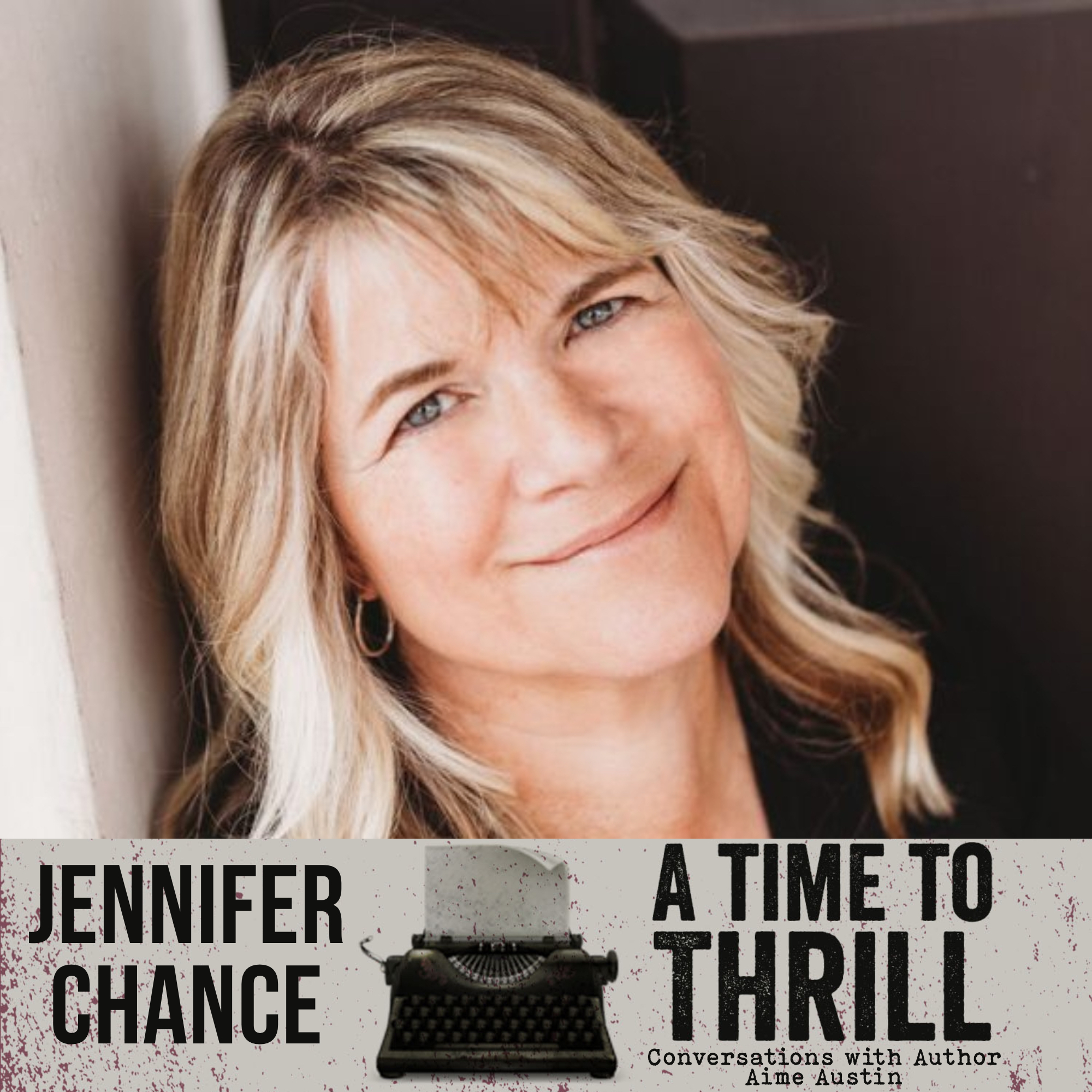
So I met her on a beach retreat. I will include a picture in this intro.
It was on. We were in Houston for the Roma Sloth or Mastermind. And again we did a beach retreat afterwards because everybody was available.
And this time it was. They were. They have all been in California except for this one, to the best of my knowledge. Well, there were those Hawaii ones years ago, but whatever. So the. This was on in a place called Galveston Island. I don't know. I didn't do any arranging. I got in a van with my luggage and then we ended up on this sort of island inlet sort of thing. We took a ferry and during. Okay, that's a lot. I don't know, maybe there are like 15, 20 of us. Actually, I have a picture of all of us in the room. And the funniest thing about the picture is that everybody had like a MacBook and it was just like a picture of like 20 MacBooks. Anyway, so we were on this beach or tree, I think we rented two houses. But it's where I met Jen. I had not known her before. So we all know a lot of authors and we all know a lot of authors in common, but obviously everyone can't know everyone.
And she was a delight. And actually during the retreat, she actually did tarot for everyone. It was the best. We do talk about that in the interview. And she mapped out my future. Everything happened. I have some thoughts about that. But I do think about it often, especially when issues come up that she sort of mapped out. And actually the best is after this interview she did another one with me, which I'm going to tell you looks a little better than the one from 2019 before COVID So we talk about that. But some super interesting things came up that I hadn't thought about in a while. And I spent far too long Googling one. She reminded me of the era when we saved. I don't say documents. We saved files from 1980s computers on cassette tape. I had really forgotten about this. Like, I just like clearly excised from my memory. But I remember having a computer at home. And I would try to save things that I worked on at home to show people at school on the TRS 80, each classroom had one. And then we had a basement that had IBM computers, Radio Shack computers, PC equivalents, which were not equivalent back then, as well as early Macs which were apples Back then, she just, like, dredged up all these things I hadn't thought about. And we talk a lot about her journey. Super interesting. And we also talk a lot about the evolution of not only romance, but romance publishing. From a lot of early books with I can't believe I read books. Literally women being pulled by the hair. And it was okay.
Or lack of consent was okay. But then, of course, there's General Hospital and that whole thing, so. So it's a super interesting conversation. She is a true delight and really made me think. She pulled out things that, after watching the edit, made me think, wow, I really need to think a lot about all of this in the era of romance publishing. AI, there's so many things that have changed over the years, and you just sort of go with the flow. But this, like, was an interview that made me stop and think about, like, the different things that happened through time.
So let's go. I have so many questions. I actually got so many answers. I think you'll love this one. So, without further ado, Jennifer Chance.
Hi. The sponsor of this month, this month's podcast is Audible.
So, as you know, I like to read and listen at the same time. I was actually just doing in the car. I had to drive.
[00:04:22] Speaker B: Oh, my God.
[00:04:23] Speaker A: I had to drive, like, 20 minutes for something I should have done last week, but was unprepared, so I had to go back. Okay. All that said, I listen and read at the same time so I can continue this story while I'm driving and then come home and read a book.
So this week, I'm reading and listening to two books. The first is Michael Connelly's Nightshade. So I got a notification that Michael Connelly's new book was coming out. And I thought, who is this? What series is this?
And somehow a year ago, another book released, and I never heard of it, skipped me something. So it is the first in a new series because, as you know, Harry Bosch is getting old and I can't remember the name. Renee Ballard, the surfer lady.
I'm trying, which she's not winning me over.
And then there's a Lincoln lawyer, but love him, but I mean. So this is series number four. I guess I've already forgotten the name of the guy. Anyway, so I'm reading and listening to that. I just started. Fair enough. And I only drove from here to Westwood and back, so we're talking maybe 40 minutes max in the car.
So I'm reading and listening to that. And that goes well. Although. And usually the narrators for Michael Conley are really good. Not the biggest fan. Fan of this current. This new narrator for this new series. But alas, we shall see. Okay, the other book that I just finished reading and listening to is An American Marriage by Tayari. I actually don't know how to pronounce it. Jones, can we talk about that?
So actually, the narrators. Fine.
Don't love the book.
So I think it must have been an Oprah Book Club pick.
And I was looking for something to read. I think it came across my feed because she has a new book out that I. Don't ask me the name of it.
She's Kin. Kin Kin. I keep seeing the COVID so it's actually working. She has a new book out and I was like, okay, I'm not going to read that, but let me see what else she wrote. And this book came up and it was available.
I could do it both Kindle and Audible, which is not actually true for every book. I will say that.
So because.
Because it was available and I had a long flight ahead of me to Korea, I actually didn't end up listening to it on the way there, but I did on the way back because I had a long flight ahead of me. I got the book.
In the book, the. There's a woman and her husband is wrongly accused of a crime.
[00:07:12] Speaker B: And.
[00:07:12] Speaker A: And he goes to jail.
Then he gets out of jail. And then it's like the aftermath of that because, of course, she's fallen in love with somebody else. It's been five years. She's moved on.
He was innocent. You know, there's a lot of layers to that.
Kind of interesting. Like, it's a story. Like, I love a story that I have never heard before. Like, it's not predictable. You don't know what's going to happen.
So all of that I enjoyed about the story.
Let me tell you what I didn't like. I swear to God, halfway through the book, we're going back and forth and like, shifts to the past and the present, and they are discussing their marriage, which had been portrayed as being great.
And, you know, her, like, falling in love with somebody else was this betrayal.
Reading the book, reading the book and. Or flipping through the Kindle, listening to the Audible. I don't know. This part I read because I remember the words, because I was like, let me go back to see what I thought happened. Happened.
He. In their first year of marriage.
I think I'm mostly gonna get this right. Had an affair. And that was a strain on their marriage.
And I'm like, okay, so I should have said spoilers. These are spoilers. And I'm like, wait, I thought this marriage was perfect. Your parents are talking about, it's perfect. And maybe, you know, your parents wouldn't know necessarily. And I was like, oh, but he was a player. And it comes out that, like, he had been a player in college, which is where she met him. He was a player, and he had this affair and then, I don't know, bought a house. And they were playing happy families. And, you know, he was this loving spouse.
So he gets out of jail and sleeps with somebody else.
And, like, all the while musing about this Dear John letter he had received from his wife while in prison.
And I'm like. So he reverts to type, and the first thing he didn't do was contact his wife or wait a minute. Or get his bearings. No, the first thing he did is run to this woman's house in this tiny town in Louisiana. And I'm like, I don't like this guy. Can we just cut the story here?
So I did finish the book.
Clearly, I had thoughts. I had had a lot of thoughts.
All that said, this is a sponsor read.
So about Audible.
If you click the link in the show notes or hit ebook. Ebooks, Buzz Audible, you can have one free title on me. Perhaps I would not listen to this title. There are Casey Court titles available that you are more than welcome to listen to.
And you can get them for free rather than between 19 and $25 or one audible credit.
[00:10:07] Speaker B: You can.
[00:10:08] Speaker A: And you can listen to my Lovely Narrator, Dan McGowan Narrate Casey Court.
The first three. The first three. The first six books in the series are available on Audible and there'll be a link for that in the show notes.
But sponsorship is what keeps us here, keeps the bills paid. I much appreciate you clicking that link. Perhaps not for an American marriage. Maybe not even for Nightshade. Perhaps for Casey Court, or there other millions of other great titles that you can listen to. It's Ebooks, Buzz, Ebooks, Buzz Audible. Or click the link in the show notes.
And now let's go. I have so many questions.
Hi, and welcome to A Time to Thrill. It's me, your host, Amy Austin. This month I have the delight of speaking with Jennifer Chance. Hello.
[00:11:08] Speaker B: Hello.
[00:11:10] Speaker A: So wait, the first question I actually have for you is, what state are you in?
[00:11:13] Speaker B: I'm in Ohio.
[00:11:14] Speaker A: So you still. You. How can I say this? You are still there.
[00:11:20] Speaker B: Super. In the Midwest. Yes. Okay.
[00:11:22] Speaker A: Because occasionally. No, not occasionally. Often you are. You're Traveling. That's what I want to say. Often you're traveling.
[00:11:27] Speaker B: That is true. That is true. Right now, I'm actually. I'm physically there. I'm living there. Everything. It's all Ohio all the time right now.
[00:11:35] Speaker A: So. Wait, how do you. I was gonna say, how do you like Ohio? I don't mean the way that that came out. I lived in Ohio for five years in between New York and la.
I was following my ex. What do you call a trailing spouse? That was. That's the title for. Okay.
[00:11:49] Speaker B: I mean, it sounds totally different. By following my ex, I was like. I was hunting him down. I know.
[00:11:54] Speaker A: That's not what I. I know. That's why I rethink that. And so he got a job there, and that's why we were there. And then I was like, I need to see some sun. And we moved here.
[00:12:05] Speaker B: Right. And water. Yes. It is exceptionally landlocked, so I'd never
[00:12:10] Speaker A: done that before or again.
But whereabouts did you live in Cleveland.
[00:12:15] Speaker B: Oh, okay. All right. I'm down in Cincinnati, so a little further south.
[00:12:20] Speaker A: No, I've been. Because. For the. Because the job he had. The part of the job was being in Cincinnati four weeks out of the year. There's some number of weeks out of the year. I'm not going to be able to. To gather that information from way in the past, but I did go the first two times, and then I didn't go after that.
[00:12:40] Speaker B: I can't imagine. I mean, there's so much to do.
[00:12:43] Speaker A: But I hear it's all hip now. Like, you know, I'm giving 19 more three me. Yeah, it is.
[00:12:51] Speaker B: It is better. It is better. It's. It's. And of course, I'm not, though, Right. So it's gotten more cool and I have decreased in my cool factor. So it's like, it's fine. So. But no, I'm actually a little north of the city, but I get down there from time to time.
[00:13:06] Speaker A: Yep.
Okay.
[00:13:07] Speaker B: So.
[00:13:08] Speaker A: Well, a. How's the weather? I'll ask you that because. I don't know.
[00:13:11] Speaker B: We have finally had spring. It's amazing. So I actually. Because, again, the older I get, the more of an old lady I get. I covered my tulips, right. Because there was a freeze. I know.
[00:13:24] Speaker A: Like an adult.
[00:13:25] Speaker B: And I had to do it for three days in a row, which I thought was excessive. By the. We were having a conversation at the end. I'm like, we're done here. So if you. If you cannot manage this, I am Gen X. I was a latchkey kid, you have to suck it up and deal because I'm not going to continue to coddle you. This is dumb. And so. But it straightened up fine. We have sunshine, which is kind of nice in Ohio because it doesn't always happen.
But I'm super ready for spring. It has been a hard winter, and I'm over it.
[00:13:55] Speaker A: That's true. I.
So I dipped my toes into weather, as it were. It's been hot here, which is not great at all. But I put on winter boots and I stepped out in the snow for a few days, and I was like, oh, I remember this. And then I promptly got on a plane and left it.
[00:14:12] Speaker B: So you're like, let's. That was fun. Let's stop that. Yeah, no, I'm. Well. And I grew up in Montana, so.
Yeah. So snow, it's. In and of itself is not something that really is a lot. But the difference of winter in Montana and winter in Ohio is the level of humidity. So in Montana, it's beautiful. It's sunshiny days. It may be super cold, but as long as the wind isn't going, it's no big deal. In Ohio, it's always wet on top of being cold.
Not awesome.
[00:14:41] Speaker A: Not my favorite part I didn't enjoy.
[00:14:44] Speaker B: Yep. And in the summer, it's wet on top of being hot. Also not awesome. So, yeah, so, yeah, stay in California. You're definitely better there.
[00:14:53] Speaker A: I will only say this. I've always had a dog, like, my whole life. Actually, I don't have a dog right now, but when I moved to Ohio and I was walking the dog and the dog didn't like the weather, and I was like, well, I don't.
[00:15:05] Speaker B: This literally is your element. What are you doing? Yeah, no, I totally get that
[00:15:10] Speaker A: she didn't enjoy that. So. Okay, so I'm going to ask you about growing up in Montana then. What?
Okay, like how?
[00:15:18] Speaker B: Like, why?
[00:15:19] Speaker A: No, no, no, I don't. I was born in New York City, so the thing is, like, I had no control over that. You know what I mean? So as much as I like, talk about, like, my son makes fun of me, it's like, you're such a New Yorker sometimes. And I was like. But I didn't choose it. Like, I was popped into a hospital one day and off to the races. So I want to know what. How did. What kind of role did reading play when you were younger there?
[00:15:43] Speaker B: Actually, quite a bit because my mom was a teacher, and so she always encouraged reading. And we also had four kids, and she made it Clear that she was going to be a reader like she was. Whenever she was home she was reading a book. And so we either had to entertain ourselves or also read. So I actually learned to read at a very young age and started off, I want to say the first thing I ever read was the Happy Hollisters series, which was this like mystery series that was suitable for, you know, kindergarten age. And, and that which is when I started reading and. And then quickly graduated to Nancy Drew and it just was off to the races from there. I didn't actually discover romance until, see, I was about 12 or 13 and I found a book in my grandmother's house, as many a romance person has said. And I'm reading it like, oh, this
[00:16:33] Speaker A: is a cool miss.
[00:16:33] Speaker B: What going on? And it was a historical. So. Oh yeah, yeah, yeah. And honestly I would say and, and people who've read me would probably agree it seriously impacted how I write because I tend to write with them even though I'm writing contemporaries. I tend to write with a more historical flair. You know, I use, I use language that isn't necessarily current all the time. And, and it's much better if I'm working with people who are billionaires or princes because they're, they talk at a level that, you know, makes more sense with the way I write. But it was just because that when I grew up that's what I mainly read was historical once I got into romance.
[00:17:13] Speaker A: So wait, do you remember that first book? So I remember the first book. It was at my grandmother's, my father's mother's house. I actually bought it later. It's on the shelf.
[00:17:22] Speaker B: Oh, I do not. It, it definitely was historical and it happened to do or had to do with a sea captain.
Yeah. Who landed in this, you know, and as one does and fell in love with the local miss and I think he ended up sweeping her away as one also does. And yeah, but, but no, it was, it was not a closed door romance. No. 13. I was still pretty, pretty innocent.
[00:17:51] Speaker A: And
[00:17:53] Speaker B: 13 year olds today probably not as innocent as I was the time that I was like, hello, what is going on? And yeah, to this day I can describe that scene. I won't, but I could.
[00:18:05] Speaker A: So I will say I envy all of you this because the first one I picked up was like a Mills and Boone. I don't know. Well, she was in New York so I don't know where she got it, but it was like a Mills and Boone, very closed door, punishing kisses romance. And despite that. And I've reread it like a couple of times. And.
Okay, when I was little, I reread it a lot and I was like, whatever the feeling is I'm getting from this book, I like this.
And then I discovered there were more. I don't know what I thought when I was.
When I was little. I don't know if I had, like, extrapolated the idea of, like, if there's one like this, there's many. Because, you know, books in my family, well, they were not series. Somebody read that. So they were like, you pick up this book and it'd be good, and you pick up that book and it'd be bad. And then I didn't. Genre was a new thing when I discovered that.
But I.
I didn't know that historicals had open door sex until much later because I just kept reading contemporary and I had to evolve as they did. So first it was closed door, and then lack of consent where I can get into that. And then it was like, slightly open man.
[00:19:10] Speaker B: So much like dragging people by the hair in the books that I grew up. And that actually became a problem too. But I'm totally interrupting you, so you keep going.
[00:19:17] Speaker A: No, but the evolution was slow. And then later when I met other people, they're like, well, did you not read historical? And I was like, well, history.
Like, I'm interested in history and theory, but not in a book like that.
[00:19:29] Speaker B: Right.
[00:19:31] Speaker A: Like, I will talk about history, but I don't want to read it. And so then people were like, but historicals had this. And like, I don't know, maybe 14 or 15. I was like, well, nobody told me this. I was waiting for temptation to turn into Blaze.
So I didn't know that. I don't know what I would have thought if the first book I had picked up, I.
I can't.
I don't know if my brain would have been able to, like, take it all in.
[00:19:56] Speaker B: Yeah.
[00:19:57] Speaker A: Because it would have been like, wait.
[00:19:58] Speaker B: Because I had questions. Yeah. And I. There was no one I could ask even back then. I'm like, not asking because I wasn't technically supposed to be reading this book. And not that anybody had outright said no. It was just a book on her shelf. But.
But as I was reading, I'm like, this is interesting.
And you're like, yeah.
[00:20:19] Speaker A: Wait, so. But when you read that, did it have all the. Oh, my God, the pulsating members and the manhood.
Manhood word. I can't.
[00:20:27] Speaker B: Because you know what, Jennifer? Chance doesn't care. So I'm gonna go there. The Thing that to this day totally scarred me with that book was the accoutrement that they used for birth control, which.
Yeah. Which was like part of a. Another animal. Like.
[00:20:47] Speaker A: Yeah.
[00:20:48] Speaker B: Some sort of. Yeah. And I'm. And of course, I'm like, so not. Not coincidentally, did not involve myself with another person for quite some time.
I'm like, that's a hard pass. There'll be none of that. Yeah, so that was. It was. But it was very explicit in the book. And I mean, you know, hooray for safe sex. And yet was it safe?
[00:21:11] Speaker A: Well, not disease free, but probably.
[00:21:12] Speaker B: I mean, not disease free.
It's like, I'd like to see the labeling on this.
Define.
[00:21:21] Speaker A: I just.
I. All of you who started. Okay, so. Okay. So when. Okay. After you read that, how did. Did you go back? Because I don't know if Then like Nancy Drew or whatever. Not. Whatever.
[00:21:35] Speaker B: I didn't by then.
[00:21:35] Speaker A: No.
[00:21:36] Speaker B: Because. All right.
[00:21:37] Speaker A: And those are younger books. I mean, I know.
[00:21:39] Speaker B: Of course. Yes. But by then I was also hardcore into my JRR Tolkien, CS Lewis, you know, Dragon Riders of Pern, all of that. Like, so that all was happening. And especially that last one and ongoing. There was much more of a. Of a romance element to those. And so no, I.
Even.
So the other. Another series that I grew up on because my mom was such a fan was Zane Gray novels.
And you could find all of them in the library, and there were 40 of them. So that was really my first experience with a long extended series and that you just. You just ate them like candy. She became a librarian later on in life. So really this was. This was just like hardwired into my system that we would be reading all the time. Because if you were reading, it was one of the few things you could do in my house that was okay to be doing. And ergo, you didn't have to do chores. As long as you're reading, it's fine. Like, not exclusively, but, you know, so you could play, which I'm like, yeah. Or you could read. I'm like, I'm in. I'm in on that. That's fine.
[00:22:41] Speaker A: I will say this. So I'm an only child, so it's maybe different, but it was the one thing I could do. So my world is all adults, and it's the one thing I would do where nobody would ask me any questions or bother me.
[00:22:53] Speaker B: Yeah.
[00:22:54] Speaker A: Because, you know, people come over, she's reading. Because my. They. People had company so often when I, you know, they would bring.
[00:23:01] Speaker B: Yeah.
[00:23:02] Speaker A: Bust out the coffee and the pound cake and Company was coming. And I didn't always want to talk to adults. I didn't want to ask, what grade are you in? I didn't want to answer any of the questions. Didn't want to answer them. So the minute, like Company was over, I was like, let me go sit over here in the kitchen. Because I wanted to hear what they were saying because it doesn't love a little gossip. But I also didn't want to participate. So I'd be. And she's reading. And then nobody would bother me.
[00:23:29] Speaker B: Right? Yep.
[00:23:30] Speaker A: And.
[00:23:31] Speaker B: Yeah. And so. And of course, movies played a big role in that too. And movies I tended to be drawn to were early on. Pretty much anything with Harrison Ford in it, that was really the requirement. And so I.
That was probably the start of me wanting to write stories. Was watching, you know, Empire Strikes Back and I mean, yes, also Star wars, but Empire Strikes Back and the Indiana Jones movies that I was like 12 or 13 around that time. And that, that was actually the inspiration for my first amazing 40 page handwritten story with a.
With a main character called Indiec Fair Sooth. Right, whatever. It was a combat. It was essentially just the two of those movies combined, plus the guy falling in love with me because of course. Right. So here we are today.
[00:24:29] Speaker A: Okay, so wait, what is it about movie. Okay, okay, so I live in la, so this is gonna be like influenced by that. Because the most people I've met who loved movies as a kid then like work in movies. Like, they wanted to tell visual stories. This is not my thing. I. Whatever. That's. I can't even imagine trying to. Like, I. I was talking to somebody recently and they were like talking about some shot and they're like. So for like three minutes I thought about it and I was like, I would have walked out of the room and got a book out of him. Like, you tell me when these people are right.
[00:25:02] Speaker B: Right.
[00:25:03] Speaker A: Are you moving yet?
[00:25:03] Speaker B: No. Okay.
[00:25:04] Speaker A: Okay. And they're like, But I was visualizing then how the story is going to unfold. And I was like, you've. It's like music composers. I'm like, I hear what you're saying, but you've lost my brain's ability to get on that and get on the bus with you. So then what. But what is it about movies that then made you want to write? Because that's. To me, it's the opposite of writing. I don't mean this in the way it's gonna go. It's the opposite of writing because it's really such a visual. I mean, obviously they're written, but it's such a visual domain.
[00:25:33] Speaker B: I think for me it was sort of the story in between the shots.
So like, you know, the. I wanted to know their thoughts. Like, I wanted to know, you know, how did they get to this point, where were they going from here?
And, and that was storytelling to me. And honestly, growing up the way I did, I mean I was, I didn't realize it so much at the time, but we were, we were, we were fairly poor. And so the idea of being in like doing movies or writing for movies or that just, that wasn't even anywhere near the table, let alone on it. Whereas writing was something I could do and, and could do from a, you know, just a pen to start. And, and when they first started coming out with computers, my father worked in a. In a job where they had him trying out various computers or whatever. And so we would get his cast offs. And so my first computer was Commodore 64. Actually it was VIC 20. I know, right, I know.
[00:26:33] Speaker A: The fact that I know this well is awful. Awful.
Moving on.
[00:26:38] Speaker B: Yeah. And so, and I wrote for a school project, I wrote a computer program that was called the Silver Key that was choose your own adventure story. Right.
And if you hit something, if you went, yes, it went over to this other side of the, you know, the program.
[00:26:52] Speaker A: Yeah, but you remember those like as early video games were like that because they were all. I was just telling my son this because he just doesn't understand the world that I lived in. No. And I was like, well, they were text based. And he's like, what'd you do? I was like, well it was yesterday when you hit enter. And he was like. And you found that interesting? And I was like, it was amazing.
[00:27:10] Speaker B: Yeah, it was like, don't even get me started on Pong, man. It was the best.
[00:27:14] Speaker A: I was like, this stuff is amazing.
Okay, that's interesting. Okay. Because what you're describing actually is one of my biggest issues with movies. So they're not my favorite favorite storytelling medium. I personally think.
I think a 16 episode TV series is about what a story needs to be fully fleshed out. So my. And especially like. And you'll know you'll remember this, like in the 80s, movies went through this era where they were like two hours long, then they were like 90 minutes. There was like the 90 minute.
And I was like, I feel like you'd sit down in the theater and like before you know it, you'd be like, oh, I guess that's Done. But I. It didn't feel like that's when movies actually lost me. Well, then they became three hours and there's too much. But then there was that era where I was just like, but what else is going on? Because you're telling me this, like, super, super, super, like, quick story.
I don't know.
Like I'm thinking of Ferris Bueller, which maybe is more than 90 minutes, but in my head, not so much. And it was like, okay, so he quit. You know, he like skipped school. Okay. And he's having these adventures. I guess that's it. You know? And it didn't feel like there was enough story. But I guess you were inspired by the missing parts. Which is interesting because I just walked away and thought, I'm going to read a book.
[00:28:25] Speaker B: Right, right.
[00:28:26] Speaker A: But you were inspired by the missing part. So I have to ask you, do you still have. I actually don't have it anymore. I used to have the first story I wrote. I wrote it on a steno pad because I don't know why there's a steno pad in my house. Right. But do you still have it?
[00:28:40] Speaker B: Yeah, yeah, I found it. It's one of those things that you, you know, you open up, you're like, oh, you know, because you don't want to get rid of it. And then you're like, but, Jen, if you died tomorrow, nobody's gonna want this. Right? It's not like. It's not like. They're like, ah, Jen Chen's papers. No, that's not going to be part of it.
But I do. I do still have that. And I do not have the tape cassette that I saved the silver key on. But I should have, because that was. That was a poot.
[00:29:13] Speaker A: But wait, now I have to ask you, because I. Okay, you. You brought up something that I haven't thought about. So I had a friend who lives in.
[00:29:20] Speaker B: See, it's like therapy.
[00:29:22] Speaker A: No, no. So I had a friend live this in apartment, which doesn't mean anything. She had a good view in Brooklyn. Doesn't, like, doesn't matter. But she had an interesting apartment because I. I lived in a house and I always wanted to live in an apartment because I was like. Because they had high. No, I'm right there with you.
[00:29:36] Speaker B: I'm one in a loft. You know, I've always. Yeah.
[00:29:39] Speaker A: And I was like, I'm in this little squat place in Brooklyn. But you all have, like, you know, whatever. But we used to record. We used to set up stories for the Barbies, but then we would Record them on tape.
I don't even know what happened to them. Who knows? They're probably somewhere.
[00:29:53] Speaker B: Look at you.
[00:29:55] Speaker A: But did you.
What possessed you? Okay, I left tape recorders as a kid. So it's just. I thought it was a cute little thing you pressed, you know, playing record and do it. Because we had a microphone. Because my grandmother. No, no.
[00:30:06] Speaker B: When. The very first. The earliest computers, if you wanted to save something, there was no floppy disk. You saved it to a cassette. It literally was a cassette.
[00:30:14] Speaker A: This is true. Why?
[00:30:15] Speaker B: Oh, my God.
[00:30:16] Speaker A: I haven't thought about this. Oh, yes, Because.
[00:30:19] Speaker B: It's because you blocked it out.
[00:30:23] Speaker A: Oh, I was in fourth grade, okay. Yes.
[00:30:27] Speaker B: Oh, my.
[00:30:28] Speaker A: Okay. What else are you gonna bring up?
[00:30:30] Speaker B: I know.
[00:30:31] Speaker A: I haven't thought about that in so many years because when I got my first computer, it was a five and a quarter inch floppy, but it was like 1985. So there you go.
It was the new era. Right? Oh, I forgot about the cassettes. Oh, okay. Sorry. That's just blowing my mind because I just.
[00:30:51] Speaker B: You know, I'm here for you. Yeah.
[00:30:53] Speaker A: Okay. What else can we dredge out of memories that I forgot? Because I remember the cassette. Well, no, the cassettes were so unreliable because I would do. I would record something at home and then I would go to school and I was like, I'm going to show you what I recorded. And I had. I feel like it was a 50% reliability rate.
[00:31:07] Speaker B: Yep. Yep. Anything that you can repair with Scotch tape, it's probably not the best medium. Yeah. So.
[00:31:15] Speaker A: Okay. Sorry. Okay, that's. I'm gonna have to. I'm gonna have to go lay down for two hours and be like, what?
[00:31:23] Speaker B: Yeah.
[00:31:24] Speaker A: Okay. So then.
Okay. So between that and the silver key, when did you think to yourself, realistically? Because I think. Okay, I'm sure you've met a lot of people who. I would like to write a book, but the number of people who actually go through with it is not a great percentage. So what possessed you to think realistically I can actually do this?
[00:31:46] Speaker B: So pure lack of knowledge of the fact that it was an industry. Right. I was just like, oh, I can totally do this. And I did. And then I just. I was good at writing. Like, writing was just something I was always decent at in school. Don't ask me to add anything.
Ideally, if logic's involved, 50, 50. But writing was something I could absolutely do. And.
And so I was always, like, great at that.
In essays and things along those lines. I.
I won little awards and all that stuff. You know, it Was a small town, but so I just. I always knew I was going to make my living as a writer.
I didn't think that I could necessarily become a fiction writer, but. But I didn't think I couldn't. So I.
But then I, you know, I went to college and got a. Got a degree and all that nonsense. And then I thought, okay, well, I don't know how to become a fiction author, so I'm going to get a job.
[00:32:46] Speaker A: And.
[00:32:47] Speaker B: But I got a job in writing and I was in, you know, corporate branding and things along those lines. And actually, the very first time I started, I actually took a class that was offered through Writer's Digest. I don't know if they're even still around, but it was a fiction writing class. I think the author's name was Rue Emerson.
She was a science fiction fantasy author.
It was awesome. So I wrote a really horrible book. And. But I was like, this is great. This is the greatest thing ever. And anyway, so then I was kind of hooked into it. And very shortly after that, I stumbled into.
It was actually at the library and there was a sign up for the meeting of the Ohio Valley rwa.
And they were having. Yep. They were having a conference, a writers conference. I'm like, so that's. And here I am, so.
[00:33:41] Speaker A: Oh, wow. Okay, that's.
Okay, that's.
So then what did you think? Because I remember the first time I went to an RWA meeting and it was much later than I was. This was maybe it's like 2006 or something like that. Oh, yeah.
[00:33:55] Speaker B: Late 90s.
[00:33:56] Speaker A: Yeah, I know. So what.
What was it like? I can't imagine. Okay. Because there was no ebooks. There was no ebook. I'm not saying in 2016.
[00:34:03] Speaker B: Oh, no. But, yeah, no, it was. Yeah. There wasn't the idea of possibility that maybe one day there might be another medium. It was all mass market paperback at that point.
[00:34:13] Speaker A: Yes. And so.
Okay, so late 90s. I'm trying to think.
Okay, so it was still.
[00:34:24] Speaker B: Come on, you can go.
[00:34:27] Speaker A: It's in there now.
[00:34:28] Speaker B: I'm gonna change like a messy bun.
[00:34:30] Speaker A: Yes. Okay.
There will be no pictures flashing on screen of that era. So.
Okay, so no, I'm thinking about. Because I remember when I was reading and what I was doing then. So. But what were the romance writers talking about? Them? Because the.
When, even when I joined in rwa, the publishing field was very narrow for women who were going to write in this genre. And actually for women writing a lot of genres, that's a different conversation. But what I could. What was it like? Because I can't even imagine
[00:35:04] Speaker B: was tons of rules.
Right. Because you, because it was a very genre driven market and like publishers were literally like on a hill, you know, where there was like this, this golden road that went up there and there were horses and like horns along the way. And you just, you would try all you could to get up to the gate, you know, kind of a thing. And the best is in. We were able to have like editors or agents come and we could do pitch sessions. Right. And. But even the process for submitting was all paper, so you would bind up your manuscript.
And I remember sending my first manuscript to Harlequin, which was in Canada, and I literally taped that thing up like a football because it was precious when I first got my, my first request and sent that off. And then you're like, what happens? Like, what happens if it gets lost in the mail? You know, and, and yeah, and so it was, but it was all, it was all very much a. We are the keepers of the secrets of the kingdom, and now that you are among us, we are going to help you to one day, you know, reach the promised land kind of a thing. And so.
[00:36:20] Speaker A: Okay, so it wasn't.
How can I say this 10 years later? It wasn't much different.
[00:36:25] Speaker B: Yeah, no, it wasn't. Honestly, I think RWA was probably very similar from the 80s or whenever it started all the way up through, through. Until it wasn't.
[00:36:34] Speaker A: Until it wasn't.
[00:36:35] Speaker B: Yeah, until it wasn't. And.
But it was, I mean, so I still have friendships, very active friendships from that.
[00:36:44] Speaker A: Yeah.
[00:36:45] Speaker B: And I, I actually became, I was president of my local chapter at one time. And you know, the big, the big win was when we got like Sherilyn Kenyon and Jenny Cruzy to come and speak to our group and things like that. Yeah, it was pretty big. Yep.
[00:36:59] Speaker A: Okay, so.
Okay, I have two questions because.
Okay. My experience. And I'm going to be like, I know people, everyone's experienced that same. My experience with RWA was this lovely place where I could go once a month on, I don't know, Saturday afternoon, Sunday morning. I don't know, I have to think about that. That changed.
[00:37:17] Speaker B: But usually Saturday morning, I think for us. Yeah.
[00:37:20] Speaker A: And I could talk to people about, Let me say this. When I first walked into a meeting, somebody said, said something about the voices in our heads. And I was like, oh my God, I'm not alone.
And so. Oh, you have voices in your head too. Because in my family it's, you know, people, you Know.
[00:37:39] Speaker B: Yep.
But.
[00:37:42] Speaker A: So I really appreciated that. And I did appreciate people sharing knowledge. So people were like, this is the kingdom.
We can't give you the whole key because none of us all seem to have the whole key together.
[00:37:54] Speaker B: Right. We'd like to. If you find it, you better let us know. Yeah. So it was very collegial. Very, very. There was very high level of camaraderie. Yeah.
[00:38:02] Speaker A: So I did appreciate that. And I did. So let me say that local chapters, I appreciated. The thing that I struggled with the most was when I went to, like, my first RWA meeting. And they did treat publishers as if, like, somebody had come down out of heaven.
And I was like, but this is okay. But I went to law school, so my thought was, I want that. But also, isn't this a business relationship? So why are we treating a business relationship where I have to, like, stand in line or be lucky to pitch or be lucky to talk to them or, you know, that kind of thing. And that's the part I really struggled with.
[00:38:42] Speaker B: And I think in part, we. A lot of the. Well, romance writers were romance writers, and they looked at it like a romance.
They looked at this relationship like there was a disparity of. There was. Obviously, there were power dynamics.
And. And you would be chosen. So literally all the language supported that as well. And so. And if you could just be perfect, you know, you, too, could be chosen one day. And. But then you had to, you know, you had to keep being perfect.
There are some parallels here, but.
But yeah, I think that's. I think that's why. And you're. And you also are dealing with. Now you went to law school, as you said, you're dealing with a lot of people who did not come from a business background and so didn't have that understanding of what those business dynamics might be.
And. And that also, I think, totally informed how they interacted with and presented those relationships.
[00:39:37] Speaker A: No, because. Because the first time I got, like, the. Okay, it is the paper era. So the first time I got an agency agreement, you know, it came. Came by FedEx ripping open my envelope. So anyway, it came by FedEx, and I was looking at it, and I was like, okay, but I'm reading this like a contract. And when I'm reading it, like a contract with somebody whose obligations seem a little, like, loosey goosey to me in terms of agents, I still think I have a lot of thoughts about agents.
[00:40:06] Speaker B: Some of my agency agreements were nuts. Yeah. They're like.
[00:40:10] Speaker A: And I was like, wait. And. But then everybody was like, but this is the only way to get to that other place. So, yes, this may be unfair, but it's going to get to that next place. And then you get to the next place, you're like, oh, wait, that's also unfair.
[00:40:23] Speaker B: Also unfair. And yet unfair in different ways. That's cool. Yeah.
[00:40:27] Speaker A: So that was. It was maybe in my mind, I still can't put the two together. It was just interesting. And I think now it's actually, well. Well, things have just changed a whole lot for a whole lot of things.
[00:40:40] Speaker B: But. But there was also that lottery issue, too, because you could work and work and work and do all the things right. Get there, get. And then something just happened, you know, like, you finally got the deal and something happened that actually was my experience and through nobody's, you know, independent fault or anything like that. Whereas other people, you know, made it. They made it over the.
[00:41:04] Speaker A: They made it over the line.
[00:41:05] Speaker B: They got the brass ring and everything, and there seemed to be no rhyme, no reason to how this works. So that.
[00:41:10] Speaker A: What was your first experience then? Or not first. What was that experience that.
[00:41:14] Speaker B: As I sold.
Okay, first, I. I won the golden heart, if you remember that.
I want to say that was like 2008, and I thought I'd made it, like, okay, here we go. Everybody's just gonna come knocking on my door. And I did. Had some interest, but I didn't sell that book, which I thought was just an atrocity. And that actually ended up becoming the.
I don't know if I have it.
Oh, I do.
My very first book, Getting Wild, was. This was my very first indie book. And this was what I won the golden heart with in 2008. And I eventually, because I love this story, and now I think I have more than 30 books in that series.
So it was great, but it just wasn't right for the market at the time, and that's fine. So I went off and I thought I'd made it, quit my job as one does.
[00:42:02] Speaker A: And. Yeah, you're not the only one. So I'm just gonna.
[00:42:06] Speaker B: So. And then got another job. And so anyway, kept going. And then I finaled in a Golden heart again in 2011, sold that book, got an agent, sold that book was amazing. It was a young adult book, and it was that time where young adult was just super hot and it was a historical.
So back to those roots, which was great.
And I sold it to Simon and Schuster and. And I can say these names because, again, this was nobody's fault. It just was what happened in the business and as it turned out, when that book came out, it was the spring of 2013 and, and that was the quarter that Simon and Schuster got in a big fight with Barnes and Noble and they did not. Barnes and Noble elected not to publish or to put out any books by debut authors that quarter in retaliation for whatever the fight was.
And my career never recovered from that. From a traditional standpoint. I sold, I sold a few more books, but I, it never, it never got over that hump. And, and I'm not saying that other authors didn't like, they were able to like to pivot faster than I was, what have you, but that, that was, that was my experience. And so that was 2013 and I self published my first book in 2015.
So.
[00:43:25] Speaker A: Okay, so a. I'm sorry because it's just, I mean.
[00:43:30] Speaker B: Right.
[00:43:30] Speaker A: Yeah, but it's, it, but it's, you know, now that that story is like almost everyone's story.
Did the imprint close? Did the editor leave? Like, I mean, it's just like an endless, like.
[00:43:46] Speaker B: Well, yeah, yeah, there were, there were. They're, you know, they, Simon and Schuster, God love them. They actually, they bought the third. It was a five book series because it's the Maids of Honor, it's like a spy series.
And there were supposed to be five books and they bought the first three, but since the sales never could kind of dig out of that hole, they ended up not, not finishing that series, which.
And then it just sort of. And then, and then of course you're like, oh, you're that girl who didn't sell anything. Even though you're like, but, but, but
[00:44:17] Speaker A: I know, but let me tell you the story. Let me.
[00:44:19] Speaker B: Yeah, like omg, you know. Exactly. So, but, but yeah, so it's, it's, it was an experience.
But you have to, as you know, more than any author knows, you just have to pivot. You have to figure out what you're willing to do in order to continue writing stories.
[00:44:41] Speaker A: So what? Okay, so then I have two questions.
Do you think that if it had not been for RWA that you may have written a different genre?
Written like, how can I say this? Like, no romance, not no romantic elements. The romance would have been a smaller part of the story.
[00:45:06] Speaker B: Probably not. Because as people would tell you if they've read my books, romance is not generally the, the key driver. My mind tends to be like, I write a lot of urban fantasy. I've written some high fantasy, I've written some historical.
I.
But I would say that RWA taught me how to Write romance better. I would say that.
And also, although I'll tell you the thing that really probably taught me the most was in my role with rwa, as ovrwa, I ran the contest, the chapter contest, and. Yep. And it was great because I was able to.
[00:45:48] Speaker A: We.
[00:45:48] Speaker B: We had to call editors and agents to get them to judge the final rounds. So that, you know, allowed me to make some of those contacts, which was fabulous. But I also, because as with all contests, it was tough to find judges, I ended up judging a ridiculous amount of first chapters. And I learned so quickly what was good and what was not.
And.
And that, I think probably served me so well. I mean, there were so many small things about RWA that you just don't think about that it just gave you that opportunity.
[00:46:23] Speaker A: But.
[00:46:24] Speaker B: But no, I probably would. Would remain writing romance.
And thank God for RWA because I finally learned how to write it well.
[00:46:33] Speaker A: So, okay, so all that said, what are you writing now or what are you not. What are writing? Well, what are you publishing now? Writing and publishing are not necessarily no worries.
[00:46:44] Speaker B: No worries at all. I have a new series actually, that just came out with Oliver Heber, and it's called the Accidental Exorcist. I.
I'm terrible with figuring these things out, but as I try and kill
[00:46:57] Speaker A: myself, don't pull the computer.
[00:47:00] Speaker B: I know, but this book is the story of an exorcist assistant. She's worked with him for like 15 years. She's in her mid-20s, and she's really good at assisting him with. With the exorcisms because she can see the demon inside the client.
And then as the course of the book goes on, she discovers that it's possible that she herself is possessed and that that is why she's so good at what she does. And.
And so while she's coming to terms with that, her mentor dies in very suspicious circumstances. And so she's thrust into the role of exorcist to help a family that is overrun in their estate with deeds. So that is the first book. It came out in February. The second book came out in March.
That was Sexiest Sin. And then we have Guilty of Sin that's coming out in May.
And it's. It's horror romance, which is a slightly different genre for me. That's probably one of the things that I would not recommend anybody do as an author. I tend to just to try different things, but this is a lane that I think I. I am finding real, real interest in staying in. And so that's what I'm working on now, so.
[00:48:15] Speaker A: I can't believe I was gonna say this. I was gonna say what possessed you? But I didn't.
But, but.
[00:48:22] Speaker B: Right.
[00:48:23] Speaker A: Okay. Okay. I clearly my, my interest in writing is really narrow. Like it really is. Like I can write three things and that's probably all I'm ever gonna do. But what possessed you to, to go down this road? I guess.
Well, it is an interesting question that you were writing. No, I don't know. No. You had just started reverse Harem. I don't know what you wrote before that.
[00:48:44] Speaker B: Reverse hair.
[00:48:45] Speaker A: Yep.
[00:48:46] Speaker B: Yeah, that was also fun. But see that those, those had a mystery element to it.
This book has a mystery element to it. And so that, that interested me. But I have always been interested in the occult and the darker side of existence. As I think, you know, I have been a tarot reader for over 30 years and so that has taken me down some very interesting shadowy paths.
I was also raised Catholic, so I have a very deep understanding and appreciation. Understanding, but certainly an appreciation for how the Catholic Church has handled exorcisms. And in the mid teens I got fascinated with all of that and did a ton of research and that research ended up informing this series quite a bit. And was it is there is some scary stuff out there. And so I wanted to find a way to bring that to, to readers that, that was interesting, you know, a little scary, but also had something to say.
[00:49:51] Speaker A: So, so that's interesting. Okay. So there's. Well, let me say this. Well, I guess you would know the answer better than I. It is my understanding that there is a renewed interest in horror written by women. Is that a trend that you see? I, I only, I read it in like, I read it in an article like you know, like Publishers Weekly or something like came and I read it in an email and I thought okay. And then I haven't thought about it since.
[00:50:16] Speaker B: Right. I, I would say I, I totally have heard the front end of that. Renewed interest in horror written by women wouldn't surprise me. It's just a different perspective.
What I have found to be the most fascinating about writing horror, as opposed to some of the other things that I've written is the intimacy that's involved that the, the scariest, most horrific acts are generally the smallest.
When it starts to get some like big bombastic kind of thing, you. It can be absolutely terrifying. Absolutely a thriller, but the horror is generally small and close.
And so that I could see that that might be something that women would have an interesting perspective on. And so I could See how that would be interesting.
[00:51:00] Speaker A: Okay, I'm gonna have to think about that because I don't read horror because I like to sleep at night.
So.
[00:51:06] Speaker B: No, this has been.
Oh, yeah, this has been.
[00:51:10] Speaker A: There have been some things, like, I can only watch.
I don't watch horror movies and I don't. I read one Stephen King book once when I was like 14 and I was like, never again. This was lovely chatting.
[00:51:24] Speaker B: You can.
[00:51:25] Speaker A: You can have. Move along.
[00:51:27] Speaker B: Right, right. You can.
[00:51:28] Speaker A: And it's not.
[00:51:29] Speaker B: No. And I'm very visual, so watching horror movies is something that's very difficult. I. I've obviously started doing a little bit more because now I'm interested more in the craft and. And I think if you can establish that distance, you're able to watch those things with a more studied eye. But if you tend to get super, super swept up in a story, super immersed in. In the visuals and the sound and everything else, or horror is an issue.
[00:51:59] Speaker A: Well, because I was always. I read once, and I think this was about. I don't know if it was about war coverage or something, but it was. It suggested that the human brain can't unsee. So once you see.
[00:52:09] Speaker B: Yes, that is true.
[00:52:11] Speaker A: So my entire life goal, I swear to God, I think about this all the time. Like, especially because, well, I live in LA and some things that I just don't need to see, but I. My entire life goal is to not see it because then I don't ever have to metabolize it. So then how. And reading is not as bad. But I. Well, let me say this. If I see it coming. I quit at a book a few years ago, and I was like, I don't know what I thought. Okay? I don't read blurbs, so I.
This is my own peril. Like, I, you know, this looks good.
[00:52:42] Speaker B: So that's.
[00:52:43] Speaker A: That's on me. Like, I. I see a cover and I'll read a book. I have. I can't read the Blur because I don't want to be spoiled. I want the whole thing to be new.
So I get into messes that I shouldn't be in.
And I started reading a book and he was. I think the guy was gonna torture people.
And I was like, okay. And then he was like. He was like, out. And he was like, he. I don't know if he had a steak or a bone or something. He was out looking for dogs. And I was like, I'm not. I don't get hard pass, but I could see that this is.
Nope. So then how do you?
And I, when I'm writing, I do think about the books, like all day. Like, it's more thinking than writing, actually, to be honest. So in the shower, when I'm driving, you know, all of that. So how do you exist and then also write about. Because I, I think I was possessed. Like, I wouldn't be able to, like, yeah, I wouldn't be able to separate from it, which maybe is what's wrong with my brain, because I would, I'd be convinced I was possessed. I'd be getting an exorcism.
[00:53:46] Speaker B: Right? No, and, and I, and again. And what's interesting, I hadn't thought about this until just now, but in the work that I did about. I've read cards for a long time, and about three or four years ago, I got the urge to do it professionally. So I started doing zoom readings and I went to psychic fairs and stood at a booth and I was that girl behind the table that people would just randomly come up to to do a reading. And you just don't know, right? You, you, you, you think you're like, oh, I know what this reading, this reading is going to be about money or it's going to be about relationships. Like, I'm psychic, I should know these things. No, and so some people come up and sit down and I, I had a couple of people, like a darkness that had sort of attached to them. And, and some people who had some things happening in their homes that they were concerned about. And so we would do the cards and see, you know, what they should do. And it generally was, was very interesting, the kind of information or guidance that came through. Because when I do readings, it's not my guides. It's, it's the individual's guides who show up. It's just my quirk. And, and, and so they were like, yo, these are the things you have to do. And like, and sometimes it was get out, you know, that kind of thing. But, but as a result of that, There, there is a way through, right? And so if something, if something dark now, humans, not so much, but possessions, the darkness that comes with the demonic possession, that kind of thing, there's a path there. There's a reason and a path. Some of the things that people are encountering, like what you were saying with the torturing of, like, what is going on there. That, that to me, that, to me, in fact, that's one of the future books that I have already. Writing is going to be a tough book to write because the humans are going to be the ones who are the villains, I guess you would say, in that, because their level of darkness can. Yeah, right. And. And can astound because it's been fascinating to do the. The study on demonology and. And just what literature is out there about this. And it can go some pretty dark places, but humans. Humans got them beat. You know, there's.
[00:56:13] Speaker A: There's. Yeah, you're discussing my eternal struggle. Because I.
No, I was. I think.
So I'm gonna be honest. Like, I will. Honest. Like, I was driving my son to school, I think, one morning, and I mean, he takes the bus sometimes, but sometimes I drive him. And I was driving, and we were on Las Vegas, about to turn onto the. The town freeway, and I think they had just announced that.
No, announced, like, the Russians had just invaded Ukraine. And I was like, I give up. Like, I literally just showed up.
[00:56:47] Speaker B: That's interesting. So, yeah, sorry about that.
[00:56:49] Speaker A: But, yeah, but I give up. Like, that's the. That. I think that was the day I thought, oh, I think I've lost faith in humanity because I was. Because I'm so old. So maybe then I was, well, probably 50. I just turned 50, probably. And I thought, okay, well, we have art and we have lyrics. When we have music. And, like, you can get on a plane and you can visit people all over the world and we can, like, break bread. And so, like, I'm that person and it's whatever, you know. No, it's good. That's good. No, no, no. But four years ago, I was like, I don't think humanity is at the place I thought it was, and I continue to be. So like, at the same time, it's just very hard. So I'm like, my son likes to watch the news when we travel. I would never watch it, but he's like, he likes to. To watch news from different perspectives because we're in a different country.
[00:57:39] Speaker B: Right. Well, that's. That's good.
[00:57:41] Speaker A: Fair. I wouldn't do it. I don't ever turn.
[00:57:44] Speaker B: Yeah.
[00:57:45] Speaker A: You're like, yeah, okay. But, you know, I have to accommodate another human being's preferences. So, like, we're in, like, Korea, like, watching the news, and at the same time, it's like, would you like to go see this museum? And it's like, I can't hold these two things. Or even. We were watching the news, but then also watching the Artemis because it took off while we were there, right? Yeah, because we thought it was going to be too early in the morning, but it was delayed, so it was 7:30.
[00:58:14] Speaker B: Amazing. Yeah.
[00:58:15] Speaker A: Time in Korea, whatever that is. Sixteen hours in the future, tomorrow already. And so we're watching that, and I like. And they're going behind the moon. And like, I'm like, they're talking about exploration, and it just feels so exciting, expansive.
And look at humanity. And then they're also like, also, we're bombing Iran. And I'm like, I can't put these two things in my head, but I no longer have as much faith in it.
So I guess. What am I saying? What I'm saying is, then how do you.
How do you write books that have some sense of hopefulness when there's darkness in them?
Because I would say my readers say that my books are not so hopeful these days.
They're like, oh, come on, man.
[00:59:06] Speaker B: What? Similar to probably what you experienced. It's. You really have to focus in on the moments, right? And so there can be moments of abject horror and fear and loss.
And then because of the human ability to shift, you can very quickly have a moment of gratitude and hope and joy and possibility that could be even so small, you know?
And so usually it's that balance.
And the other thing that I say, I've. I've done talks on managing change is. And trying to understand, like, how to get yourself through a horrific change or even just a change that, my gosh, you never expected to be here. How in the world are you going to ever get through it? Et cetera. And what I tell people is that you have to look at this life, the entire life as a roller coaster ride. And you signed up, you decided that you were going to take this ride. And the reason why you did that is the. Because you knew that eventually you would get off this ride and you would return to the all that is and. Or however you want to. To phrase that there is a beginning and there is an end, and on the other side is absolute joy. And so everything that you are learning here, the lessons that you have, some of them suck, some of them are great, but.
But they're all part of why you're here.
And.
And that. And if you can start looking at it like, okay, what is the lesson I'm taking from this? And sometimes that lesson is, you know what? I need to focus more on joy. Because there's so much out of my control that if I just obsess and we know these people obsess, obsess, obsess. News, news, news. Doom scroll. Doom scroll. Doom scroll.
To what end? You know what? You're not. As a result of this, you therefore gave up Eight hours of productivity because you were in a spiral. And we only have a finite period of time on this earth.
[01:01:08] Speaker A: I know you can't get the time back. That's always the.
[01:01:09] Speaker B: Yeah.
So, you know, and psych. And it's not just. Sometimes it's not just an external thing. Sometimes it's other people. You know, you. You desperately want to pour into another person, and eventually you're like, I cannot continue to pour into something that's not pouring back into me.
And. And these are all. It's just this. It's just this whole flow of energy that you have to kind of manage. But all of that said, I try not to watch super dark things right before I go to sleep because I'll dream about them. That's. And that is. That is absolutely. If I'm doing research, especially like when I. You. You brought up the torture. And that's.
Since clearly I have a reaction to. It's probably something I should explore a little bit more for the book because I'll probably write it pretty well. But.
But that's. That's one of those things that I, you know, certain, like, people with kids are like, I cannot watch anything that, you know, abuses a kid or anything like that. And. And I totally get that because there are things that I'm like, you know, if you're. If it's a torture thing, that's not my. My gig, you know, But.
But yeah, and it's. I. You just have to kind of manage that. A lot of meditation after the fact, like you. Oh, I just did all this, and now I'm going to think about something else, and it has to be a conscious decision.
[01:02:29] Speaker A: Oh, that's interesting. I mean, the conscious part. The conscious decision part of it, not the. The rumination part of it. Okay, so then let me ask you this. So how.
I'm gonna say this, like, in terms of writing, how have you gotten here? Because how many. Not how many genres, how many different. So many detours have. Do you think you've taken over the years in terms of writing?
Well, let me start with this. How many books have you written?
[01:02:55] Speaker B: I've written over probably somewhere between 50 and 60 books at this point that I publish.
[01:03:01] Speaker A: Okay, and so then.
Well, I have two questions. A, why do you think.
No. Okay. Taking publishing out of it. Because traditional publishing will. You have to be in the box. You have to be in that box that you signed up for.
Taking that out of it. What do you think possessed you to have disparate, like, genres in terms. Yeah. Disrespect genres, I guess.
[01:03:28] Speaker B: So I, to a fault, am curious about different areas of focus.
The probably the only thing that I have not written is a straight up mystery where the, like, it's just a mystery. It's not a historical mystery or an urban fantasy mystery, you know, but like mystery I think is one of the most difficult things to write. But that said, I, you know, I've tried rom coms, I've tried urban fantasy, I've done high fantasy because that's, you know, I grew up on that.
The not. I have not done a western, I think. And, and I grew up in some, to some degree in Montana for several years. Read a lot of that, lived a lot of that.
It's not as Rome, you know, it's. Sometimes it's hard because you're like, that's not actually romantic, that, that life. It's a hard life, you know, but, but I, I think for me it's just curiosity, you know, to learn because I love learning. And so I'm like, well, if I'm going to write about it, then I'm going to learn a whole bunch about it. And so, so that's probably the main reason. It's not a, it's not a smart decision, in my opinion. I think I am a little too diverse because people don't know, like, it's a Jennifer Chance book. What does that mean?
[01:04:45] Speaker A: I mean, it's a chance.
[01:04:47] Speaker B: Yeah. Take a chance. Yeah, but, but yeah.
[01:04:51] Speaker A: So what.
Okay then.
Well, it's, it's. You can't go back. But knowing what you know now, do you think that you. Going forward, that you will stay.
[01:05:03] Speaker B: Yes. In a lane, like any lane. Just, you know, pick one.
[01:05:07] Speaker A: Well, I don't want to make it too narrow because like things.
[01:05:10] Speaker B: No, no, no.
[01:05:11] Speaker A: So you can't write vampire books for 9,000 years unless, well, there's one person.
[01:05:14] Speaker B: Unless you are a vampire, in which case you could, you can.
[01:05:17] Speaker A: But other than that person in Anne Rice, I don't think there's a lot of people who could stay in that lane.
So then there has to be. Let me say this. Contemporary writers have to have some flexibility, I believe.
So within that flexibility, what do you think your future is writing wise?
[01:05:36] Speaker B: I have found that other than, I think probably a very small handful of books, every book that I write has some sort of paranormal element to it. Sometimes it's just whimsical, like it's chance or whatever. But sometimes it goes very, very deep into it. So I would say that the through line for all of my books is that there's a little bit of magic in some way or form.
I feel like going forward, the lanes will be. I also write as Jen Stark and that's pretty, that's always been pretty solidly urban fantasy. It's just, it's something I really, really enjoy.
And that's going to be restarting later on this year.
That is going to stay urban fantasy with chance. I do pardon the pun. I do take a few more chances with that. I like to explore things, but this, this new series, I think as long as we find readers for it, I could see that going on for, for quite a little bit.
There's just so much to explore and it does touch into the paranormal element, the, you know, supernatural thriller, that kind of thing. So I could see that both of those being kind of solid pillars for me going forward.
[01:06:49] Speaker A: Okay, so one last question. What are you reading now? Like, what do you, because look, I, I, I don't read anything, so I'm the wrong person. I'm like, sure, whatever. Let's see, what do you read? What do you enjoy reading?
[01:07:03] Speaker B: I read the, and it's interesting because it's hard for me to read in my genre other than because it becomes a research process. And then you also don't want to be repetitive or mimic because I can be a natural mimic as well. And so I tend to gravitate towards thrillers and mysteries and thrillers. And some partly because I'm so impressed by it. You know, I, I enjoy them, but I find once again, they are the most visual books out there.
[01:07:38] Speaker A: So wait, more so than historical and the dances and the ridicules?
[01:07:43] Speaker B: Well, right. I mean, I mean, I'm a big fan of historical as well. But that's different. It's usually those, usually, oh, gosh, I went through a huge historical phase, but, but I would say now I tend to, because I almost exclusively listen to books, so audiobooks. And there are few things worse than a poor, not poorly written, but maybe not the best romance scene in audio
[01:08:12] Speaker A: because I have discovered that you can, I, I can, I can skim.
Yes, you can get away with some
[01:08:18] Speaker B: stuff on the page because you're like, okay, but when it, when you have to listen to it, you're like, you're so dumb, you know, and, and, and, you know, and again, some, sometimes it has nothing to do, you know, sometimes it's because of the actual writing, sometimes it's just the inflection of the narrator. And they could be perfectly delightful narrators, but it just isn't working for you.
[01:08:35] Speaker A: Working. Yeah.
[01:08:37] Speaker B: Right. Whereas I could pretty much, you know, have anybody read a mystery or a thriller to me and I can, I can get wrapped up in it. So.
[01:08:46] Speaker A: So what is the visual aspect? Because. Okay, the thrillers I enjoy most.
Well, let me say this. I read some traditionally published authors who, you know how it goes, their books get longer as, as their career goes on. So I'm ending up reading a lot of descriptions of the English countryside, the Irish countryside and Los Angeles.
And so that part, it's visual, but I don't know, it doesn't. Yeah.
[01:09:16] Speaker B: Okay, here's the thing. When you're dealing with thrillers, there's not a ton of description. Right. It's so focused, it's so plot driven.
[01:09:26] Speaker A: Okay. We're reading the different thrillers, I think. Okay, I know what's going on. Well, no, I'm going. I'm. I'm reading traditional authors at the end of their career.
[01:09:34] Speaker B: So.
[01:09:34] Speaker A: So.
[01:09:35] Speaker B: Well, I mean, like the one, the
[01:09:36] Speaker A: book, 300 pages to 700 pages right now.
[01:09:39] Speaker B: And that's. Yeah, the books I'm reading tend to be more the genre focused I'm reading right now. It just came out a book called Revenge Prey. It's by John Sanford, who was a former journalist, I think, back in the day. Pretty sure that's right.
His writing is very, it's descriptive, but it's very hard hitting and moves.
And when I write, I can sometimes meander off and go down this oubliette and talk about it for a while and then meander back. So for me, listening to this kind of writing helps me stay punchier in my own work. And plus I just enjoy it.
So it's.
Yeah, to me, to me it's the, it's just the visual. It, the more visual and I think for today's readers, the more visual you can be with your writer writing, the better because we're dealing with people who are now like kind of trained on Netflix, spinsing and that sort of thing. And so it's like, and then, and then, and then, and then, and then.
[01:10:36] Speaker A: Okay, that's really thoughtful because I don't.
Okay, I hear what you're saying. Because I will say this. I do struggle with.
When I came of age and reading books, like there was a prologue and the entry point, it was an on ramp, you know, And I was like, I'm here for the on ramp. And then there was like the, the period, the era, you know, in media res, where like it just had to. And I was like, okay, that's a little abrupt. But okay, you insist. But I hear what you're saying about the visual because.
And I know that in theory we're competing with people who are like, I could put this down and I could binge whatever on whatever right on my phone. Yeah, I know it's my son. I know it's, it's crazy.
I was like, we shared a tv. He's like, really? I'm like, yeah, we did it. Okay.
[01:11:27] Speaker B: But you know, it's interesting and I will, I will share with you my most hated thing in. Usually it's in, it's in visual media like TV shows, etc. I consider it so lazy and so aggravating. And it's the frame. And even when I find it in written words makes me insane. Because what that means to me is that you didn't start the book in an interesting enough place that you had to start it somewhere else so that you could get me, get my attention. And then it's like, oh, let me take you back and get you all the way up to this point. It makes me bananas. And I think that that's partly because
[01:12:05] Speaker A: talking to somebody about it yesterday. So there's a story that's difficult and they're like, well, I just want to start here. And then what, what we're going to do is we're 12 months earlier. And I was like,
[01:12:16] Speaker B: you're like, yes. You're like, but must you. I love that. Yeah, but that's, but that's to me is like, no, no. I bet there's something there. If there's a reason to start at 12 months earlier, great. And my God, a 12 month ramp. That's.
But, yeah, but my books tend to be over a short period of time too. So that's another thing. I don't, I don't write 20 years later. You know, I don't write this saga. I tend to write more tighter frame time frames.
[01:12:43] Speaker A: So that also has so interesting.
[01:12:45] Speaker B: Okay, okay.
[01:12:46] Speaker A: Because I've written both kinds. I. There's one that's amazing to me because
[01:12:49] Speaker B: that saga thing, that's a whole different like field to a book.
[01:12:54] Speaker A: But I. Okay, but did you not read like in the 80s, the sagas were the thing. And I still like, okay, I could not. I don't know if I have the. I don't know if I'd have the time and wherewithal. I'm not like 14 to like delve into a saga. But I do like the idea of the past having a huge influence on the present. So I do have one series that alternates past and present chapters. Like they're 13 and then they're 33 or something like that.
[01:13:17] Speaker B: I do love those.
[01:13:18] Speaker A: I love those. Yeah.
[01:13:20] Speaker B: Oh, and then like, even the movies, you know, where they had. What was the one Scissors. I don't. It doesn't matter. But yes, like, where you said, like, this happened in the past, now this is echoing it in the future. Yeah, Total catnip. Totally agree.
[01:13:33] Speaker A: Yeah, I love that. But this saga, I don't know if I'd read through it now with all the generations I've seen thinking about it, because my son was asking about some book when we were traveling, and I was like, oh, that's one of those generational sagas. Like you're gonna start. They're gonna start in like 18 something, and then it's gonna be the wars and whatever is happening in Asia. I was like, but that's a. I did not discourage it, but I was like, that's a. That's a commitment. Like, that's a commitment. And if you're ready to make that commitment, go forth. But I don't commitments anymore.
[01:14:02] Speaker B: Enjoy.
[01:14:03] Speaker A: Right, Enjoy.
[01:14:04] Speaker B: Well, right. I mean, I remember I was reading the, The. The Robert Conrad books. I think that was the title Wheel of Time. And I realized pretty early on that this, this book that took. Was this big was three weeks.
Took place over three weeks. I'm like, that seems like, excessive, you know, so that was like, wait, no, no, no. You know, so it's. It was one of those saying, like, ah, I could just skip ahead a couple of books and only be a month later, you know, so.
[01:14:33] Speaker A: Yeah, yeah, I know.
I. Yeah, I will say that. That's true. Okay, so I guess this last question, which is in theory in my head, is a short question.
Excuse me a second. Sorry about that.
How did you come to tarot reading? Because the only other person I know, well, that was her family. I'll call it the family business, what her family did. So that's. Oh, nope.
[01:15:01] Speaker B: It's so funny. She would be mortified. She's no longer with us, but same grandma.
She had a deck of cards in her basement next to all the romance novels. And it was a. It wasn't a tarot deck, but it was a soothsayer type deck, you know, where you just. It was playing cards that happened to have little, little phrases on them. And that was the fair. I was so young at that point, but that was my first idea of like one of these cards. And then a friend of mine gave me a deck when I was in high school, and.
And I got interested in it at that point, and I just started reading. And I've really read only for friends and family for decades because, you know, I was corporate vice president. Like, what are you doing? You know, and.
But then I started just a few years ago, going out in a more public way with it, and.
[01:15:59] Speaker A: Because you did readings for us back in the day, but I didn't know at the time if you had done them public.
I don't think it was a question I would have asked, to be honest. It's not the kind of thing I've been like, hey, hey.
[01:16:12] Speaker B: But, no, at that point, I was not public. In fact, that was one of the first times that I did reading for people I didn't know very well because, you know, but it seemed to resonate, and people, you know, responded well with it. And. And my readings tend to focus more on how will you get through this? Not like, the end is coming. Enjoy.
[01:16:37] Speaker A: I do.
I do, actually. I think about it from time to time. I can't believe I'm saying this. I still think about it from time to time.
Yeah. That's all I'll say. I think about it from time to time.
[01:16:48] Speaker B: Yeah. Yep.
[01:16:49] Speaker A: And it was probably. It was before COVID so, like, six or seven years ago.
Well, I know, because then. Then.
[01:16:56] Speaker B: Right. All a couple of things. Right. Yeah. And people are like, did you predict that? I've had people ask me, like, can you predict what's going to happen, you know, in the world type of thing. And as it turns out, no. Like, that is not part of my gift. I would love to know, but my part. My gift is very much centered on the person that is in front of me.
[01:17:16] Speaker A: So. Wait, do you ever write about it, then?
[01:17:19] Speaker B: My urban fantasy books have a very strong tarot underpinning. She is. She literally is an artifact hunter who uses tarot to find things. And that has become a bigger part of my practice recently, of people who've lost things. And. And I read cards to help them find them. And.
And it. When it works, I'm like.
But, yeah, so, no, it's because you can read the tarot cards in many different ways, and she happens to read them to help her, you know, solve mysteries and find things. So.
[01:17:51] Speaker A: Okay, so one last question. You've seemed to. I don't call it travel a lot. You seem to be out of town a lot. So where are you going?
[01:18:00] Speaker B: So I try.
[01:18:01] Speaker A: I know you used to go to Montana, but I don't know if you
[01:18:02] Speaker B: still go I go to Montana. Absolutely. I try to get to the shore, any shore really, at least once a year. I. I much prefer to be by
[01:18:13] Speaker A: the water and I go once a week and I think that's barely. I rarely go, but I guess it's not okay.
[01:18:20] Speaker B: Yeah. And so I.
And I have been going. Been able to go over to Europe and various places. I, you know, some of the places I've recently been to. I went to Croatia actually this past year I was in Paris again for the first time in 30 years. Gosh. Over 30 years. Because I was a student when I. I studied over there when I was a student. Yeah. And so it was cool.
It has. It was so much cleaner. So.
But true.
[01:18:47] Speaker A: But also hot. Well, the window. Well, yeah. Okay. Anyway.
[01:18:50] Speaker B: Yes, but. Yes. And so no, it's a little. I've been down to Central America. I have not yet been to South America, but that's on the list. And I. I'm hoping in a few years to. To go to Asia, actually to go to Vietnam is. That's on the list.
[01:19:05] Speaker A: I've always wanted to go. There's so many. There's so many places. Sometimes I want like. And I think, did I duplicate a place? But I still haven't gone to all the places I've wanted to go. But I was talking to my son about it and he was like, what is about Vietnam? And I said, maybe I'm from a certain era.
That it holds. Because.
Does not hold the same space in his head that it holds in the head for somebody my age. So I think that's different. I always wanted to go to Vietnam, but I just.
[01:19:32] Speaker B: Well, I love that. I love that you travel, that you travel with your son. I feel like so many people are quick to make judgments about all sorts of things here and other places, and yet if you've never been to another place, you don't. You don't have, I think, a broad enough perspective to really make some of those judgments.
And.
[01:19:54] Speaker A: Well, that's my goal with my son because I wanted him to know. I've met people who were like, I'm. I'm like this, this. Whatever. It's la. Whatever. For me, it was. New York is not the center of the universe and it's not the only thing out here. So there's people doing, well, everything.
[01:20:09] Speaker B: Amazing things. Yeah, amazing.
[01:20:11] Speaker A: But, you know, everywhere. And you need to see it so
[01:20:14] Speaker B: that good, bad and indifferent, you know.
Right. And they have entirely different perspectives on how to live life and, and what's on going up or down or good or bad. And, and it just, it's. I'm a high input person, so I'm always trying to learn. But, but yeah, it's my number one.
[01:20:30] Speaker A: It's my problem.
[01:20:31] Speaker B: It's my number five. It's a huge problem.
[01:20:33] Speaker A: So, yeah, it's a, I can't.
[01:20:35] Speaker B: That's part of the reason why I keep trying new genres. I'm like, Jen, so I feel better
[01:20:42] Speaker A: that I've only, I've managed to keep it, keep it, keep it tight. See, you're amazing.
[01:20:47] Speaker B: No, you're.
[01:20:47] Speaker A: No, I, I, oh, trust me. I had a thought yesterday, okay. Because it was about Artemis. And I said to my son, I said, I, I said, I'm never going to write this book. I was like, but I'm going to tell you this idea for a book and in one day, if you ever become a writer, which you probably won't, just this is the idea. So you keep this in mind, right? Like, and I thought I was like, I'm not doing world building. I'm not doing that. I was like, but I, I want, I want to read this book. So you go, go, go, go, go write it.
Right? But yeah, no, I will stay in a narrow, I'm gonna, I'm in the narrowest lane here.
[01:21:18] Speaker B: No, it's. Honestly, if I were giving per. If I were giving advice to an author starting out, I would say find the thing you most love, right? And write the heck out of it. Like, don't, don't jump.
[01:21:28] Speaker A: Okay? So I'm not doing that because the thing I like to write most I can't sell, which is women's fiction.
I love it. I love it so much. I, but I, well, but those are not my best selling titles, right?
[01:21:40] Speaker B: But that, that to me then I would segue into the whole magic faucet conversation where figure out what is your magic faucet, the thing you can turn on that will help fund the rest of your life. And then because your, the rest of your life is funded, you can spend the time that you want on the thing that you love the most.
[01:21:56] Speaker A: I agree. I agree. So Jen, I want to say with a name that I did not get as a child, but it was on the list of names that I could possibly have. They put names in a paper bag and Jen was one, but I did not get it.
[01:22:10] Speaker B: So that's how, that's how, that's how they decided on your name.
[01:22:12] Speaker A: Yeah.
[01:22:13] Speaker B: Oh my gosh, that's so funny.
[01:22:14] Speaker A: So for which I am thank God,
[01:22:16] Speaker B: because there were eight eternality gens.
We are of the age of Jen.
[01:22:21] Speaker A: Yeah, I was like, oh, things for which I'm grateful. Not that, no, it's a fine name. But I'm just like, I didn't get, I didn't, I didn't get it out of the bag.
[01:22:31] Speaker B: It was well, well loved.
It was.
[01:22:35] Speaker A: So. I want to thank you so much for taking the time to talk to me today. It's so, so good to see your face like and like, you know, fully moving.
And I want to thank you for taking the opportunity to discuss all of this with, with the listeners and some viewers.
[01:22:52] Speaker B: Yes.
[01:22:53] Speaker A: Oh no, all good. All good.
[01:22:54] Speaker B: Yep. So no, but thank you and hopefully we can do it again sometime. Much reason to do it again soon. Yeah.
[01:23:02] Speaker A: Yeah. So all right, bye. But time to thrill with me, your host, Amy Austin. If you enjoy today's episode, I hope you'll share, rate and leave a five star review on Spotify, Apple Podcasts or wherever you listen. You'll help others find and enjoy my conversations with brilliant women creators. Also, please hit the subscribe button on your podcast app. In addition to hosting this podcast, I'm an author. My latest book, His Last Mistress is out now. Check out the five star reviews. Get your copy before someone else spoils the twist. I'm also the author of the Nicole Long series of the Regal thrillers. The first four books in the series are now live. You can download Outcry, Witness, Major Crimes Without Consent and the Murders Began to your e reader right now. I'm also the author of the Casey Court series of legal thrillers. These titles are available wherever books are sold, your local library and also an audiobook. You can follow me on Substack, Instagram, Bluesky, Facebook, and TikTok tock all at. Legal thriller author One long word. Thanks for listening and I'll be back with you soon with more great conversations.