Episode Transcript
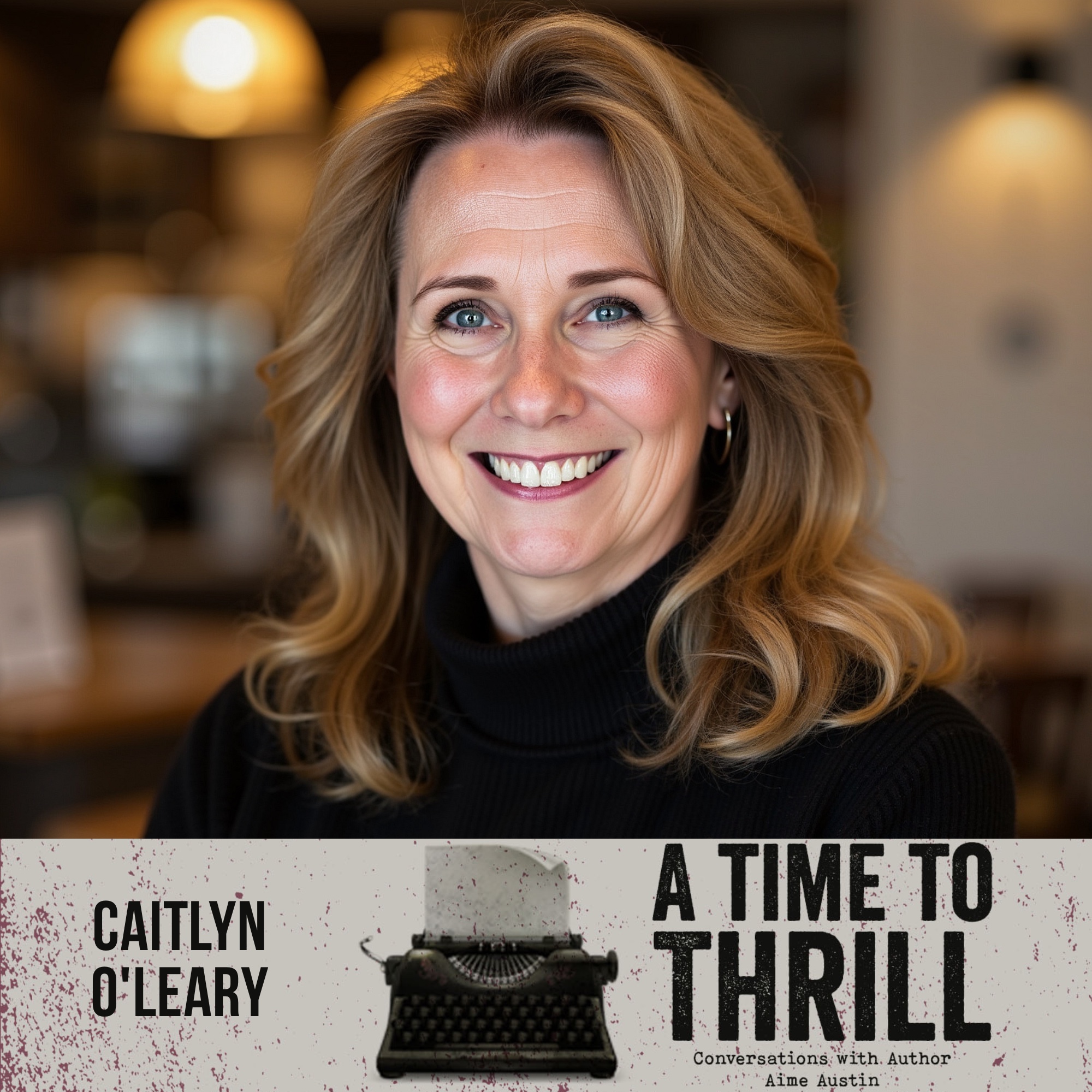
[00:00:00] Speaker A: Hi and welcome to A Time to Thrill. It's me, your host, Amy Austin. It is November and this month I have the delight of welcoming USA Today best selling author Caitlin o'. Leary.
So Caitlin, how did I meet her?
[00:00:15] Speaker B: Okay, let me think.
[00:00:16] Speaker A: So Caitlin, she actually talks about this in the podcast. I meet a lot of people. I just don't always remember exactly where I met them, especially in the romance community. Because before COVID we used to go to tons and tons and tons of different conferences and you'd meet people and actually see a lot of people at the same conferen.
But Caitlin, okay, so she used to live in Southern California, but she's from the Pacific Northwest and is back home for her.
I met her at a.
Excuse me, the hair is gonna actually drive me crazy.
I'm trying video, but what do people say to you? Okay, there we go. Sorry.
[00:00:51] Speaker B: She's gonna drive me crazy.
[00:00:53] Speaker A: So I met Caitlin at OCC, the Orange County Romance Writers. Probably about nine or 10 years.
I was like way more active in the community.
So she came to speak at OCC and then subsequently came to our. Our. I used to be a member, I guess our.
The OCC conference that we used to have every other year in Brea.
I think we used to alternate years with the Los Angeles romance writers for having conferences. That's my actually best recollection.
This is all before COVID and before RWA imploded.
[00:01:30] Speaker B: So one of the things that I.
[00:01:33] Speaker A: Admire about Caitlin and other authors of her ilk is that they had corporate experience and marketing experience before they entered the fray of book writing and marketing. And I'm here from the future to tell you that having that experience goes a long way. I didn't have it and I had to learn, as learned as I'm doing, but without the background in sort of like brand storytelling and analytics and those sort of things that I think help writers better, like market their books and figure out, like, who their audience is.
That was not something I thought about.
I didn't think about it when I was traditionally published. And later when I realized that traditional publishers weren't keeping up with the market, especially in like 2012, 13, 14, I had to learn a lot about that. And all that I have learned, it's not perfect.
And with AI, especially AI, controlling some of your advertising, that is changing.
All that said is that Caitlin writes well. She writes a number of things, but one of the things that she does write and she's written a lot of is Navy SEALs.
And on this podcast, I've actually interviewed three other authors who write Navy SEALs, most recently Lynn Ray Harris, before that Sharon Hamilton and also Cora Seaton. And I think Navy SEALS presents an opportunity.
[00:03:08] Speaker B: Let me say this.
[00:03:09] Speaker A: So Caitlin also writes small time romance. And I think what is interesting and what those two genres sort of share is it comes in sort of like a built in brotherhood community that becomes like a sort of separate character that readers can engage with and follow. And I find that utterly fascinating because it's not the kind of thing I thought about. I've written series like in romance, but that focused on LA and a group of people who sort of loosely, well, some are related, some are not, knew each other, but doesn't have that sort of sense of community that I think people look for when they look for a series so that they're really like hoping and waiting for the next story from the next book. Person who they've seen in the background.
All that said, it's a super fascinating conversation and welcome to video.
I guess I should have said that. So this is the first, not the first.
Months ago, the video capabilities for recording podcasts became available and easily.
[00:04:19] Speaker B: I could.
[00:04:20] Speaker A: Have used them easily. But to be frank, interviewing women of a certain age, I certainly didn't want.
[00:04:25] Speaker B: To subject everybody to like having to.
[00:04:27] Speaker A: Like feel that they had to appear camera ready on video. But I can't all go the way of the dinosaurs. So I am now doing podcasts in both audio and video.
[00:04:39] Speaker B: So if you're hearing this in audio.
[00:04:41] Speaker A: You can go to YouTube and watch it in video.
[00:04:45] Speaker B: All its glory.
[00:04:47] Speaker A: You get to see actually Caitlin shows the trees.
[00:04:49] Speaker B: This is the thing I actually love.
[00:04:50] Speaker A: About the Pacific Northwest. There's so many trees. So she shows us her trees and I'm sitting in the same place in my dining room. I always end in front of the picture of Cleveland, Ohio and backlit by a window because unfortunately the thing about LA is that buildings have a lot of windows. And I actually haven't lived in a place that didn't have like a ton of big windows. And there's really no wall that has a plug.
[00:05:16] Speaker B: I'm looking at the walls that doesn't.
[00:05:19] Speaker A: Have a plug or a cabinet where I could sort of sit and record this.
[00:05:23] Speaker B: Other than my bedroom, which I guess.
[00:05:25] Speaker A: The one wall without a window is where the bed is.
So all that said, join us on video.
They'll be on video going forward.
It's gonna be. It's November. It's my birthday month. Wish me a happy birthday. As I creep into my old, my old age.
And without further ado USA TODAY best selling author Caitlin o' Leary before we dive into today's conversation, I want to take a moment to thank this episode's sponsor, Audible.
[00:06:00] Speaker B: You know how much I love a good story.
[00:06:02] Speaker A: I write them, I read them, and sometimes when I can't sit down long enough to open a book, I listen to them. Lately, I've been listening to Audible while I walk, travel, or even sometimes while cooking dinner for there's something about hearing a story perform that makes it come alive in a different way. I just finished okay, Julie Chan Is Dead by Leanne Zhang, an Alice Feeney book, beautiful, Ugly and the latest Linley book by Elizabeth George.
[00:06:31] Speaker B: So I'm going to be honest, this is how I do it.
[00:06:33] Speaker A: I get a book both on Kindle and on Audible and I go back and forth listening to both. So when I'm driving in the car or with my son at some activity, I will listen to audiobooks and then when I'm home I read them on Kindle And Audible makes it easy to switch back and forth in the app.
[00:06:53] Speaker B: Honestly, I do it every time.
[00:06:56] Speaker A: I just, I want to keep the book going while I'm driving and so I just switch to the audiobook and then when I get home I switch back to the Kindle because honestly, I can read faster than I can listen.
Anyway.
[00:07:10] Speaker B: The best part is that with Audible.
[00:07:12] Speaker A: You get a 30 day free trial. You can start listening today. You get one audiobook you can keep forever even if you cancel. So if you've been wanting to read more stories that pull you in and won't let go, including my own Casey Kourtz series which are all available on audible, go to audible.com the link is in the show notes or in the alternative ebooks buzz Audible.
[00:07:36] Speaker B: Hi, it's Amy Austin and welcome to A Time to Thrill. This month I have the absolute delight of speaking with USA Today best selling author Caitlin o'.
[00:07:45] Speaker A: Leary.
[00:07:45] Speaker B: Hello.
[00:07:47] Speaker C: Hi.
[00:07:48] Speaker B: Okay. How are you?
[00:07:50] Speaker C: I'm doing good. I'm doing. I just finished a book. It got uploaded yesterday and it will be on sale and live this Friday on Halloween.
[00:08:00] Speaker B: Okay. That's as the person hasn't released the book in a while. That's so that feeling. I was just discussing that feeling with a friend who's like taking a hike. Excuse me, A hiatus from writing.
And it's such a. I don't know how to. It's not like having a baby that's overstating it, but it's a. It's like I've done this thing and here we go.
[00:08:22] Speaker C: Oh, my God. It's a relief.
I mean, yeah, I couldn't believe when it got done, but it. I don't know if everybody here understands this or your watchers understand this, but I am always a last minute person. I procrastinated since I was in second grade.
So Amazon has this thing where you have to upload it at a certain point. Okay. And I had 45 minutes left to upload it.
So I am sweating bullets. I'm like, can I get this uploaded? Can I get this uploaded? And I did by 45 minutes. So right under the bar or whatever.
[00:09:05] Speaker B: So I'm the exact opposite. I'll upload it six months in advance.
So the thought of what you just said, I might break out in hives and we can't have.
[00:09:15] Speaker C: We can't be friends anymore.
[00:09:19] Speaker B: I think I wouldn't. Like, but what if, like, what if like a tornado comes? Like, I don't know. Not that that's. You know what I mean? I don't know.
[00:09:26] Speaker C: I've been doing this since, let's see, probably 2019. I've been getting better. I've been really getting better. So the last four books before this one, I. I've gotten like two days ahead of time. I've really been excited about that. I felt so much better.
But this one was. Yeah, I. I kind of.
[00:09:48] Speaker B: So wait, I don't actually know this. Are you. Did you do the Becca Symes class back when everybody did the Cliftonstrengths and all of that? Yeah.
[00:09:58] Speaker C: Huh.
[00:09:59] Speaker B: Okay. So I assume your number one is not disciplined.
[00:10:01] Speaker C: Oh, no, no, no, no. That's way, way down. Okay.
[00:10:06] Speaker B: Way.
I'm on the discipline end. So, like, I struggle, like, with the idea that there wouldn't be like a very, like, day one. We do this.
[00:10:16] Speaker C: I do have a calendar now though. That's. That's pretty cool.
[00:10:20] Speaker B: Yeah. Okay, we won't say that. So what's the book that's coming out?
[00:10:27] Speaker C: Joy's Homecoming. So I'm kind of excited about that. But I bet you you're a plotter.
[00:10:34] Speaker B: No.
[00:10:34] Speaker C: No. You're a panster.
[00:10:36] Speaker B: Yes. So. Oh, once the.
[00:10:39] Speaker C: Do we have to explain to people what a plotter and a panster are?
[00:10:43] Speaker B: No, because we've had this conversation with many, many authors on the podcast. The idea of plotting. Okay, but that would ruin the joy of the book. Like, and I mean, is it is writing is hard enough if I have to know what it's like? How would you know what it's about before you write it? Like, I Can't figure that out. Brain wise, neither can I.
[00:10:59] Speaker C: And what's more, it surprises me. All of a sudden I'm kind of surprised. Oh my God, that happened.
Yeah. And then my audience is like, oh my God, that happened. So it works out really well, I think.
[00:11:12] Speaker B: I write to tell myself a story, so I always have these ideas. This is the hard part about writing.
[00:11:16] Speaker A: I'll ask you this.
[00:11:17] Speaker B: Like, in the beginning I have like, it's like a kernel of an idea, which is unfortunate. And then I'm like the first 20,000 words, I'm excited, excited. Like, look at, look at what's happening. And then I hit a wall. And I do it for every book. Like I now know this, but the first couple books I thought, the world's coming to an end. I hit a wall and nothing. I'm like, huh, this was such an interesting idea, but a book can't be 20,000 words. So then what happens? So that's the, then it becomes more work because I'm like, okay, well. And then I literally have to bike or walk or do something repetitively physical in order to, to like work it out, which is when my house is very clean, the banister outside. Because you know how a California is. Like I have an archway, doorway, and so basically the dust comes in, right? Unfortunately. So then I clean out the dust from the vestibule. You know what I mean? Like, this is like what I have to do. So.
Okay, how can I say this? How did you find out that you were not a plotter? Like, did. When you wrote the first book, did you try plotting?
[00:12:23] Speaker C: No, it never even occurred to me.
Never even occurred to me. I just started writing and this is fascinating.
[00:12:31] Speaker B: So wait, okay, let me ask you about the first book you started writing. Did you write from beginning? From beginning.
[00:12:36] Speaker C: Okay, so this is kind of how I got into it. Okay.
What I did is I decided that I, I wanted to write this book. Right? That's how we all decided to do.
[00:12:47] Speaker B: Yeah, I know.
[00:12:48] Speaker C: And I wanted to write something that was kind of science fictiony and I wanted to do an alternate universe and I wanted to do it in the future. So this was exciting. And you didn't start small.
I did that.
And so I sent it to three different publishers. Two rejected it and one said it would take six months before they would get back to me. And I am not a patient person.
So I immediately said to myself, no.
And then I went out and looked to see what people were asking for different publishers and four different publishers were asking for Minaj and For those of people who didn't know what Minaj was, that was the love between two boys and a girl.
And that was the point where I'm like, oh, I'm going to need a pen name for this.
And so I read like 40 Minaj books in a month. And I'm like, okay, I've got the. I've got the pattern. I've got the formula for this thing now.
So in six weeks, I wrote a Minaj book. And it was about 80,000 words. And I sent it in and they accepted it in 12 days, which was really cool.
And then I wrote four more Minaj books for this publisher in a year.
And then I'm like, okay, well, that was fun.
And then the only person. Now, I'm gonna go on a side side thing for just a second.
So after the first binage book, one of my siblings. I have four siblings. And one of them narc to my dad, okay. Who was 82 at the time. And they said, hey, Caitlin has a book published.
And dad got all excited. He calls me up, I'm living in California. He's living in Seattle. And he's like, I hear you got a book published. And I said, yeah, I did get a book published. And he's like, I want to read it. And I'm like, no, you don't.
And he's like, no, I really do. And I said, hey, dad, it's the love between two boys and a girl.
There's this pause, and he's like, I still want to read it. And I'm like, hey, dad, it's love between two boys and a girl, and they're going to exhibit their love sexually.
Another pause, and he's like, still want to read it? And then I said, dad, it's the love between two boys and a girl, and they're going to exhibit their love sexually at the same time.
And he's like, huh?
And he's like, I still want to read it. And I said, dad, it's the love between two men and a woman. And. And she has three orifices, and they're not going to be using her mouth.
Oh, it was really great talking to you. I'll talk to you later. Bye.
Okay. So two days go by, he calls me back up, and he's like, have you sent me the book?
And I'm like, oh, my good God. So I send him the book. He's the only one. I've written 63 books now. He's the only one who's read all 62 of them.
Okay. Because there was one book in the Minaj series that had a little bit of bdsm, and I'm like, oh, no, he does not get that book.
[00:16:11] Speaker B: Oh, my God.
But I love that he read it. I mean.
[00:16:17] Speaker C: Oh, yeah, he read it.
[00:16:18] Speaker B: So wait, I'm gonna ask you, like, what did he think? I mean, I don't even know. Like, or did you like.
[00:16:24] Speaker C: No, he liked it. Okay. But he did say I became a better writer after it was just a man and a woman, Just a couple.
He thought I became a better writer. So I think what I did.
[00:16:36] Speaker B: I think. I think.
[00:16:38] Speaker C: Okay, what I did next is I found out about indie writing. And then I said, oh, indie writing. Okay, I'll. I'll do that. And so I took my old manuscript, and by then I knew enough about writing that I'm like, okay, it was too much of a plot. I can't go the future and an alternate universe. So I just did an alternate universe. And so I did three of those books. And it had an elite Navy team at that point. And then I'm like, well, if I'm writing an elite Navy team, maybe it should just be Navy SEALs. So I started writing Navy SEALs, and I've written 37 Navy SEAL books. And then I started writing small town books. But some of them have. They're the retired Navy seals who come to this small town. And Now I've got 63 books.
[00:17:26] Speaker B: Okay, so I have to ask, are you retired? How old are your retired Navy SEALs? Because I know people retire from the military, like, realistically, earlier.
[00:17:34] Speaker C: Yeah, I would say my oldest now. He became a lieutenant commander, so he retired when he was 44.
Now a lot of the Navy SEALs are retiring more when they're in their early 40s or late 30s, because they put 20 years in. You know, they'll start when they're 18, and then they'll retire when they're 38.
[00:17:56] Speaker B: Okay, fair.
[00:17:58] Speaker C: Actually, I think Simon retired when he was 48.
[00:18:01] Speaker B: Okay, so what. Okay, are the. How old are the heroines in those books then?
[00:18:07] Speaker C: I think my oldest heroine was 42.
[00:18:13] Speaker B: So this is off a tangent, not where I was going to start, but what. So then what is the reception of readers to heroines in a.
In a older age bracket generally?
[00:18:26] Speaker C: I have. My readership is. And I've kind of tracked all this, and my readership is probably traditionally 40 years old and up.
So they're happy with this.
Now, I would say the youngest I have written is probably 23, but the hero was 28.
So that kind of you know, I would say my typical age range in this because there oftentimes the hero will find the girl on a mission. So he'll be 28 to 32. So she'll be something like 27 to 31.
[00:19:11] Speaker B: Okay, okay, that's so. Okay. So I think a lot about this because.
Okay, my preference and this is probably all about me is writing people in their 30s.
But I have flirted a little with them being older, but I don't know who the oldest was.
Probably not out of their 30s. I'd really have to think about it. It's a lot of books. But that's interesting. But I. From what I see in like author groups and I don't know because I'm not, as my son always says, you are not your readers.
Is that people really, readers really like younger people no matter the age of the reader. And it's something I wonder about for other people because I, because I do see covers now with older like with the gray haired people who are like often they retired military but they have gray hair or they have the beard and all of that. And I always wonder about the reception. But many authors have said to me the reception on those books and this may be the COVID So that's a different issue and is not the same as the young, younger hero covers.
[00:20:15] Speaker C: I think the sales rate. I do a lot of market research, Amy. So I think that the.
There is something where they have a new category in Amazon which is for the older demographic.
It is not as high rating as some of the other.
However, what I'll do because I usually have a team. I'll have a team that I will write. So they're usually eight to nine members on that team and they will all get a story.
Now I had Commander Clark and he, he was somebody who was recurring in a lot of the books. So we knew and that's why I'm sorry, I didn't remember that he was 48. So they were expecting his story.
[00:21:07] Speaker B: Okay, okay. That's, that's, that's a whole different relationship with the reader because I forget about the teams. Like so a lot of people, I mean I. So you're the fourth author and SEAL author I've interviewed. So Cora Seaton Lynn Ray Harris and Sharon Hamilton. Okay. So I mean, I mean you know, so these people. But the team aspect is similar to.
And I've only written a couple series romance people do. They do because people are like, so what about that brother? Like what about that brother? When do we get into the brother's story. So they're more. They're more invested in that person as a person. And less than that person is a placeholder for whatever it is, age wise. Okay, so the thing actually, I wanted to talk to you because what I think is very interesting is that you are more savvy in marketing than some of us.
Because when I met you, you were talking about marketing. I don't know.
I know I met you before COVID so maybe 16, 17, something like that, Right?
[00:22:11] Speaker C: Yep, that was about the time.
[00:22:13] Speaker B: And you were talking about marketing. And I had been in the game for all of maybe four years. And I was like, what does she say?
[00:22:21] Speaker C: Well, you gotta remember I was a sales and marketing.
[00:22:25] Speaker B: I need.
[00:22:26] Speaker C: Yeah.
[00:22:27] Speaker B: So you and a couple other people who have had that background, like Bella, Andre, something like that, are always in my mind, this is me so much more savvy. Because you've thought about, like two ends of the spectrum. It's like an interview I saw with like Geneva Rose where she was like, I just wanted a publisher because I knew I could market it. And I. That's not been my experience. So when my first publishing experience, I was looking for marketing and I came in.
Well, there's two issues with marketing, but I came in at a time when publishers weren't spending that much money on marketing, or they were. And this has always been the case. They spend money for marketing for a certain level of author, and then they wait for everybody else to see sorted out, you know, sort of like, you know, like the Hunger Games. And if you survive, then maybe we'll see.
[00:23:13] Speaker C: That's true.
[00:23:14] Speaker B: And so I didn't. I was so interested in getting published and telling a story that I had not thought about what happened after. It's like, it's like rom coms where you're like, oh, they're going to get married and nobody ever thinks about what happens after.
[00:23:29] Speaker C: Right.
[00:23:29] Speaker B: And so I didn't think about it. And when you met me, I may have been in the thick of, oh, my God. I had just gone from publisher to indie and I hadn't really thought about what happens when you sell. After you sell the first five, the first 1,000, the first 5,000, then what do you do?
And so did you come into it thinking about the marketing in the beginning? Like, so you had a traditional publisher. Did you. Had you thought about marketing then? Or was it like during the heyday where people just buy things and so then you didn't have to.
[00:24:01] Speaker C: I did. Even when I had the traditional mark, Traditional publisher, because they didn't do anything. They had their own website, so they had their own readers, but that was about it. So if I wanted to branch out at all, I had to go find those readers. And I didn't understand about Facebook ads. And Facebook ads really weren't big at that point because I brought into the game at 2014.
And so there were Facebook groups at that point.
[00:24:31] Speaker B: That's true. I remember that.
[00:24:34] Speaker C: So I had to market into Facebook groups. So I learned about that early and figured out. And there were also bloggers, and there were also.
So I wanted to get on blog posts, and I wanted those kinds of reviews on blog posts. So I spent time emailing bloggers saying, can I get you an arc?
And that's an advanced reader copy.
And to see whether they would review it and put it on their website. And then I put it into a lot of reader groups. So I probably had more readers outside of the normal.
[00:25:19] Speaker B: Yeah, no, I remember that. So in the early era, like, of.
Oh, my God, I feel so old. In the beginning, when ebooks became popular, there were several, probably more than I know, but several publishers in romance at least, who were really successful building their own universe.
And so they had a universe of readers. They knew what their readers wanted, more or less, and they could sell direct, which I'm sure made a lot of money because they could avoid that middleman. But they sold direct and they were very specific, so you could do very well. But when, maybe like around 2014, 2015, when they had to branch out to Amazon, there was a stutter.
So a lot of those. I mean, I don't even know. I'd have to look it up. I don't even know if, like, 90% of those publishers didn't survive.
Maybe there's two left.
[00:26:05] Speaker A: And.
[00:26:05] Speaker B: But. And so they didn't make that transition, but you were able, as a writer, I mean, as an author, to make that transition. So when you went indy, what was your thought about how. I was excited about it?
[00:26:18] Speaker C: I was excited about it because I was already kind of marketing on my own. And then, you know, I didn't have to pay the publisher or they didn't take a cut. So, you know, as far as I was concerned, now I am a control freak, so you might understand that.
[00:26:38] Speaker B: And teeny bit for baby, this is.
[00:26:41] Speaker C: A little tiny bit. You understand that. Okay. So they were always in charge of the blurbs that went on the back of the book, and they were always in charge of the covers. And in my opinion, they always did a poor job.
So I wanted to Write my own blurbs. I wanted to write my own or create my own cover.
And then I found my first book that I put out in that alternate universe universe, you know, was only ranked at 60,000.
And I wasn't happy with that. And I lucked out. I got to talk to Lauren Blakely and she got to review my blurb and my cover. And my cover had a Manchester half naked guy and he had a big gun kind of Rambo style over his chest.
And then I had my. My hero was Hawaiian.
[00:27:32] Speaker B: I had one good. I had to take it off because of ads, but go ahead.
[00:27:36] Speaker C: Well, back then it wasn't an issue because again, we're talking 2015.
And.
And then I had a Hawaiian and I can't remember how to pronounce his name, but he had four syllables in his name, a typical Hawaiian name. And then her name was Wakow.
Wachowski. Okay, So I had both of those names, the first name and the surname, and they were really hard to pronounce. And she's like, get rid of them. Because, you know, the, the reader is just going to stumble over those names.
[00:28:15] Speaker B: You don't want the reader to start. You don't want it frictionless, right in the blurbs.
[00:28:20] Speaker C: So I got rid of those surnames in the blurb and she said, and make your blurb much smaller.
So I probably had it 300 words. I got it down to 140 words. I didn't put their surnames in there. And I got rid of the gun on the man chest and I got it down to ranking in the 20 thousands.
So, you know, I, I got some good advice very early on and did that for the next three books. And I asked a lot of people and I, and I really studied the market. I studied which books were in the bestseller list in my genre, what was working, what wasn't working. And I think when you and I were together, I got to give a presentation at California, dreaming about covers and about blurbs.
And that was just because I had studied it so much.
[00:29:21] Speaker B: Okay, I have a thousand questions.
Can I ask you this? What do you think made you receptive to the advice? Because what I have observed over the years or that there are some authors I know who, they're like, I can't.
[00:29:38] Speaker A: Sell books, I can't sell books.
[00:29:39] Speaker B: And everybody's like, it's your cover. And to me it's obvious. Like, it actually just happened the other day. Somebody's like, I can't. My book sales have like gone off. And I was like, okay, I'M bored. Let me look at the covers. And I was like, oh, it's the covers. I mean it's like, it's the covers. And I'm. But how so some authors change the covers and some authors refuse, but then they come back asking for advice and the answer has not changed.
[00:30:06] Speaker C: Right.
[00:30:07] Speaker B: So what made you receptive to changing the covers where some people. And part of it's sunk cost theory. Like I understand that like I paid $400 or whatever it is, or I got, I hired a photographer and they took the picture, whatever that is.
But you can't, you can't make people love it. I mean, you can't make people love it.
[00:30:24] Speaker C: It's numbers.
Numbers.
Like I said, it changed the rank. So I'm always going to look at the numbers. Now if I change the COVID and my rank had gone up because you always want a low rank.
So if my rank had gone up to 100,000, I would say, oh, that was a bad choice.
And then I would have to do something else. So.
[00:30:52] Speaker B: But you're, you're willing to change in the moment.
Yeah, so. So I guess so what me, what do you think? And this may be your personality. What do you think is that willingness? Because there's such resistance on. And I've had this resistance. Like I had a cover once, I had a cover once and I was up in San Francisco and a very well known author said to me, that's not gonna work. And I was like, but I just hired exper person and I had to wait nine years to get that appointment. And she gave me this cover and she was like, do you want to sell books or do you want to keep your 400 bucks? You know what I mean?
And I, to be frank, I hung onto that cover slightly longer than I probably should have, but I eventually that covers so long, you know what I mean? Like the COVID maybe lasted like six months, probably should have lasted six weeks or less, but it lasted six months and I let it go. But I do know authors who have held on 10 years and at this point they should have changed the COVID anyway.
[00:31:49] Speaker A: Just because.
[00:31:50] Speaker B: I don't know what the because is, but I admire like, I was like, I admire your ability to make those changes. Do you think it's because of your marketing background? Do you think it's just because, like this is not working. Let me do something different.
[00:32:04] Speaker C: I think it's both.
You know, the marketing background does make me willing to change.
And I've seen, you know, where you have to pivot quickly in, in this industry, you do not want to be left behind. There's always going to be another author who could come up behind you and grab that market share.
So you have to be very cognizant of that.
And you know, if, if you're not willing to make that change quickly, then you're, you're going to be left behind.
[00:32:42] Speaker B: So I'll ask you this because I actually don't know. Did you go to the first ram?
[00:32:48] Speaker C: No, I went to the second or the third ram, but not the first one.
[00:32:53] Speaker B: Okay, okay.
Because the thing that happened at the first one that was the most startling was meeting these 30 year old authors who were like, we saw you old people and we decided to leap you.
[00:33:06] Speaker C: Oh, well, there you go.
That is true.
[00:33:09] Speaker B: Then it was, it was a moment, you know what I mean? It was just like, oh my gosh, here we go. Like I was just, I struggled a little with that because I was like, oh, they. And they didn't have the sunk cost, they didn't have all the feeling. And they also didn't have that lingering the age that like we came up with the, that we were at the bridge between traditional indie.
So most people I know had some traditional books, whether it was 10, two or one or whatever, and they had not had that. So they didn't have any of those feelings like about or any of those ideas. Because like getting your coverage changed as a traditional and published author was very, very difficult. So unless you sold X number or the series changed or you got X deal or Y dealer stuck with whatever, flip phone, weird dog, dated, whatever, oh look, there's a cocktail on there. Like so many things that we got stuck with that we accepted and then tried to work around and they were like, there's no, there are no barriers. We can change whatever, whenever.
And I, I admired, a little envious, but I did admire their ability to not be wedded to any of that stuff.
[00:34:31] Speaker C: Yeah, that. No, but I didn't see them. But that's really smart on their behalf.
[00:34:38] Speaker B: So when did you have. You had no FOMO or regret switching from traditional to indie?
[00:34:45] Speaker C: Oh no.
Oh no.
Because they weren't doing any marketing for us. There were bad covers and there were bad blurbs. Like I said to begin with, I was not, not doing well on my cover and I was not doing well on my blurb. But you know, I immediately got some feedback and was able to fix that.
[00:35:07] Speaker B: So I will say this is the oddest thing. I'm just thinking about it now. Do you remember the day, the days, the Era when Joyce Lam would do the. I don't even remember what it was. Whatever she did in USA Today where she would, like, feature books.
[00:35:19] Speaker C: Huh.
[00:35:20] Speaker B: So one of the things I did is I would redo the blurbs for some of the features.
And that's actually what taught me blurb writing. Because I looked at. Because. Because USA Today was not going to have 9 million words.
I think we had to rewrite them, and they all had to be 50 and under.
And that's when I was like, oh, this is too long. And the only ones we didn't have to rewrite were Harlequin.
[00:35:47] Speaker C: Oh. Because theirs were short.
[00:35:49] Speaker B: They knew what they were doing. Everybody else was just like. And especially, like, a lot of the smaller publishers, they would have, like 150, 200 words, and she's like, 50 or less.
I was like, wow. So, I mean, I would. That's the. That exercise was the way I learned how to write shorter blurbs because otherwise I would have meandered to the end of time.
Mm. Mm.
Yeah.
So when I'm gonna ask this, because I actually don't know this, what do you. What is it that you learn, like, in corporate marketing? Because I grew up in an era where I knew people. So when I was in college, people were like, I'm gonna be in marketing or whatever. And I honestly had no idea what they were talking about. I was an English major, and I just couldn't.
I couldn't fathom what it was.
It's like, I just didn't know.
[00:36:38] Speaker C: I was in corporate marketing. Okay. When I was in the corporate corporation, I did so many different things. I was a production manager. I was an av, did metrics. So for two years, I did metrics management. So that helped me really hone in on numbers and see everybody's productivity. I was marketing and sales vice president for a chandelier company that was selling big chandeliers to Vegas.
That's so unique.
[00:37:15] Speaker B: Okay.
[00:37:15] Speaker C: Yes. It really is.
[00:37:19] Speaker B: Okay.
[00:37:21] Speaker C: If you can imagine this sold 5 foot across, 57. 47 Magnum. 57 Magnum, 47 Magnum gun to Rihanna, all in Swarovski crystals.
Okay, okay, okay, okay. So it was all custom made. So when you think about that, you really have to change on a dime. That, yes, we can do this. Here, here. Let me tell you all the different things that we're capable of doing. You want this? Let me tell you how we can do that for you, how we can manufacture this. Let me tell you our capabilities.
So that's what marketing was in my world.
[00:38:05] Speaker B: Okay, okay.
[00:38:07] Speaker C: So my. My job was to explain our capabilities and really get people thinking more than anything, thinking outside of the box and thinking how I could draw them in and draw their interest.
[00:38:25] Speaker B: So, okay, so how does that translate to books? Like, I just. This is the thing. When you're saying this, I can sort of see it, but my brain is just like, okay, like, it doesn't.
[00:38:36] Speaker C: Well, it's the same thing for books. Okay, how can I take something? Because I would often make a flyer for different design firms and say, hey, look, this was our process. You know, we. We had welders, we had a foundry, we had, you know, blacksmiths. So this is all of our capabilities and look at the pretty things we could make.
So aren't you interested in working with us?
So, hey, this is the pretty picture, the COVID Here's the blurb telling you what's inside the book. Aren't you interested in reading this?
[00:39:22] Speaker B: Okay, okay, I hear you.
I mean, because obviously not obviously I read a lot and I've thought about over the years, what is it that makes me read a book?
And I.
[00:39:36] Speaker C: Is it the COVID Are you a cover girl or a blurb girl?
[00:39:40] Speaker B: I don't read blurbs because there was an era. I don't actually know if this is true anymore because I don't read blurbs. But like in the late 80s, early 90s, New York books spoiled the book and blurbs.
[00:39:53] Speaker C: Yes.
[00:39:53] Speaker B: After that happening a couple of times, I couldn't. I need to come to a story completely fresh. I can't know what's happening. That's me. That's not everybody. Some people like to know what happens in the end. I'm like, I gotta walk in, like, with blinders. So I stopped reading blurbs. So then it had to be the COVID or the. Where it was slotted. So it's like, if this is going to be crime fiction, then I assume it's going to have these elements. And so. But I read a lot of dots. I mean, honestly, like, I used to be a completist. I had to read everything. I also had a lot more time. So I would just read everything and.
Okay, I'll tell you. I know how I know it's covers, especially for women's fiction at some point. So the libraries always have free books for sale. And I'm going to be honest, last week I managed to walk by. I was so proud of myself. The guy's like, are you gonna stop? And I was like, no, I'm not gonna stop.
But at some point, I brought home the same Three copies of the same book that I hadn't read. It was only my son. He was like maybe five or six. And he was like, you already have this book. And I'm like, what? And he goes over to the shelf and he's like, you have this one and you have this one. Why do you keep bringing it home? And I was like, oh, love the COVID I can remember it's a woman with her hands behind her back, she's wearing a hat. I don't even know what the book is now at this point, read the book. The book did not live up to the COVID but something about the COVID was so compelling that I bought it. Bought it or bought it?
Borrowed it.
[00:41:22] Speaker C: When we're done here, you're going to look at some covers for me.
[00:41:26] Speaker B: I know.
[00:41:27] Speaker C: So, yeah.
[00:41:29] Speaker B: So do you think, okay, so. But you think, okay, so there's different readers. So you think some readers are cover readers and some readers are readers?
[00:41:36] Speaker C: No, no, no, no. I've actually done. Because I've got a fan group of 3700 on Facebook, so I've actually done surveys in my group to ask them how many of you are cover people and how many of you are blurred people. And it usually comes to 50%.
[00:41:53] Speaker B: 50.
[00:41:53] Speaker C: 50.
[00:41:55] Speaker B: So you're selling different people, different things. I mean, that's right. You're attracting different people for different reasons to the same product.
[00:42:02] Speaker C: I know that it's. It's just as important to do a cover as it is a blurb.
[00:42:08] Speaker B: Okay, so I'm gonna ask you this.
[00:42:09] Speaker A: What is it?
[00:42:10] Speaker B: Because I know covers better, maybe because I'm attracted to them is because it's what you see first, frankly, because they're larger. What do you think it is about a blurb? Oh, my gosh. I have to think about it. So I will read blurbs. Like, if I'm looking at, in a research point of view, if I'm looking at like, what are the best selling psychological thrillers right now? And I will read the blurbs or I read the blurbs of women's fiction, which actually I have a lot of problems with because they're like, she's going to find the true meaning of home. Her dad died and she's going to go back and look in the attic. Her mom died, she's going to go back and she's looking in the attic, and it's on a beach or it's in the mountains and she's going to find the true meaning of love, home, friendship, whatever. Like, so I've read those I wish they were different because I love women's fiction, but I'm always like, do I want this right now? And it may be a completely different story, but they have decided that that is the funnel that we're going to put you in.
[00:42:57] Speaker C: Right? But it's nice to know that that's what you're going to get. And you're like, okay, read this 47 times. Not interested in this.
[00:43:06] Speaker B: Not today.
[00:43:06] Speaker A: No.
[00:43:06] Speaker B: No Adirondack chairs today, people.
[00:43:09] Speaker C: Okay? So I want something with a different hook, okay? I want something where somebody. For me, I want, like, I would say every fifth book that I write, even in the Navy SEAL series, because I've written 37 of them. You know, I want the wounded hero. I want somebody who's suffering from PTSD and he needs the. The woman to kind of step up. So I'll mention that in the blurb. And for me, some. Sometimes that's what I want in the book.
Okay? So I'm going to mention that in the blurb, okay, Here. I want somebody who's going to be his partner and kick ass just as strong as he is, and they're going to fight together and partner together against the bad guys. So I'm going to mention that in the blurb because that's the mood I'm in right now.
[00:44:02] Speaker B: So then let me ask you this. Is your aim that all of your readers read all of your books, or is it your aim that, like, if the people love the piece of PTSD and I've read a couple of them, and I. Well, I'm 50, 50 on it, depending on how it's handled, then I'm in the mood for that. Especially if they're isolated, because then they have to deal with their issues. But that's my particular thing. I'm like, oh, he's gonna have issues, and they're gonna be stuck in a cabin. Yay. But do you.
[00:44:25] Speaker A: Or.
[00:44:26] Speaker B: Or do you. Are your readers like. I like that. I like the wounded hero. I like the strong hero. I like the hero who's coming back home. I'm like, the hero has to move to a new place or whatever. Are they looking for different things, or do you want your readers to be satisfied by everything? In the sense that I know I'm going to get a Caitlin o' Leary book, and it's going to give me X, y, or Z feeling?
[00:44:44] Speaker C: Okay, I have had it to where the woman is a victim. Okay. I've had it to where she is really, really strong. I've had it to where she has a PhD. I've had it where she is a waitress. I have had it to where. So. So we run the gamut on. And, you know, he's always a Navy seal on these 37 books, but this guy handles everything with humor. This guy is the one who's been traumatized. This one, you know, has no filter because we. We've read about him, and he's. He's just got the emotional depth of a mud puddle, you know, so.
[00:45:29] Speaker B: One.
[00:45:29] Speaker C: Of my readers, and I kind of like how she's explained it. You know, I pick up a Caitlin o' Leary book, and it's like a box of chocolates. I never know what I'm going to get.
[00:45:38] Speaker B: Okay.
[00:45:39] Speaker C: And I like that.
[00:45:40] Speaker B: But she knows she's going to get. Be satisfied. Let me say that.
[00:45:43] Speaker C: Yes, she knows she's going to get a happily ever after. She knows she's going to get some suspense. Okay, There you go.
That's what she knows.
[00:45:52] Speaker B: Okay, so did you know that those two elements were the hooky elements in your books at book one versus book 37?
[00:46:03] Speaker C: Yes, because I always read.
So when I was 12, I was reading the Neighbors, Harlequin romances.
And then when I was 14, I was reading James Bond and Robert Ludlum. And then when Tom Clancy came on board, I was reading all the Tom Clancy.
So I really like suspense, and I really liked romance. So when romantic suspense, I saw that coming in, I'm like, oh, my God, that is my pocket. That's what I really like.
So I want to write that. Even when I was writing the alternate future or alternate universe, it was romantic.
[00:46:42] Speaker B: Suspense at its core. Okay, so did you know when you started that you had this core story.
[00:46:49] Speaker A: That you want to tell?
[00:46:50] Speaker B: Because what I have learned, like, I'm in. I'm on book 30. I finished book 30. I have 29 out. When I wrote maybe 15, 20 books, you started to realize, oh, I like to tell a certain kind of story. But I don't think if you had asked me on book one. Well, book one was a horror show from. It was just hard. But if you had asked me on book one, I would not have been able to give you that information.
I would have been like, no, I'm telling this one unique tale. You know what I mean? But by the time you've written enough, you're like, oh, this is what I like. I like damage terrorists who are a struggle both in, like, romance. I like heroes who not. I like beta heroes. I do love them.
Love them. Sorry, Love them.
Who Are emotionally intelligent. Like I have a specific. Like, I can see it now. It's as clear as a bell. But at the beginning, I didn't know that. Did you know that that was like the pocket that really like drew you in at the beginning? Or is it only like 63 books in knowing then what it is that you. The kind of story you like to tell? I guess.
[00:47:57] Speaker C: No, I knew I wanted romantic suspense right from the get go because even with those Minaj books, I was putting romantic suspense in by the second book.
[00:48:06] Speaker B: Wow. Okay, so that's a level of self awareness I do not have. How did you become a. How were you aware of that? Was it the kind of story you like to like to.
Did you want to put the best elements of the things that you like together? I guess is what I want to say.
[00:48:21] Speaker C: Rephrase that question.
[00:48:24] Speaker B: What made you.
Okay. Romantic suspense has. Okay, when we were younger, romantic suspension. Spence was sort of marginal. I don't want to say marginalized. Yeah, it was.
[00:48:33] Speaker C: It was a very.
[00:48:33] Speaker B: It was on the margin.
[00:48:34] Speaker C: Yeah.
[00:48:35] Speaker B: So what made you think about putting those together when it's not contemporary romance, historical romance? I mean, there's like two, like powerhouses, right?
[00:48:44] Speaker C: And I'll read anything. What. What made it. Like I said, I just loved.
I. I loved the James Bond, the. The Robert Ludlum, the Tom Clancy so much. And if you think about Robert Ludlam, who wrote James. James Bourne, Jason Bourne, that was romantic suspense. He always had that. That woman with him.
Okay. You think about Tom Clancy and you think about his wife. Okay. There's a lot of romantic suspense that's going on in there.
Okay.
[00:49:21] Speaker B: You're making me think a lot because I write romance and I write suspense. I've never wanted to put them together ever.
Okay. But.
[00:49:28] Speaker C: But they. They had that and I just wanted to turn up the volume. I really like a happily ever after, so I really wanted. But Jason Bourne, there really is. That girl is with him the entire time.
She is fighting right beside him.
[00:49:46] Speaker B: Okay, this is true. This is true. This is true. This is. I'm like, I. Yeah, I don't think I thought about it that way.
[00:49:54] Speaker C: So I really wanted to have my happily ever after with things that go boom.
[00:50:01] Speaker B: Do you think, though? Because, okay, as you're saying this in my head, I'm picturing picturing the Lovelam covers, which I can see a lot of them.
[00:50:08] Speaker A: I don't know why.
[00:50:09] Speaker B: Maybe they were like prominently featured in bookstores and I can see romance covers and those two do not have a middle ground in like 80s and 90s, in like book covers. So then how did you land on what that was going to be, gun notwithstanding? But you can't have that. But how did you land on what that was going to be to. To broadcast what the book was about separate from a blurb?
[00:50:35] Speaker C: I think by the time.
I think the only ones that I was reading at the time that was. Were true romantic suspense were Janita Lowe and Suzanne Brockman.
Those were the two.
Other than that, I. I didn't see romantic suspense out there until I started writing. Then I saw Susan Stoker and Marianne Jordan was also writing it at that point.
[00:51:10] Speaker B: That's true.
[00:51:12] Speaker C: And so I came up at the same time as a lot of other romantic suspense people.
[00:51:18] Speaker B: Okay, I see. I, I see. I, I see. Like, I just, I'm thinking about it in the time.
Yes, yes. Because the 80s and 90s were different than now. Yeah. The time before that there was. I. I even know the Harlequin line has the purple cover. I just can't think of what that line was called that had desire.
[00:51:38] Speaker C: I think it was known there was suspense. There was suspense because I know one.
[00:51:43] Speaker B: Writer who did it from la, but I don't know.
I don't even know when those started. I don't think they were always around.
[00:51:49] Speaker C: They. They weren't. They absolutely weren't.
So I know that that just made me happy. Now if you were to ask me what I would ultimately like to do and, you know, this is something after I am done just writing and you know something that maybe 10 years from now I would like to write something along the lines of Pat Conroy.
[00:52:16] Speaker B: I was just thinking about Pat Conroy yesterday. Hey, sports fans.
[00:52:20] Speaker A: Sorry.
[00:52:21] Speaker B: I don't know. Like, I just was thinking about. I was actually thinking about him talking about books being autobiographical and his relationship with his family after writing the books. I was thinking a lot about that.
Yeah, that. Those books. This is so interesting. I was just thinking about it yesterday because I. I don't think about Pat Conrad every day, honestly. But those books really affected me. I don't know, maybe I was like 15, 16. I'd have to think about it. I think I was in high school at the time. I read those, like those books and they, for some reason, they affected me so much. But I can't think of. What would you call that genre then?
I was gonna look this up yesterday, but I never got to it.
[00:53:00] Speaker C: I. I'm not quite sure, but, you know, I've got the Irish Catholic background. There's mental illness in My family. So I really, you know, go and. And relate to that.
So I. That is something.
[00:53:14] Speaker B: So. And I.
Because I was thinking about this week, the impact of that was so great, but I've never. And I was thinking about this yesterday. I was gonna look it up, but then, I don't know, I had to drive myself on somewhere. I haven't delved into why those books impacted me and why I never looked for more like them. It was sort of like a thing that felt unique. And then I went back to the. The two or three things I liked.
[00:53:39] Speaker C: Yeah, I'll reread Beach Music. I'll reread the. Not the Great Santini so much as I'll. I'll reread Prince of Tides in Beach Music.
[00:53:51] Speaker B: Oh, for me, it was the Great Santinian Beach Music. The most that really. I think about it when I think about, like, great books that have, like, I thought about. I think about it often, but not to this extent that there's some authors I just like, think about a lot more.
[00:54:08] Speaker C: But, yeah, Ludlow's one and Webb Griffin is another one that I really like.
Okay.
And that's helped me a lot for what I write.
[00:54:22] Speaker B: Okay. So who did you. Who were your formative writers before? So who did you read when you were younger? So you read the Harlequins. That's the thing a lot of us did, which were anonymized on purpose. Like, I mean, they sold series, and they sold them in a certain way that.
How can I say this? I feel that we as readers were not encouraged to follow a specific writer. And now I understand the reasons for that and the reasons for people having all the pen names and all of that. But those books, for me, had.
I found the storytelling compelling. But I was really young, and I couldn't have told you why. In my teens, I found it compelling. What was it for you that got you like.
Like, you know, what did they. How did you.
[00:55:03] Speaker C: There were a lot of bad writers, as far as I was concerned. There were.
[00:55:08] Speaker B: But they were short, so you could, like. No, next.
[00:55:12] Speaker C: You know, I immediately. Okay, there was Nora Roberts. There was Lindsay.
[00:55:18] Speaker B: Oh, Joanne Lindsay.
[00:55:19] Speaker C: Okay, Joanne Lindsay. And there was Diane, who was Diane.
So we also had Jennifer Green, who was also Jeannie Grant.
[00:55:33] Speaker B: Yeah, I know. I remember those. They all had the names. Because when I figured that out and I was younger, I started looking at copyright pages. I was like, oh, so Billy Douglas is also Barbara Delinsky, who's also. And I was like, got it, got it, got it.
[00:55:47] Speaker C: So it got to the Point where I would only read certain authors in that same thing.
[00:55:52] Speaker B: Yeah.
[00:55:52] Speaker C: Huh.
[00:55:53] Speaker B: But do you know what it was about those authors? Because I've gone back, so I have a lot of these books on my shelf.
Like the things I don't. The things that crowd my house, that really walk by the book, the sale. I was like, I don't have any space. You know that, right.
Do you know what it was about those authors that was compelling? Because I now know, like, I now know is like those family. For me, family stories or God knows, a locked cabin. I still to this day, I don't know what it is I love about that.
[00:56:20] Speaker C: For me, it was always the emotional depth. Okay. When. When we really.
It was the emotional depth of the hero so often.
Okay. In those harlequins, we only got to see it from the woman's point of view.
[00:56:40] Speaker A: Those.
[00:56:40] Speaker B: The one point of view days. But.
[00:56:41] Speaker C: Yeah, yeah.
But even Jeannie and Jennifer Green, and she was, in my opinion, she and Nora were the best at giving us a good, well rounded male figure in their books.
[00:57:00] Speaker B: Okay, that's interesting. Okay.
[00:57:03] Speaker A: Huh.
[00:57:04] Speaker B: Okay, I'm thinking about this because the ones.
Okay, now I'm gonna have to go look at the point of view because I remember when the first time we got like dual point of view, but that had to be the mid-90s. It was much.
[00:57:15] Speaker C: Yeah, but these were even from just the female point of view, you know.
[00:57:20] Speaker B: But they still were able to paint a sufficient hero picture because I often felt that the hero was like, like, I don't say a cardboard placeholder, but honestly, kind of.
[00:57:27] Speaker C: Yeah, yeah, but they, they did a nice job at explaining, you know, the guy's point of view and the guy's depth for us.
[00:57:37] Speaker B: Okay, that's fascinating. Okay, okay.
[00:57:41] Speaker A: Okay.
[00:57:41] Speaker B: So I get that. But then what did you later get out of, like the Ludlam books? Because those are. They're written so differently. Like they're more about pacing and action or moving the story forward and less about how people feel, you know? Yes.
I'm in a hurry. I don't have time for a conversation, but I feel I gotta go. Chase. Absolutely.
[00:57:59] Speaker C: Okay. I. I could read 800 page Ludlam book all night and into the day and then call and sick to school.
Okay. And I was really good at forging my mother's name. Okay.
[00:58:15] Speaker B: I was excellent.
[00:58:16] Speaker C: Yeah.
[00:58:17] Speaker B: Okay.
[00:58:17] Speaker C: By God, you know, I'd go into that principal's office and. Or vice principal's office with a note really easily.
[00:58:26] Speaker B: No, I remember I read something years ago. It's like, oh, you know, when you've already decided to give up tomorrow, you're like. And it's. For me, it's always like 2am and you're like, just one more chapter. And by 2am you're like, so what I'm going to do is I just letting go tomorrow right now. Like, I'm just going to finish that. But they were so good. What I loved about the pacing of the stories, which I didn't always get in romance and I've tried to incorporate actually my own romance, was that hook. Like, you get to the end of the chapter and you're like, I'm gonna put this.
[00:58:53] Speaker A: And then they had that one line.
[00:58:54] Speaker B: And you're like, I'm just gonna turn the page, just gonna flip it, and then you're in. You're like, you know, lights on, like dawn coming, you know.
[00:59:04] Speaker C: And I only think I got good at the, the, the end of the chapter.
On my 30th book, I'm only good.
[00:59:14] Speaker B: Intermittently, and I know it. Like, I think if I were a better person, I would go back and really work hard to rewrite those hooks. I don't, because I'm a pants and I'm not that interested the second time around, unfortunately, looks dead to you after.
[00:59:26] Speaker C: A certain point, but it's.
But I really think it wasn't until my 30th book that I really started thinking of ending that chapter on a hook.
[00:59:39] Speaker B: It's. Well, it's hard. I'd. If it were easy, I guess I would do it. So. For me, exactly.
It's hard, but I do, when I see it done, I love it. And I'm always like, oh, I love it. And there's an author I love to death. And I read her for a different reason. But I remember putting. So she just came out with a book and the book's probably like 800 pages. And I was like, okay, I gotta, like, savor it. Because she's only writing one a year or one every 18 months, so I gotta savor it. And the way I was able to savor it is that I knew at the end of the chapter it was just gonna be like the chapter was just gonna end and the next chapter may or may not relate, you know. And that made it easier for me to stretch the book out for like a week.
But I. But for some authors I'm looking for, and I rarely do this, so I did. I'm not saying this because I would not write like, this lush storytelling. Like, she was describing the English countryside I'm not a lover of the English countryside. I mean, I've been to the English countryside more than once, and I thought, oh, this is so interesting. I just want to live in this English countryside for a moment. And that is okay. You don't have to move the story. Story forward.
But I can be honest. 80 to 90% of books I don't think readers are reading for. There are some readers who love lush description. I'm not saying that. And Kristen Ashley can have that corner of the world, but I don't think. Think that most readers are looking for that. They think they like this compelling story more than they may love the lush description.
[01:01:05] Speaker C: I will agree with that. Well, and you tend to write what you like to read.
Okay. So I, I'm not going to get into what somebody's. Speaking of. Kristin Ashley. I'm not going to get into what somebody's wearing.
It's just not going to happen in my book.
[01:01:24] Speaker A: Books.
[01:01:26] Speaker C: Now. Right now. I, I'm always looking for the next Nalini Singh book.
Okay. You know, when's that coming out? When's that coming out? Because I know that, you know, the next day is.
It's going to be finishing up her book.
[01:01:44] Speaker B: I'm wrestling with that. I was like. Because I was like, okay, well, it's 10:00am It's 2:00pm oh, well, you know what?
You know what?
Today's just gonna go.
So I'm gonna ask you this because this, like, came up recently.
How do you feel about being someone's favorite author?
[01:02:08] Speaker C: I, the, the highest compliment I ever get is hearing that I'm somebody's rereading.
Okay. And I am amazed when that happens because I have people that I reread, you know, for comfort, for whatever. And I'm like, no, I'm reviewing. You've got to be kidding me.
And, and I'm just amazed. I, I cannot believe that I, you know, I'm, I'm like, I want to write back to them on Facebook and say, for real.
[01:02:45] Speaker B: How do you, how do you integrate? The reason it came up is because. So I'm reading. So one of my favorite authors is Elizabeth George. And one of my readers who says I'm her favorite author recently rated Elizabeth George's new book and only gave it, like, four stars. And so I look over at my son, and I was like, well, how did she give her four stars? Because she's a better writer than me, and I would always give her five stars, but she gives my book five stars and this woman the four star. And so and he's like, but if she's your favorite author, you have to be other people's favorite author. And I was like, but I can't.
In my head, they would love these other people. Like I do. You know what I mean? Like, you know what I mean?
Because I can't be my favorite author. Maybe I am. I don't know. It depends on the day, but you know what I'm saying? Like, I just, I was like, but, you know, there's better writers out there.
[01:03:33] Speaker C: Yeah, and I absolutely do know there's better writers out there. But it comes to the point, point where it's just taste.
It comes to the point where it's just, you know, I'm going to like this kind of ice cream. I'm going to like this kind, you know, chocolate chip mint versus cookie dough versus strawberry. Now, you know what's in my freezer?
[01:03:58] Speaker B: I like mint. My son doesn't. So he has chocolate, some plain chocolate chip, something. And I taste those two. Sweet. I didn't get it.
So it stays. He's like, you didn't eat any. I was like, yeah, we're good.
[01:04:10] Speaker C: But you know, and there's different times, but that's just what happens. And I'm like, well, okay.
Hot damn.
[01:04:19] Speaker B: So what do you. Oh, I'll ask this now. Do you. Okay, I'm gonna ask you two questions. But first, do you read as much as you used to?
[01:04:27] Speaker C: Yes.
[01:04:28] Speaker B: Oh, you have. Okay. Because I have found, like, actually Zadie Smith said this once in an interview, and I thought, yeah, the, the only thing I like more than writing is reading. But I can't do both at the same time. Like, if I'm literally writing, I can't be reading. And I think I could put this down readable. I mean, like, I get to put this down and read a book.
[01:04:46] Speaker C: I can still read something like Tom Clancy or something like that James Patterson, but I can't really read romantic suspense because I'm afraid it'll get into my head. So, like Riley Edwards, so a Susan Stoker can't read that I am going to be coming out with a paranormal romantic suspense series.
So I'm afraid I'm going to have to give up Nalini Singh, which is just going to kill me.
It is that. That's coming out next year.
But yeah, so I'll read billionaires. I'll read, you know, a lot of different things that are just not in my wheelhouse that I'm writing. And I'm writing small town romantic.
[01:05:44] Speaker B: Okay, so what primary genre okay, wait, no, no, let me go back and ask the question. It just came in my head.
Okay. What came to my head is Murder, She Wrote. And I was like, if I lived in this town, too many people die.
I can't live in Cabot Cove. How do you write small town suspense? Because I'm worried that there's too much happening in a tiny town where I can't visit unless something happened to me.
[01:06:12] Speaker C: Good point.
Oftentimes, you know, it'll be something that the person is.
It's happening in la, and they're bringing that back from LA to Jasper Creek, Tennessee, and then they have to go back to LA to resolve. Does that make sense?
[01:06:38] Speaker B: Okay. Yes. Not. Not a lot of bodies in Cabot Covenant.
Yeah. Correct. Okay. Okay. So the question I was gonna ask before that, and it's actually like my last question for you is, what do you.
Not. What are you reading now? So much. But what kind of things?
Okay.
[01:06:54] Speaker A: How.
[01:06:54] Speaker B: Knowing how the sausage is made. What kind of books, like, pull you in now or attract you?
[01:07:03] Speaker C: Like I said, it will be. Nalini Singh is.
I, I like world building.
I, you know, even I don't like the new Tom Clancy when it's not Tom Clancy.
[01:07:21] Speaker B: Well, there's something to be said. There are money making decisions involved in many of these things, like David Patterson or anybody. Like, I understand branding. I get it now. Like, I got it.
[01:07:31] Speaker C: I like Nora Roberts.
I like her J.D. robb series.
She will pull me in. Rourke pulls me in. I just, I like that character so much.
And the world building of that future, I just, I think she does such a fantastic job. So when I think about it, it's the world building.
Does that make sense?
[01:08:02] Speaker B: No, I hear what you're saying, because it's not. I have a different thing that pulls me in. What pulls me in is a sense of injustice. But that's, you know, that's a different. That's a whole different thing. World building I find fascinating, but it seems like a lot of work. Like, it's a lot of work to read sometimes for me because I'm like, oh, I gotta absorb all this information or it's a lot of. And I don't write it because I can't. I can't even imagine it. Like, I can't imagine the work would be involved.
[01:08:28] Speaker C: Right.
And then I will say it's going to be the angst. I always like angsty books, New adult.
[01:08:41] Speaker B: Well, I had some issues. I still have issues with new adult, but the angst level where people had turned that up. I Was like, oh, this is you. Like, that I love. I was like, oh, okay, I'm in. I mean, they're 22 and they're like, if my issue with new adult is like, they're 22, like, in 10 years, nobody's gonna give care two wits about this. But also.
[01:09:02] Speaker C: Oh.
[01:09:07] Speaker B: So, I mean, I get it. I.
Unfortunately, I get it. Okay, I'm gonna ask you one last question. I just thought about this.
When you switch from Navy seals to not switch, but switching, I guess in your head from like, Navy SEALS to like small town, how was that a hard. Is it. Is it a hard transition? Because I recently. I think about this because I recently wrote a book that was the first standalone I had written in I don't know how many years. And I realized how much world building a series does for you and how much heavy lifting it does for you. So the characters are there. Everybody lives in a place they. Everybody has it, like a. A role. And all you have to do is, like, evolve that. And when I had to sit down and write a book, I was like, oh, she has to live in a place. She has to have friends. Like, I'm like, she has to have, like a life. She has parents. Oh, my God. Like, I was like, oh, my God, I have to create like a whole world. Like, and that was just like a modern day LA world. It was not like no magic, no nothing, but. And I found it not daunting. Let's just be honest. Daunting.
And. But I hadn't done it 10 or 5 years. Who knows?
Did you find that transition?
I don't say daunting. Just how was it? How was it?
[01:10:24] Speaker C: Because I have this formula in my mind is I'll. I'll spend probably 75% of the time on the characters.
So then I will spend probably.
[01:10:43] Speaker A: No.
[01:10:43] Speaker C: I'd say 70% of the time on the. On the characters, probably 15% of the time on the suspense.
Okay, so if I know that's going on, then that leaves 10% on the. The characters in the town or the town itself so I don't have to kill myself. And then the next one in the series, I build on that other 10%.
So it wasn't daunting.
[01:11:13] Speaker B: Oh, that's so interesting. I'm gonna have to think, well, the book's written, so I guess I can't go back. It was just. So I've been thinking about writing more standalones because I got too deep in the series, like. And I, like, you know what I mean? Like 15. It was 10. And then it was five. And I was like, oh, I can see, like, people do read them all. I mean, I get up those emails, but that's a lot to like, you know, hand over. But then the thought of writing another stand and I'm like, oh, she's got to have parents too.
She can't. What? They didn't come out of a cabbage patch.
I created what.
So I do find it daunting. And yeah, I don't think about that right now. Right now I'm going to think about something else. It's just a lot. And actually yesterday when I was texting with my friend, she was like, have you thought about writing another spin off series? And I was like, very much so, yes.
Because I'm like, I have a character. I know where they live. I know her job, I know her background.
[01:12:10] Speaker C: Yeah, yeah. The metrics manager in me comes out a lot because I. I do think in percentages and stuff like that.
[01:12:18] Speaker B: Well, what. That's what she said to me. She was like, we're discussing book sales of another author, actually some other money else's book sales and what a standalone did to her book sales. And it didn't go well.
And we were all surprised, the author and then my friend, because we were like, but people keep saying they want something different. The reviews were great. Why weren't the sales great? And they were like, but they just want Jane and Jean or whatever it was they wanted.
And so she was like, but if you do the metrics and you do a spin off, don't you think you'll have those same readers? And I was like.
[01:12:53] Speaker C: Yes, it's the third book. That.
[01:12:57] Speaker B: That's the thing. We were just talking about that. She was like, it's the third book. And I was like, I hear you. But then that's an investment in the future.
And with the books, with the book market changing, I have feelings personally right now about investing in that future because the. Have you noticed. And I know I'm asking another question.
[01:13:15] Speaker C: Have.
[01:13:15] Speaker B: How have you adapted to the changes? Because it's been.
It's been a roller coaster.
[01:13:20] Speaker C: Well, did you know that from July 2024 to July 2025, there are 21% more romance books?
[01:13:34] Speaker A: No.
[01:13:34] Speaker B: Okay. Yeah. Okay.
I get overwhelmed. I'm gonna be honest. Like, at this point, even I do not look at Amazon anymore as a discovery tool. I don't even look at goodreads as a discovery tool. I'm in a group on Facebook that is a very specific group that's just like, minded People. And that's where I get my recommendations. And I was like, somebody. I met somebody, like, literally at a party, and she was like, let me tell you about this group, because I think we're the same. And it's like, the best thing that anybody ever did for me in the last year. I was like, oh, this saves me. So, but then how do you handle discoverability? This is the problem we're all having. Like, the problem we're all having is discoverability in this challenging market.
[01:14:19] Speaker C: Well, for me, I think it's two things.
I think you have. You're doing the right thing by having this podcast because it's branding.
You have to be known.
You absolutely have to be known. And you have to have your readership.
You have to have readers who want to follow Amy.
[01:14:49] Speaker B: Okay, I know this is the conversation I was having an hour ago, but, yes, okay.
[01:14:53] Speaker C: Because I personally think there are going to be more and more AI books that come out.
[01:14:59] Speaker B: I see.
[01:14:59] Speaker C: Just flat out.
And so you've got to have a dedicated readership to Amy.
And number two, I think we have to be smart in.
In putting out books. You know, it isn't just a matter of.
It isn't just a matter of, hey, put out books, but put out books consistently. And by that, I mean, if you know you're only going to put out three books, well, you figure out the right time in the year so that it is, you know, every four months instead of, hey, two months here, six months here, and then three.
[01:15:44] Speaker B: Yeah, that's what you talk about. Yes. So many. Yes.
[01:15:47] Speaker C: Oh, okay.
[01:15:48] Speaker B: See?
[01:15:49] Speaker C: See, I'm telling you stuff that you already know.
[01:15:52] Speaker B: I know, but what we struggle with, like, the groups of authors I know, is implementing that, because sometimes people are like, but it's done. I can't hold back. Or I'm gonna hold them all back, and I want to release them all at the same time. But then there's going to be a gap of 18 months. You know what I mean? Like, that's the.
[01:16:07] Speaker C: I.
I know, but you got to think about, you know, you've got to feed your readers in a consistent manner.
Okay. So that they. They will know I'm getting an Amy book, you know, every four months.
[01:16:26] Speaker B: Oh, the places we go. So with that said, I want to thank you so much for doing this interview and taking the time out today.
And now that you are not in California, we miss you all down here. But then you also, you have trees. You have many, many, many trees.
[01:16:44] Speaker C: I do have trees.
[01:16:46] Speaker B: I do have trees. And I'm Slightly envious of the.
I'm from the east coast and I miss trees.
[01:16:51] Speaker C: See all the trees? I don't know if they. Yeah, you can see all the trees.
[01:16:55] Speaker B: Oh, God. See trees.
[01:17:01] Speaker A: Out back.
[01:17:02] Speaker B: There's like the neighbor's juniper. They have a pool so they don't have any trees at all. And like the juniper of the neighbor, like too. You know what I mean? Like, that's.
That's it. And whatever. Outside the jacaranda and the.
The things that we shouldn't have.
[01:17:16] Speaker A: The.
[01:17:16] Speaker B: Not that the fig trees. The other ones. I'm so sorry. The ficus. The ficus.
So many LA regrets. Like, they're like, we shouldn't. I love Ellie. Like, we shouldn't have planted those. I'm like, yeah, they're like, now we have a side perpetual sidebar problem.
[01:17:30] Speaker A: Like.
[01:17:30] Speaker B: Yes, you do.
Yes, you do.
And then the. Even the trimming the palm trees, which are lovely but no shade.
So I thank you for speaking to me. I admire the fact that you live back where the trees and cool weather.
[01:17:49] Speaker C: And my 95 year old dad is.
[01:17:52] Speaker B: I know who I'm. I. I'm sorry. I love the story. I. I love that there's somebody who's on all of them who like loves you in that way.
[01:17:59] Speaker A: It's.
[01:17:59] Speaker C: Yeah.
[01:18:00] Speaker B: It's a gift. Enjoy it.
[01:18:03] Speaker C: I do.
[01:18:04] Speaker B: All right. So Caitlin and Louie, thank you for taking the time to speak with us today and have wonderful writing.
[01:18:12] Speaker C: Thank you so much, Amy.
[01:18:16] Speaker A: Bye the time. Welcome to Throne with me, your host, Amy Austin. If you enjoy today's episode, I'll help you share, rate and leave a five star review on Spotify, Apple Podcasts or wherever you listen. It'll help others find and enjoy my conversations with brilliant women creators. Also, please hit the subscribe button on your podcast app. In addition to hosting this podcast, I'm an author. My latest book, His Last Mistress is out now. Check out the five star reviews. Get your copy before someone else spoils the twist. I'm also the author of the Nicole Long series of three eagle thrillers. The first four books in the series are now live. You can download outcry, Witness, Major Crimes Without Consent and the Murders Began to your e reader right now. I'm also the author of the Casey Court series of legal thrillers. These titles are available wherever books are sold, your local library and also an audiobook. You can follow me on substack, Instagram, Blue Sky, Facebook and Tik Tok, all at Legal Thriller Author One long word. Thanks for listening and I'll be back with you soon with more great conversations.